
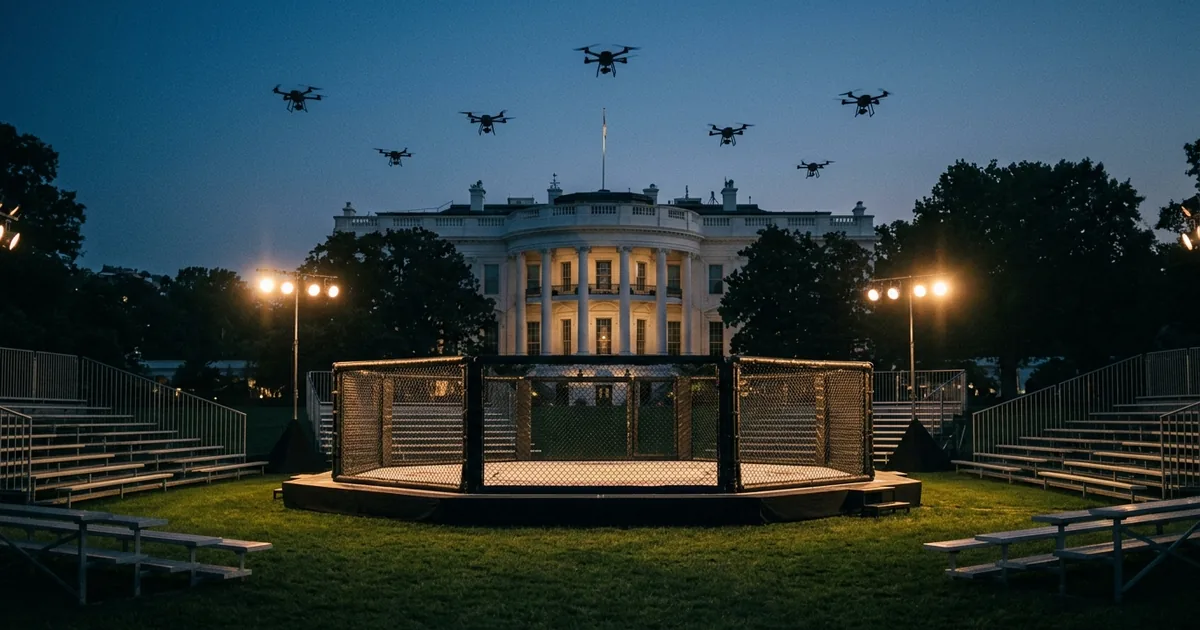
The FBI says it broke up a plan to fly explosive-laden drones over the UFC cage on the White House South Lawn and then open fire on the crowd as it ran. The case agents built to catch everyone involved was sealed by a federal court for a reason, and FBI Director Kash Patel blew it open on social media before roughly ten suspects were in custody.
That sequence, not the plot itself, is why current and former agents spent this week describing their own director in language usually reserved for the people he arrests. The bureau stopped a potential massacre feet from the Oval Office. Its leader turned the win into a post.
What the Bureau Actually Stopped
The investigation started the way a lot of plots come apart: a relative of one of the suspects called local police near Cincinnati, worried about what a family member was saying about Washington. A Secret Service threat-interdiction team working alongside the FBI obtained a subpoena for an encrypted Signal thread, and inside it investigators found a plan to send drones over the South Lawn fight and shoot into the fleeing crowd, as NBC News reported in its account of the arrests. One suspect was picked up first, and the case was sealed so agents could identify and grab the rest.
By the time it was unsealed, five men faced conspiracy-to-commit-murder counts: Tycen Proper of Ohio, Daniel Eskridge of Missouri, Abraham Hermosillo Alvarez of Nebraska, and Bryan Omar Roa and Michael Alan Thomas of California. The South Lawn card, a first-of-its-kind event headlined by Justin Gaethje and Ilia Topuria, went ahead Sunday under heavy security in front of thousands of spectators. It was the latest entry in a long run of security scares around the White House, and on paper it ended the way everyone wanted: no attack, suspects in custody, a federal case to prosecute.
“Don’t Choke on Your Own Smoke”
This is where the story stops being about five men with a drone and starts being about the man running the FBI. The case was under seal. Roughly ten suspects had not been arrested. Secret Service and FBI investigators had already agreed to unseal it and announce the takedown together, and were caught flat-footed when Patel got there first, MS NOW reported, citing three people familiar with the investigation. Secret Service Deputy Director Matt Quinn walked up to a podium and, without naming the FBI director, delivered the rebuke anyway: “Don’t choke on your own smoke.”
When a sister agency uses a press conference to tell your boss to stop talking, the problem is no longer a leak. It is the operating model. A sealed case is not bureaucratic throat-clearing. It is the mechanism that lets investigators reach the tenth conspirator before he watches the first nine on the news and runs, deletes the chat, or decides he has nothing left to lose. Announcing a sealed counterterrorism case midstream, before the arrests are done, is not a communications stumble. It is a choice to trade an active investigation for a victory lap.
He Has Done This Before
The reason agents are furious rather than merely irritated is that they have watched this exact reflex misfire before. After the assassination of Charlie Kirk, Patel went on X and announced the FBI had its suspect in custody. The bureau had to walk it back, because the person had been released, a sequence Patel later told CBS News he does not regret. One premature post would be a bad day. Two on national-security cases inside a year is a habit.
It is a habit with a paper trail. A long internal account drawn from current and former FBI personnel, reported by The Hill earlier this year, describes a bureau that its own agents call a rudderless ship under a director they see as more interested in his feed than his caseload. Patel has pushed field agents to post more “FBI wins” online. Deputy Director Dan Bongino draws the same complaint. Agents told reporters they are keeping their heads down, afraid that the wrong word gets them fired. That is not a chain of command. It is a newsroom run by someone who confuses posting with proof, staffed by people who have learned to flinch.
An FBI That Posts First
Give the win its due. The plot looks real, the interdiction looks clean, and the agents who stopped a drone-and-gunfire attack on a crowd of thousands earned every bit of the credit. None of that is in question. What is in question is whether the country can count on an FBI whose director reaches for his phone before the case is closed.
Counterterrorism runs on patience, secrecy, and the unglamorous discipline of waiting until every suspect is in handcuffs before anyone says a word. Kash Patel keeps demonstrating that he would rather be first than be right. The arrests this week worked out anyway. The open question is what happens the next time a sealed case meets a director who cannot stop posting, and the tenth suspect is still reading the news.