
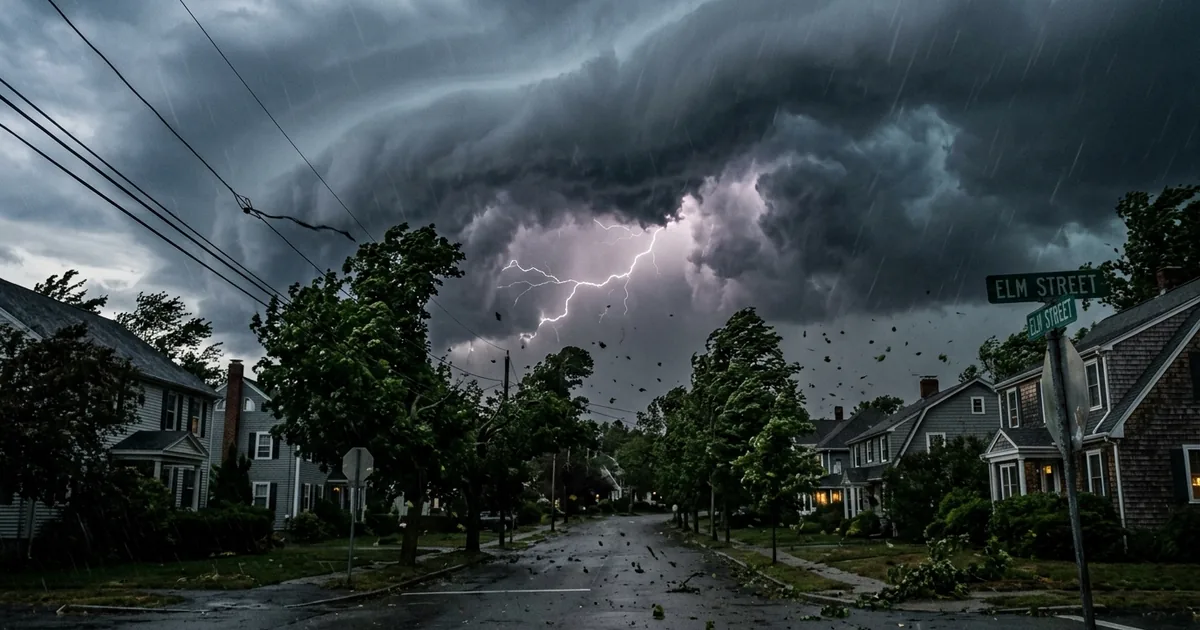
A powerful storm system tore across Massachusetts on Thursday evening, triggering tornado warnings in multiple counties, toppling trees across Greater Boston, and knocking out power to thousands of residents in a violent June weather event that forced the National Weather Service to issue its most urgent alerts for the region.
Tornado Warnings Covered Central and Eastern Massachusetts
The NWS issued a tornado watch covering Essex, Franklin, Hampden, Hampshire, Middlesex, and Worcester counties, effective until 7 p.m. Thursday. A tornado warning, the more urgent alert indicating rotation detected by radar, was issued for central Worcester County and south-central Middlesex County around 5:20 p.m. before being dropped just before 6 p.m. with no confirmed touchdowns, as CBS News Boston reported.
The distinction between a watch and a warning matters: a watch means conditions favor tornado development. A warning means one has been detected or is imminent. Thursday’s warning put residents in the affected counties on immediate shelter-in-place notice for roughly 40 minutes.
Storm Damage Was Widespread
Strong to severe thunderstorms moved across the state in the late afternoon, producing damaging winds, periods of heavy rain, and small hail. Video from the South End of Boston showed mature trees crashing down during the height of the storm. The NWS warned of wind gusts capable of causing structural damage, and NBC Boston’s live radar coverage tracked multiple severe cells moving through Worcester, Middlesex, and Suffolk counties in rapid succession.
The storm also generated marine warnings, with gusts reaching 40 knots and waves building to nine feet across Boston Harbor and the wider New England coastal waters. The combination of inland wind damage and coastal warnings made this one of the more comprehensive severe weather events in the region this spring.
June Storms in New England Are Getting More Intense
Massachusetts is not traditionally a tornado-prone state, but severe convective events have become more frequent and more intense in the Northeast over the past decade. The June 2023 tornado outbreak sequence that hit multiple New England states produced confirmed tornadoes in Connecticut and Massachusetts, and climate researchers have noted that warming Atlantic waters and shifting jet stream patterns are creating conditions that favor stronger late-spring and early-summer storms in the region.
Thursday’s storms were part of a broader system that also produced severe weather across parts of the Northeast that have seen repeated flooding this year. The pattern of increasingly violent spring storms hitting areas with aging infrastructure and tree canopy is creating a compounding problem: each successive storm knocks out more weakened trees and stresses power grids that were already repaired from the last event.
Power Outages and Emergency Response
Utility crews reported thousands of customers without power across central and eastern Massachusetts as the storms moved through. National Grid and Eversource both activated their storm response protocols, with crews pre-staged in areas that forecasters had flagged as highest-risk. The heaviest outage clusters were concentrated in Worcester County, where the combination of dense tree cover and aging utility infrastructure made the power grid particularly vulnerable to the wind damage.
Municipal emergency management agencies across the affected region opened warming centers and shelters as a precaution, though most were not heavily used as the storm passed relatively quickly. The rapid onset and brief duration of the most intense activity, roughly 90 minutes of severe conditions across the state, meant that the damage was significant but not catastrophic.
What Happens Next
The immediate storm threat moved offshore by Thursday evening, but the NWS kept a wind advisory in place through the overnight hours as the system’s trailing edge brought gusty conditions. Friday’s forecast calls for calmer weather, but power restoration crews were expected to be working through the night in areas where downed trees blocked roads and pulled down utility lines.
For Massachusetts residents, the message from emergency management was familiar and frustrating: severe weather season is here, the grid is fragile, and the trees that make New England beautiful are the same ones that take out your power when the wind picks up. No confirmed tornadoes from Thursday’s event, but the damage from straight-line winds was enough to remind the region that you do not need a funnel cloud to have a serious weather emergency.