
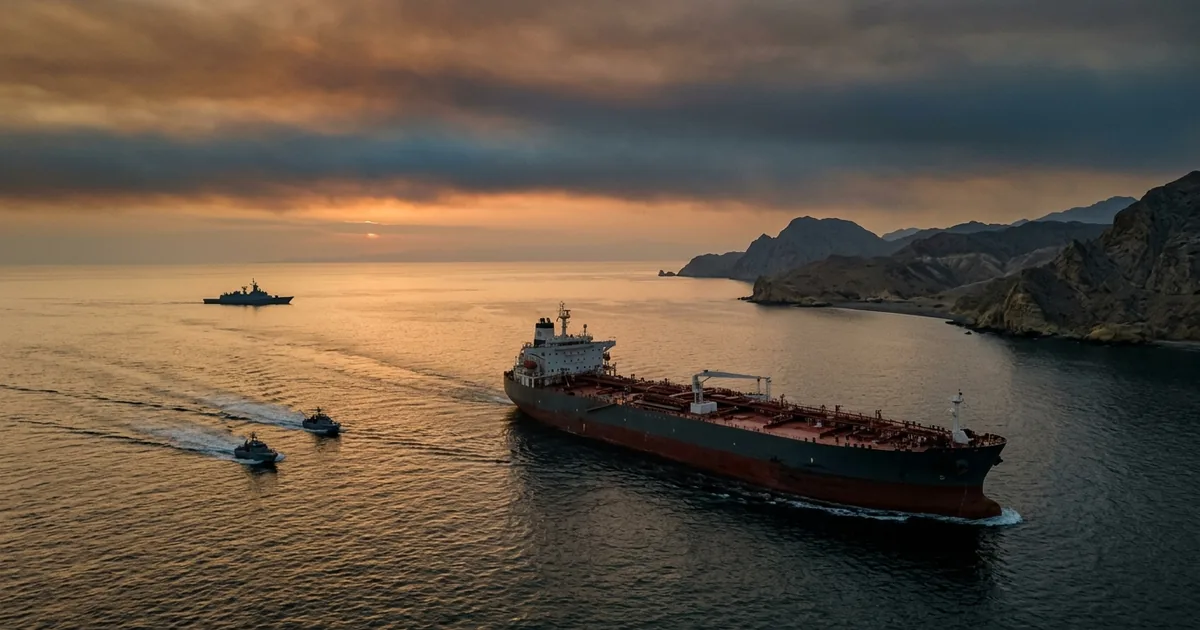
Iran’s armed forces declared the Strait of Hormuz closed to shipping on Saturday, reversing a reopening that was barely three days old and pinning the blame squarely on Washington and Israel.
The move turns the world’s most important oil chokepoint back into a bargaining chip, and it does so on the eve of the very nuclear talks the closure is meant to pressure.
A Closure That Ships Kept Sailing Through
The order came from Khatam al-Anbiya Central Headquarters, the operational command of Iran’s Revolutionary Guard, in language built for maximum effect. The Strait of Hormuz, it said, would be closed to maritime traffic, and vessels that approached anyway would have their security put at risk. Tehran framed the step as the “first step in responding to the enemy’s breach of its commitments,” with more to follow if the pressure did not work.
Here is the part Tehran left out of the press release. US Central Command said 55 commercial vessels moved through the strait that same Saturday, carrying more than 17 million barrels of oil to global markets, and that traffic had actually risen as American forces operated in the area to keep the lane open. Two days earlier, 25 ships had transited, the highest single-day count since mid-April. The waterway was “closed” the way a storefront can hang a closed sign while customers keep walking in the unlocked door.
That gap between the declaration and the radar picture is the whole story. Iran has reached for the Hormuz lever repeatedly through the 2026 war, and each time the distance between a closure announced and a closure enforced has been the variable that actually matters. A statement does not stop a tanker. Mines, fast-attack boats, and seizures do, and none of those appeared on Saturday.
What Iran Says Broke the Deal
The grievance traces back to a 14-point memorandum signed Wednesday by President Trump and Iranian President Masoud Pezeshkian, an agreement meant to halt the fighting and open a 60-day window to settle the harder questions around Iran’s nuclear program. As Axios reported on the closure, Tehran accused the United States of “clear bad faith” for failing to rein in Israel, citing Israeli troops still sitting in southern Lebanon and a bombardment that has not stopped.
The human numbers behind that complaint are not abstract. Israeli strikes killed at least 16 people in the Nabatieh area on Saturday morning, after overnight strikes on Friday killed dozens more across southern Lebanon. Iran is drawing a straight line from a proxy front it cannot fully command to the one piece of geography where it can still make the world flinch, and squeezing.
Israel tells the story in reverse, accusing Hezbollah of breaking the ceasefire first. Both governments are now arguing about who moved first, which is the oldest argument in this conflict and the least useful one. The families in Nabatieh are not litigating the sequence.
The Oil Market Has Learned to Wait
Roughly a fifth of the world’s petroleum passes through the Strait of Hormuz, which is why a closure headline used to be enough to move prices on its own. It still moves them, but less than it once did. Brent crude jumped 7.5% to $83.58 a barrel in early March when Iran first sealed the strait, pushed past $100 by mid-month, and climbed to $114.44 in May as the war ground on. Saturday’s announcement landed with a softer thud, because traders have now watched the announce-then-ships-keep-moving cycle play out enough times to discount it.
That learned patience is rational, and it is also a trap. A market that has trained itself to shrug at closure rhetoric is a market that will be caught flat-footed the moment Iran converts words into hardware. The risk premium baked into oil right now assumes Tehran is bluffing. The assumption has held all year. It only has to be wrong once.
A Truce Resting on a Lebanon Nobody Fully Controls
The deeper problem is structural, and it should worry anyone betting on the durability of the new deal. The US-Iran understanding depends on an Israel-Hezbollah ceasefire that neither Washington nor Tehran actually governs. The agreement’s first real stress test arrived not at the negotiating table but on a battlefield its principals only influence at the margins, which is a fragile foundation for a peace that is supposed to hold for 60 days.
The diplomacy is pressing ahead regardless. Trump’s special envoy Steve Witkoff and his son-in-law Jared Kushner were in Switzerland on Saturday working the technical details ahead of talks that, as The Hill noted, were still scheduled to begin Sunday with Qatari and Pakistani mediators in the room. Vice President JD Vance confirmed the envoys were on the ground even as Iran’s statement was landing. It is a strange split-screen: one set of officials negotiating an end to the war while another announces an escalation of it, with both moves happening over the same waterway Saudi tankers had only just begun crossing again.
Whether Sunday’s talks survive the weekend is the question that actually decides what Saturday’s closure meant. CBS News tracked the timeline from a signed memorandum to a reclosed strait in the span of three days. If the negotiators sit down anyway, the closure reads as theater, a costly way for Tehran to remind everyone it can still reach the valve. If they do not, the strait stops being a metaphor. For now it is both: the truce’s pressure gauge, and the clearest signal of how little anyone trusts the deal they just signed.