
President Trump drained the Lincoln Memorial Reflecting Pool this spring, painted its floor “American flag blue,” and declared a 250th-birthday triumph for the National Mall.
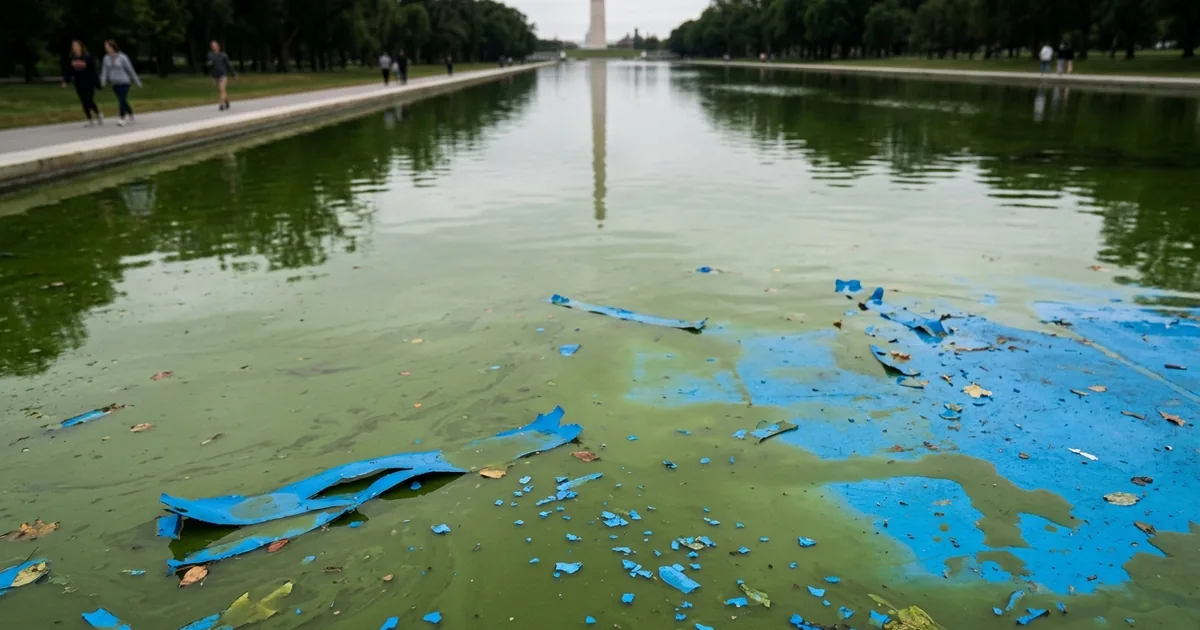
A week after the water went back in, the pool is green with algae and shedding strips of paint, and it is hard to find a cleaner short film of how this presidency actually operates.
The facts are not in dispute, even if the blame is. The administration rushed the project to completion before July 4, ahead of the country’s 250th anniversary. Within days, NBC News reported, the new blue coating began chipping, with detached strips floating on the surface and drifting below it. Crews returned to vacuum out the algae, dump gallons of hydrogen peroxide into the water, and install a filtration rig the Interior Department calls a “nanobubbler.” The pool that was supposed to mirror the Washington Monument now mostly reflects the cost of doing things this way.
A $2 Million Idea That Cost $14.6 Million
Start with the number, because the number tells the story before the algae does. Trump pitched the refresh as a quick cosmetic job he initially pegged at under $2 million. The final bill has already cleared $14.6 million, awarded through a no-bid contract to a Virginia firm. That is a sevenfold overrun on a vanity project, on federal parkland, paid for by the public, to make a reflecting pool look more like a flag.
No-bid contracts exist for genuine emergencies. A reflecting pool that had functioned for a century was not one. Skipping competitive bidding did not make the work faster or better. It made it more expensive and less accountable, and it handed a single connected vendor a windfall on a deadline nobody outside the White House had set. The pattern is familiar by now: declare an urgency, route the money around the guardrails, take the credit at the ribbon-cutting.
The Experts Said the Blue Would Cook the Water
Here is the part that should end the debate about whether this was bad luck. It was not. Scientists were not surprised, NPR reported: a dark blue surface absorbs more sunlight than the old neutral gray, warms the shallow water above it, and turns the pool into a near-ideal incubator for algae. The color chosen for its symbolism was, in plain physical terms, the color most likely to fail.
That is the tell. The choice was made for how it would look in an announcement, not for how it would behave in July. Anyone who has kept a fish tank could have flagged the risk, and the people whose job is to maintain the Mall almost certainly did. They were overruled by aesthetics. The water did what warm, sunlit, nutrient-rich water always does, and it did it roughly on the timeline any specialist would have predicted if someone had asked them on the record.
Peeling Paint, Right on Time
The sealant is failing too. CBS News reported that rips have opened in the new lining Trump personally signed off on, less than two weeks after he announced the job was finished. So the sequence reads: paint it, fill it, photograph it, declare victory, then watch it come apart in real time while crews scramble with peroxide and a machine called a nanobubbler to hold the picture together.
That scramble is the through-line. It is the same script that played out at the White House for the administration’s other Freedom 250 set piece, where the spectacle was booked first and the fallout was managed afterward. The durable result was never the point. The point was the moment of the reveal, the flag-blue water under the Lincoln Memorial, the kind of image that travels before anyone checks back a week later.
The Spectacle Was Always the Product
You can read the Reflecting Pool as a maintenance story, and the trade press will cover it that way: a coating spec, a temperature problem, a contractor on the hook for a redo. That reading is true and far too small. The more honest reading is that the pool is a self-portrait.
Every element is in the frame. The fixation on surfaces over substance. The patriotic branding bolted onto something that worked fine before. The deadline manufactured to produce urgency. The money that moves without a bid. The experts ignored, the warning signs waved off, the premature declaration of success, and then the green water, the floating paint, the cleanup crew arriving after the cameras have gone. It is governance optimized for the announcement and indifferent to the morning after.
The Mall will get cleaned up. Someone will vacuum the algae, fish out the paint, and the administration will frame the do-over as proof that it acts decisively. But the country can see the pool. Right now it is a green pond with strips of blue plastic drifting in it, sitting between two of the most photographed monuments in the world, the exact opposite of the image it was rushed and overpaid to produce.
That is the hazard of running a government as a series of reveals. Sooner or later the water turns, and everyone can see what was actually under the paint. The question heading into July 4 is not whether crews can make the pool blue again in time for the cameras. It is how many other things got the flag-blue treatment, and when the rest of them turn green.