
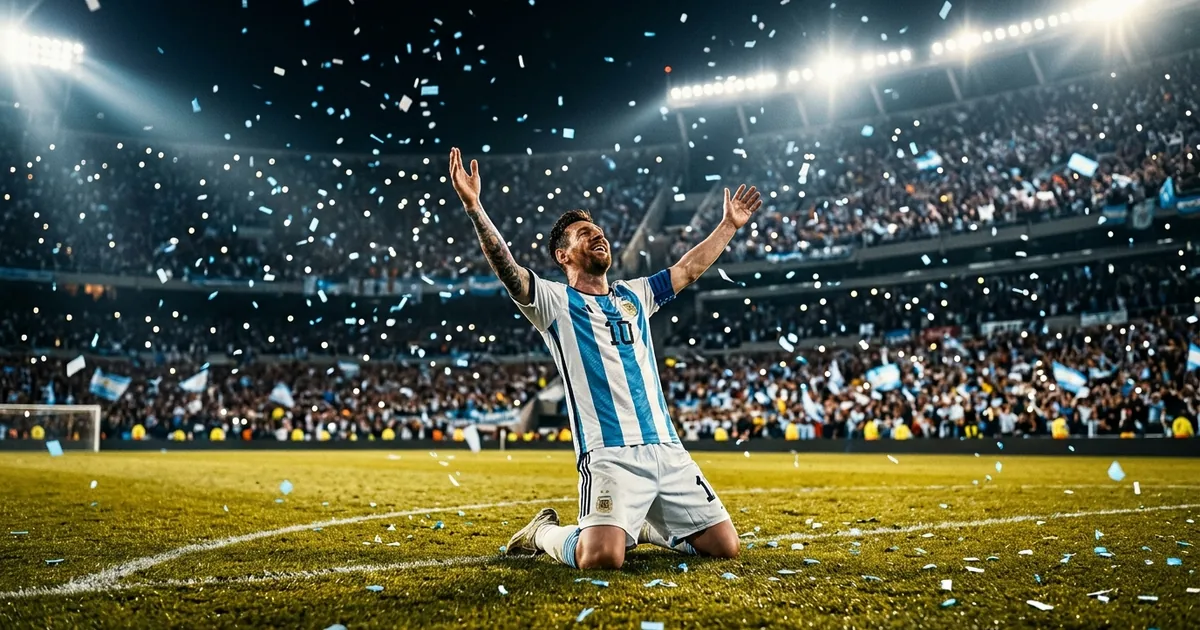
Lionel Messi became the greatest goal scorer in FIFA World Cup history on Monday, netting twice in Argentina’s 2-0 victory over Austria at AT&T Stadium in Dallas to claim sole ownership of the tournament’s all-time record with 18 goals.
It was the kind of performance that felt less like a sporting milestone and more like the universe reminding everyone why this particular 39-year-old still commands the biggest stage on the planet.
The Record Fell After a Missed Penalty
The story almost wrote itself differently. Messi stepped up to take a penalty in the ninth minute, and Austria goalkeeper Patrick Pentz made the save. For a brief, unsettling moment, the narrative wobbled. A miss at that stage, in a match freighted with this much history, would have been the kind of detail that haunts highlight reels. Then Messi did what Messi does: he recalibrated, stayed patient, and struck when it mattered most.
The breakthrough came in the 38th minute when Messi collected a through ball, feinted past his marker, and slotted home with surgical precision, according to ESPN’s match report. That goal, his 17th in World Cup play, moved him past German legend Miroslav Klose as the tournament’s all-time leading scorer. The record had stood since the 2014 World Cup in Brazil. It lasted exactly one half of football longer.
The crowd at AT&T Stadium, already one of the loudest venues in this American World Cup, erupted in a way that transcended the Argentina sections. Even neutral fans understood what they were watching. Records fall in every sport, but some carry a gravitational pull that makes a stadium go quiet for a beat before the roar hits. This was one of those.
Goal Number 18 Was Pure Theatre
Deep in stoppage time, with the result already secured, Messi added a second. It was vintage: a burst of acceleration that defied everything we think we know about aging athletes, a defender left flatfooted, and a finish that was more statement than necessity. The goal also carried a quieter distinction. As NPR reported, Messi’s 18th World Cup goal made him the leading scorer across both the men’s and women’s tournaments, surpassing Brazilian legend Marta, who holds the women’s record with 17.
Argentina’s group stage has been a masterclass in controlled dominance. Messi’s hat trick against Algeria in the opener already had the conversation swirling; the Austria double cemented it. This is his sixth World Cup, a record-extending 28th career appearance in the tournament, and he is playing like a man who understands that the clock is winding down but refuses to let the final chapter be anything less than definitive.
A Golden Boot Race for the Ages
Messi is not the only superstar lighting up the group stage. France dismantled Iraq 3-0 on the same day, with Kylian Mbappe scoring twice to bring his own World Cup tally to 16, level with Klose’s former record. Erling Haaland also struck twice as Norway beat Senegal 3-2, booking their first knockout-round berth in 28 years, while England prepared to face Ghana later in the day. The early group-stage action had already reshuffled the power rankings before Monday’s results made the argument even louder.
The Golden Boot race between Messi and Mbappe adds a generational subplot to a tournament that is already delivering on the hype. One is potentially playing his final World Cup matches, squeezing every last drop of brilliance from a career that has redefined the sport. The other is building the case that the torch is ready to be passed, that the next decade of football already has its headliner. The fact that both are scoring at this clip during the group stage, before the pressure of the knockouts compresses every mistake into a season-ending moment, is either exhilarating or terrifying for every other team in the bracket.
What Comes Next for Argentina
Argentina have now clinched their place in the round of 16 with a game to spare, and the tactical luxury that affords manager Lionel Scaloni is significant. He can rotate. He can rest Messi’s legs for the matches that carry elimination stakes. Or he can keep his captain on the pitch and let the goals pile up, because Messi at this World Cup does not look like a player who needs managing. He looks like a player who has decided that this tournament belongs to him.
There is a version of this story where Messi’s penalty miss defines the day. Instead, it became a footnote, a speed bump before the avalanche. That is the difference between great players and Messi: great players recover from setbacks. Messi turns them into origin stories for the records that follow.
The count is now 18. And if you have watched enough Messi World Cups to know the pattern, that number probably is not done climbing.