
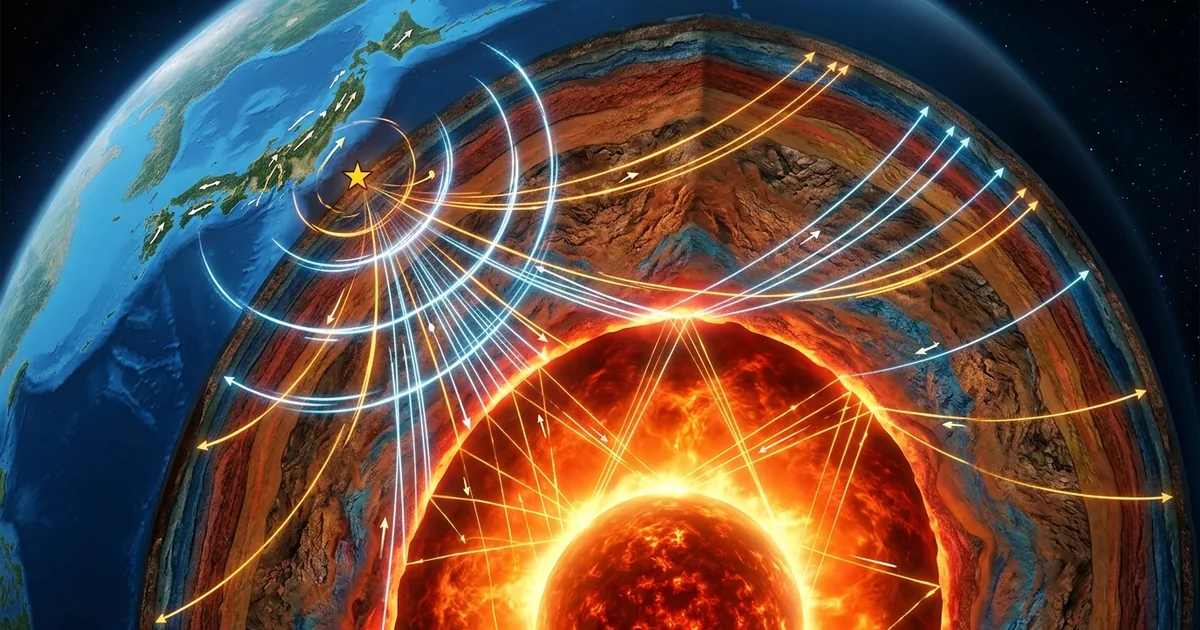
Scientists just solved a 15-year-old mystery hiding in GPS data, and the answer involves a seismic wave traveling nearly 2,900 kilometers straight down to Earth’s core, bouncing back to the surface, and physically moving all of Japan six millimeters to the east.
In a single instant.
The Mystery in the Data
On March 11, 2011, a magnitude 9.0 earthquake struck off the northeast coast of Japan, triggering the devastating tsunami that killed nearly 20,000 people and caused the Fukushima nuclear disaster. It was one of the most powerful earthquakes ever recorded, and scientists have been studying its seismic data ever since.
About 15 minutes after the initial quake, GPS stations across Japan registered something unexpected: nearly the entire country shifted eastward by 5 to 6 millimeters, all at once. The movement did not correspond to any known aftershock. There was no obvious source. The signal sat unexplained in datasets for over a decade, a seismological loose thread that nobody could quite account for.
What Actually Happened
A team led by Sunyoung Park, an assistant professor of geophysical sciences at the University of Chicago, published the answer in Science on June 18. The explanation is both elegant and astonishing.
When the earthquake ruptured, it sent seismic waves radiating in every direction, including straight down. One of those waves traveled through the Earth’s mantle, a journey of roughly 2,900 kilometers, until it hit the boundary between the mantle and the outer core. There, it bounced. The reflected wave traveled back up through the mantle and arrived at the surface approximately 13 to 15 minutes later with enough residual energy to push Japan’s tectonic plate boundaries and shift the entire island chain eastward.
This is the first time scientists have documented a core-reflected seismic wave actually setting a fault in motion. The phenomenon had been theorized but never observed.
Why Six Millimeters Matters More Than You Think
Six millimeters does not sound like much. You cannot feel it. You would never notice it in daily life. But the scientific significance is enormous.
First, it demonstrates that seismic energy reflected off the core boundary can carry enough force to trigger fault movement at the surface. That opens a new category of earthquake hazard: secondary events caused not by the initial rupture or its aftershocks, but by deep-earth reflections arriving minutes later.
Second, the 13 to 15 minute delay is predictable. CNN reported that researchers believe this type of core-reflected wave arrival could potentially be anticipated after a major earthquake, giving seismologists a new window for early warning systems. If you know a magnitude 9.0 has just occurred, you know that a core reflection will arrive at predictable locations roughly 15 minutes later.
Third, it adds a new dimension to our understanding of how the Earth’s interior interacts with its surface. The core is not just a passive ball of iron at the center of the planet. It is an active participant in surface geology, bouncing seismic energy back up in ways that can physically relocate landmasses.
The Technology That Made This Possible
Park’s team used a combination of high-resolution GPS station data and advanced seismic modeling to identify the core-reflected wave as the source of the mysterious 15-minute displacement. The key breakthrough was separating the signal from the noise: Japan’s dense network of GPS stations, installed primarily for earthquake early warning, provided the granular data needed to pinpoint the exact timing and magnitude of the shift.
Phys.org reported that the analysis required computational techniques that simply did not exist when the earthquake occurred in 2011. The data was always there. The tools to read it were not.
This is a pattern that shows up increasingly in earth sciences: old data yielding new discoveries as analytical methods catch up. The same GPS stations that recorded the 2011 event are recording every earthquake today, which means the framework Park’s team developed can now be applied retroactively to other major seismic events worldwide.
What It Means for Earthquake Preparedness Going Forward
The practical implications are still being worked out, but the discovery opens several lines of research. Can core-reflected waves trigger secondary earthquakes or landslides at vulnerable locations? Should early warning systems be updated to account for the 15-minute delay? Are there historical earthquakes whose secondary effects were actually caused by core reflections rather than aftershocks?
The study is a reminder that the planet operates on scales and timelines that are difficult to intuit. An earthquake in 2011 sent a wave to the center of the Earth and back, moved an entire country, and it took 15 years and a team at the University of Chicago to figure out what happened. The data was always speaking. We just needed better ears.