
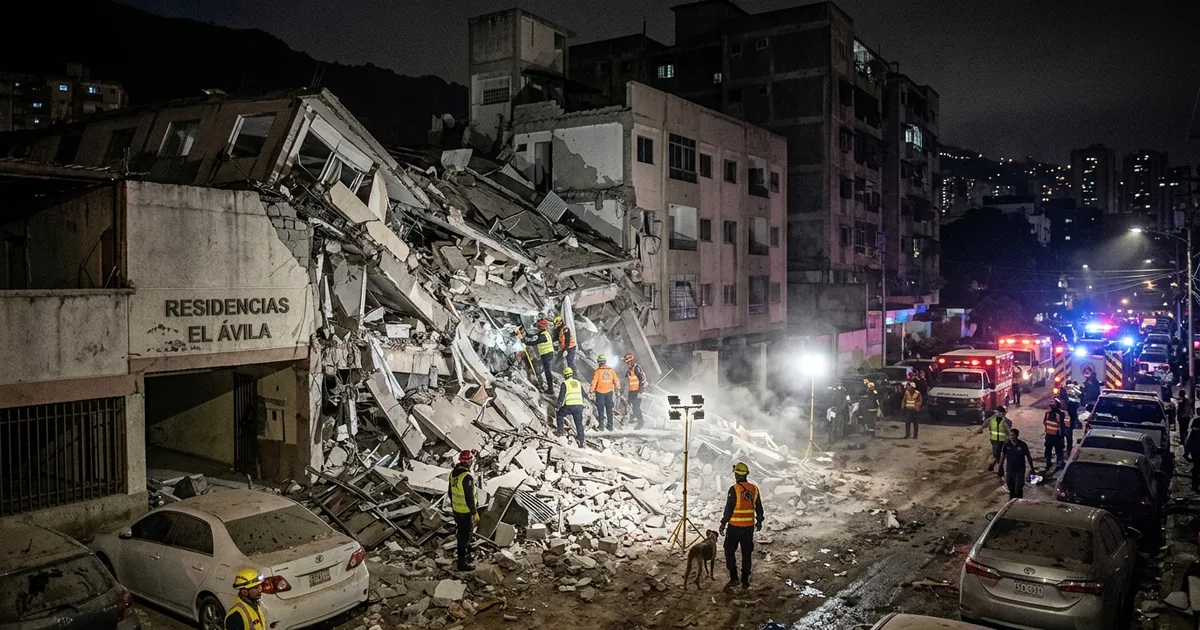
Two earthquakes ripped through Venezuela’s Caribbean coast within a single minute on Wednesday evening, killing at least 164 people and injuring more than 970 in the country’s most violent seismic event in over a century.
The catastrophe has landed on a nation still living through a different kind of rupture, the January military operation that removed Nicolás Maduro and left a caretaker government to prove, under the worst possible conditions, that it can actually govern.
The numbers are still climbing. Acting President Delcy Rodríguez confirmed the toll on state television late Wednesday and warned that rescuers were still pulling people from collapsed buildings, which means the count published tonight will not be the count we wake up to.
What the Seismographs Recorded
The U.S. Geological Survey logged a magnitude 7.2 tremor off the coast roughly 100 miles west of Caracas, then a magnitude 7.5 shock less than a minute later, close enough in time and place to register as a single, sustained convulsion to anyone standing on the ground. NPR reported that the agency’s early loss model flagged a substantial probability the eventual death toll could reach into the thousands, a projection that says less about pessimism than about how Venezuela is built: dense informal housing stacked on coastal sediment that amplifies shaking instead of absorbing it.
Simón Bolívar International Airport at Maiquetía, the country’s main gateway, closed after sustaining heavy damage, severing the fastest route for the very aid Venezuela now needs. The coastal state of La Guaira, where the airport sits, took the worst of it and was declared a disaster zone. A tsunami advisory briefly went out for Puerto Rico and the U.S. Virgin Islands before being cancelled within the hour, according to CBS News.
Why Two Quakes Are So Much Worse Than One
There is a reason seismologists use the clinical word “doublet” for an event like this, and it is not a technicality. The first quake does the structural sabotage, cracking load-bearing walls, snapping welds, loosening the connections that hold a building upright. The second quake, arriving before anyone can react, finishes buildings that a single shock might have left standing. People who ran for a doorway after the first jolt were still in motion when the second one hit.
It also wrecks the response before the response begins. Power and water fail twice. The cell network, already strained, drops a second time precisely when families are trying to reach each other. Rescue crews cannot trust that a damaged structure is stable enough to enter, because the ground has already proven it will move again without warning. The USGS now estimates economic losses somewhere between $10 billion and $100 billion, a range so wide it amounts to an admission that nobody yet knows how deep this goes.
The Strange Politics of Who Shows Up to Help
Here is where the geology collides with the geopolitics. Secretary of State Marco Rubio announced that, at President Trump’s direction, the United States is deploying search-and-rescue teams, medical resources, and humanitarian supplies to Venezuela. Rodríguez said she had spoken directly with Trump. Six months ago that sentence would have been unthinkable.
In January, U.S. forces captured Maduro in Caracas in an operation Washington called Absolute Resolve, flew him to New York to face criminal charges, and declared an intention to oversee the country’s transition. The whole episode is documented in our coverage of the overnight raid that seized Maduro and his wife, and the Atlantic Council laid out just how unsettled the aftermath remained. So the United States is now airlifting rescuers into a country whose government it forcibly removed two seasons ago. There is genuine humanitarian instinct in that, and there is also raw strategic interest. A great power that has staked its credibility on stabilizing Venezuela cannot afford to watch that country collapse on live television.
Institutions Are the Thing That Saves Lives
This is the part that gets lost when a disaster is covered as weather. Earthquakes kill people, but institutions decide how many. Building codes enforced or ignored, hospitals funded or hollowed out, an emergency-management agency that has run drills or one that exists only on paper: these are the variables that separate a tragedy from a mass-casualty event. And Venezuela enters this crisis with its institutions in the most fragile state imaginable, a caretaker presidency installed in the chaos of a foreign intervention, an election timeline that was supposed to be measured in weeks and has instead dragged for months, and a public that has spent a decade learning not to trust the state to deliver basic services.
Rodríguez took office in January constitutionally bound to call a vote within thirty days. That clock, by any reading, expired long ago. Now she has to coordinate a national rescue while her own legitimacy is contested, while foreign teams operate on Venezuelan soil, and while every decision is filtered through the question of who is really in charge. A country needs a functioning government most acutely in the seventy-two hours after the ground stops moving, the window when trapped survivors are still alive. Venezuela is spending that window arguing about sovereignty.
What to Watch Now
The honest answer is that the death toll is the first thing to watch and the least informative. The number that matters more is how fast aid actually reaches La Guaira and the capital’s collapsed neighborhoods, because a closed airport and a contested chain of command can strand relief supplies on a tarmac for days while people suffocate under concrete. Watch, too, whether the United States treats this as a humanitarian mission or a governance one, because the line between rescuing a country and running it has never been thinner than it is in Venezuela tonight. The earthquake was an act of nature. Everything that happens next is a choice.