
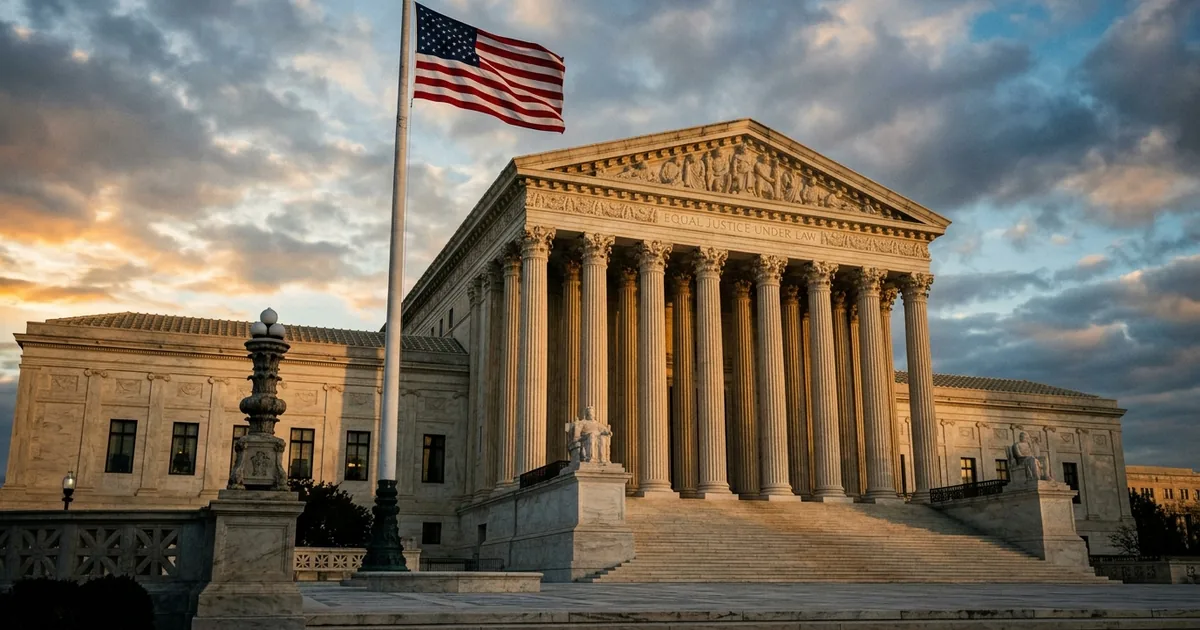
The Supreme Court ruled 6-3 on Monday that the Constitution guarantees birthright citizenship to virtually all children born on American soil, striking down the executive order Donald Trump signed on his first day back in office.
The ruling is not a surprise, but it is a landmark: the highest court in the country just drew a bright constitutional line around a right that one president tried to erase with a pen stroke.
What the Court Actually Said
Chief Justice John Roberts, writing for the majority, held that the 14th Amendment’s Citizenship Clause means exactly what courts have understood it to mean for more than a century. Children born in the United States to parents who are present without authorization, or who hold temporary visas, are “subject to the jurisdiction” of the United States and are citizens at birth. Full stop.
Roberts was joined by fellow conservative Amy Coney Barrett and by all three liberal justices: Elena Kagan, Sonia Sotomayor, and Ketanji Brown Jackson. That five-justice majority treated this as a straightforward constitutional question with a straightforward answer.
Justice Brett Kavanaugh added a sixth vote against the executive order but arrived through a different door. Kavanaugh wrote that he was not convinced Trump’s order violated the 14th Amendment on its own terms, but that it clearly contravened a federal statute adopted in 1940 that codified birthright citizenship into statutory law. The practical result was the same: the order is dead.
The 91-Page Dissent and What It Reveals
Justice Clarence Thomas filed a 91-page dissent, joined by Neil Gorsuch, arguing that the majority had “repurposed the Fourteenth Amendment to protect its own set of preferred rights” and “devalued” citizenship as the framers of the amendment understood it. Justice Samuel Alito also dissented.
Thomas’s dissent is notable less for its legal argument than for its scale and its tone. Ninety-one pages is not a disagreement; it is a counter-manifesto. Thomas has long argued for a narrower reading of the 14th Amendment, and his dissent here reads as a bid to keep the question alive for a future court willing to revisit it. That three justices signed on to a position this far outside the constitutional mainstream tells you where the rightmost flank of this Court wants to go, even when the center holds.
Why This Ruling Matters Beyond the Legal Question
The structural story here is not about immigration policy. It is about whether a president can unilaterally redefine a constitutional amendment through executive action, bypassing both Congress and the Article V amendment process.
Trump’s executive order, signed on January 20, 2025, did not attempt to change a statute. It attempted to change the meaning of the Constitution itself by administrative decree. The order would have directed federal agencies to deny citizenship documents to babies born in the United States whose parents were either undocumented or present on temporary visas. Had it stood, it would have created a class of children born on American soil who are not American, something no president has had the power to do since the 14th Amendment was ratified in 1868.
Federal judges blocked the order almost immediately. Multiple district courts issued injunctions within days. The administration appealed, and the case moved rapidly to the Supreme Court, which heard oral arguments on April 1, where justices from across the ideological spectrum expressed deep skepticism about the government’s position.
The Immediate Impact
For the estimated 4.4 million U.S.-born children of undocumented parents, the ruling removes an existential legal threat. Birth certificates, passports, and Social Security numbers for newborns will continue to be issued without regard to parental immigration status, as they have been for 158 years.
For the broader constitutional order, the ruling reaffirms something that should never have been in doubt: a sitting president cannot rewrite the Bill of Rights or its amendments through executive action. The amendment process exists for a reason, and that reason is to prevent exactly this kind of unilateral power grab.
What Happens Next
The ruling forecloses the executive-order path, but it does not prevent Congress from attempting a constitutional amendment to modify or repeal the Citizenship Clause. That would require two-thirds of both chambers and ratification by 38 state legislatures, a bar so high that the Constitution has been amended only 27 times in 237 years. The political math makes it functionally impossible in the current environment.
More likely is that the administration pivots to other immigration enforcement mechanisms that do not require rewriting the Constitution. The executive order was always the most aggressive and legally vulnerable piece of Trump’s immigration agenda. With it gone, the fights move to deportation policy, visa restrictions, and asylum rules, terrain where the executive branch has broader statutory authority and the courts have historically given more deference.
The Court’s message on Monday was blunt: the 14th Amendment is not a suggestion, and no president gets to edit the Constitution alone.