
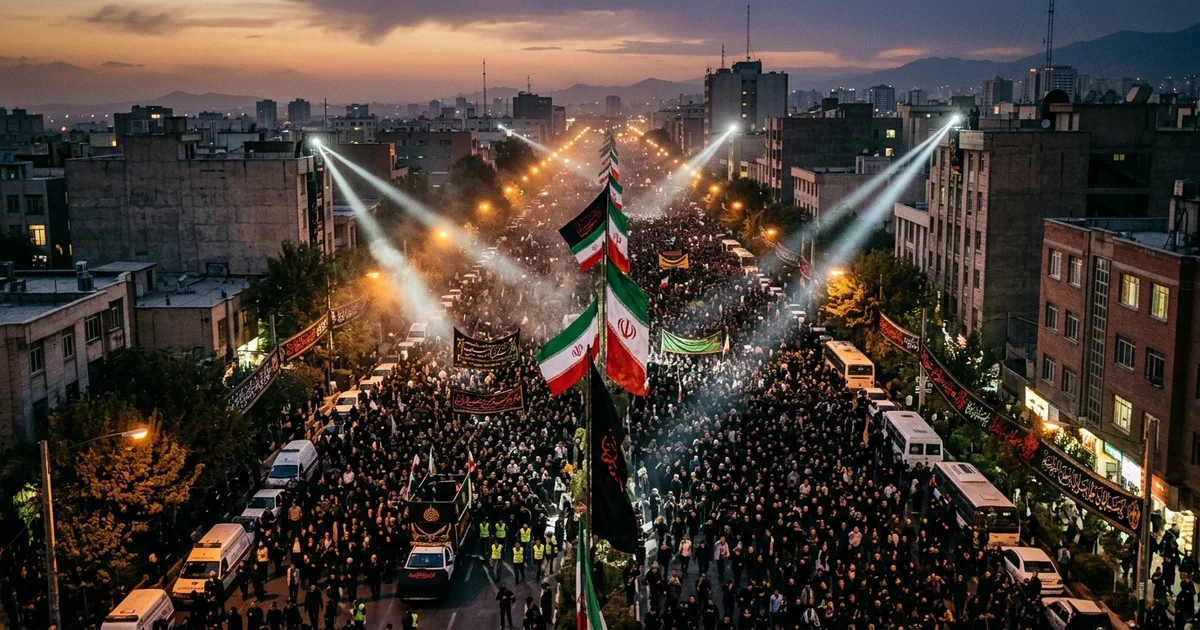
Iran is about to shut down five cities across two countries for nine days to bury the man whose death started a war.
The funeral of Supreme Leader Ali Khamenei, killed roughly four months ago in the opening salvo of the US-Israeli military campaign against Iran, will stretch from July 4 through July 9 in a rolling procession that officials are calling the largest logistical operation in Tehran’s history.
A Body Touring Two Countries
Khamenei’s remains will lie in state at Tehran’s Grand Mosalla on Saturday and Sunday before being paraded through the capital on Monday. From there, the procession moves to the holy city of Qom on Tuesday, crosses into Iraq for a stop in Karbala on Wednesday, and concludes with burial at the Imam Reza shrine in Mashhad. The five-city, two-country route is designed to echo the funeral of Ayatollah Ruhollah Khomeini in 1989, but the scale here is something else entirely.
Iranian authorities are projecting a crowd of 20 million mourners across the week. To keep that many people from collapsing in July heat, organizers have installed 6,000 water sprinklers along the route. Airports near procession corridors will close. Private vehicles are banned from streets surrounding the funeral path. The Basij paramilitary and Islamic Revolutionary Guard Corps are both fully mobilized in what state media describes as a “massive security operation.”
The Timing Is Not Lost on Anyone
That the funeral begins on July 4, the same day America celebrates its 250th birthday amid its own controversies, is a coincidence that Iranian state television has already turned into messaging. The split screen practically writes itself: one nation marking a quarter-millennium of independence, another burying the leader whose death catalyzed its latest conflict with that same nation.
The choreography of grief here is doing political work. Every stop on the procession route is symbolically loaded. Tehran is the seat of power. Qom is the clerical capital. Karbala, the Iraqi shrine city sacred to Shia Islam, signals that this funeral belongs not just to Iran but to the broader Shia world. And Mashhad, home to the Imam Reza shrine and the Khamenei family’s political base, is where the burial will cement the narrative of martyrdom.
The Son in the Shadows
The biggest unanswered question hanging over the funeral is whether Ayatollah Mojtaba Khamenei, Ali Khamenei’s son and the new Supreme Leader, will make his first public appearance. Mojtaba is believed to have been wounded in the same attack that killed his father, and he has not been seen publicly since. His absence from his own father’s funeral would be extraordinary. His presence, even briefly, would serve as proof of life for a regime that badly needs to project continuity.
The succession itself was rapid and largely uncontested, at least on paper. But a Supreme Leader who has never addressed his people is a Supreme Leader whose authority remains abstract. The funeral is the obvious venue for that to change, though CNN’s live coverage from Tehran suggests that even Western intelligence agencies are uncertain about Mojtaba’s condition.
What the Spectacle Is Really About
Funerals of this magnitude in the Islamic Republic have always been as much about projecting strength as honoring the dead. Khomeini’s 1989 funeral drew millions and nearly descended into chaos when mourners overwhelmed the coffin. The regime learned from that: control the crowd, control the narrative.
This time, the narrative is more complicated. Khamenei did not die of old age. He was killed in a military strike, and the war that followed has reshaped Iran’s position in the region. The funeral is an assertion that the Islamic Republic endures, that the institutions Khamenei built over 35 years of rule survived his assassination. The procession is the proof.
As The Washington Post’s explainer on the funeral details notes, the sheer infrastructure required to move a body through five cities while a war continues tells you everything about how much the regime needs this moment to land.
Tehran’s Largest Traffic Operation, During a War
The practical details are staggering. Tehran, a city of roughly nine million people with some of the worst traffic in the world, will undergo what officials are calling its largest traffic management operation ever. That means road closures across major arteries, rerouted public transit, and a security perimeter that will effectively bisect the capital.
All of this is happening while Iran remains in an active conflict. Air defense systems are presumably on high alert. The concentration of senior political, military, and clerical figures in one place for an extended period creates obvious security considerations that go well beyond crowd control.
What Comes After the Burial
The funeral ends in Mashhad, but the questions it raises will persist long after the burial. Can Mojtaba Khamenei consolidate power the way his father did? Will the IRGC, which has only grown more powerful since the war began, accept a wounded and untested Supreme Leader? And does the spectacle of 20 million mourners translate into genuine political legitimacy, or is it the kind of performance that authoritarian states stage precisely because legitimacy is what they lack?
The next nine days will be watched from Washington, Jerusalem, Baghdad, and every capital with a stake in how this war ends. The body on display is Khamenei’s. The real subject is whether the system he built can outlive him.