
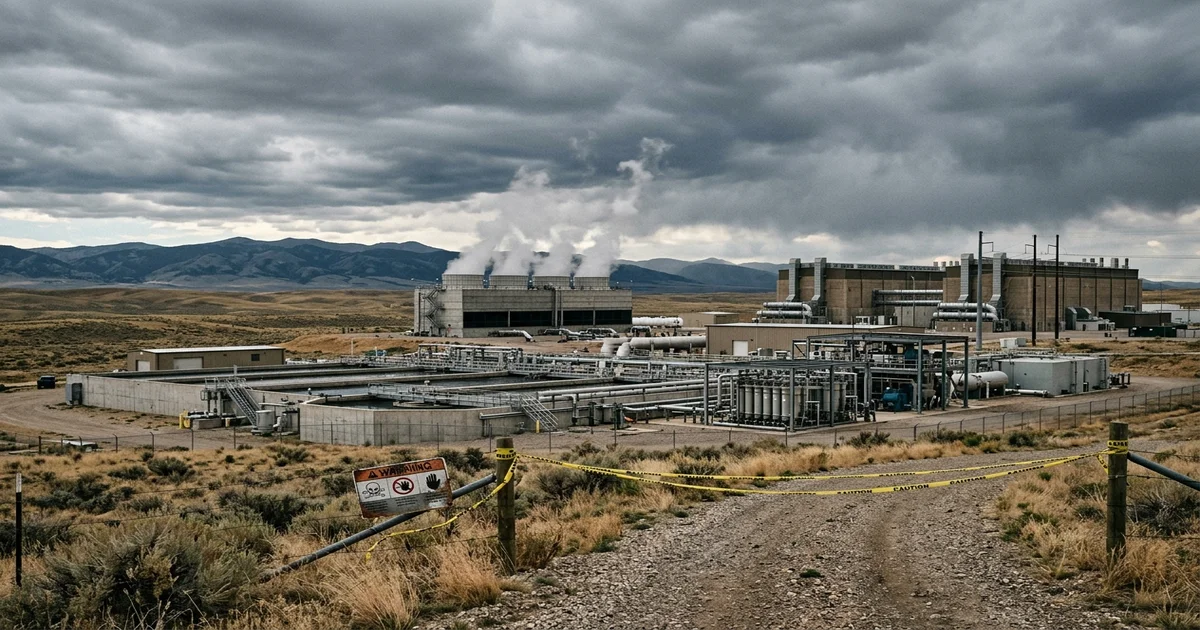
Cheyenne’s Board of Public Utilities has suspended all data center wastewater discharges after tracing a rare, metal-resistant bacterium in the city’s reclaimed water supply to a contractor building Meta’s $800 million data center campus on the south side of town.
The contamination knocked two water reclamation plants offline for months and raised concerns about airborne exposure in the parks and golf courses where Cheyenne sprays its recycled water.
The structural failure here is not complicated: a tech giant’s contractor dumped industrial cooling waste into a municipal system designed for residential and light-commercial loads, and nobody caught it until lab technicians spotted an organism that does not belong in Wyoming wastewater.
What Happened in Cheyenne’s Water
The contamination traces back to Goat Systems LLC, the entity Meta uses for construction and infrastructure at its Cheyenne campus. As Tom’s Hardware reported, Goat Systems routed flush water from its closed-loop cooling systems directly into Cheyenne’s sanitary sewer. That flush water contained Cupriavidus gilardii, a bacterium that thrives on heavy metals and rarely shows up in municipal water supplies.
Cheyenne’s Board of Public Utilities, known locally as BOPU, first detected the bacterium in February during routine fecal-bacteria sampling at the Dry Creek and Crow Creek reclamation facilities. It took months of investigation to trace the contamination upstream to the data center site. BOPU revoked Goat Systems’ discharge privileges on March 24, and a broader suspension now covers every data center connected to city water services.
Why This Bacterium Matters
Cupriavidus gilardii is not a household pathogen. It lives naturally in soil and water and typically poses no threat to healthy people. But it is an opportunistic pathogen, meaning it can infect people with weakened immune systems, and its metal-resistance properties make it unusually difficult to eliminate from water treatment infrastructure.
The real concern in Cheyenne was aerosolization. The city’s reclaimed water system feeds irrigation systems that spray treated wastewater onto parks, golf courses, athletic fields, and other public green spaces. When contaminated water is sprayed into fine droplets, the bacterium can become airborne, creating an inhalation risk that simple surface contact would not.
Both reclamation plants passed clearance testing in late June, and the reuse system is back online. But the months-long shutdown cost the city both money and public trust in its water infrastructure.
The Bigger Pattern: Data Centers and Municipal Resources
Cheyenne’s contamination incident is a case study in what happens when hyper-scale infrastructure lands in communities that were not built for it. Meta’s campus is an $800 million investment that brings jobs and tax revenue, but it also demands enormous quantities of water for cooling, and it generates industrial waste streams that small Western cities are not always equipped to handle.
The fill-and-flush process that caused this contamination is standard practice in data center construction. Cooling loops get filled with treated water, run through the system to flush contaminants, then discharged. The assumption is that municipal wastewater systems can handle the discharge. In Cheyenne’s case, that assumption was wrong.
This dynamic is playing out across the Mountain West. Data center campuses are landing in rural and mid-size communities from Wyoming to Utah to Oregon, attracted by cheap electricity, favorable tax policies, and available land. But the municipal infrastructure in these communities was sized for ranching economies and modest population growth, not for facilities that consume water at industrial scale.
A Four-Month Cover-Up That Was Not Quite a Cover-Up
One of the more frustrating details in this story is the timeline. BOPU detected the bacterium in February. It did not publicly identify the source until July 2, more than four months later. During that gap, Cheyenne residents who had been following the story through local outlets like Cowboy State Daily knew something had contaminated their water system but did not know who was responsible.
BOPU says the delay was investigative, not political, and that tracing industrial discharge upstream through a shared sewer system takes time. That may be true. But the effect was the same: a community that uses reclaimed water for public parks spent months wondering whether it was safe to let their kids play on irrigated grass, and the entity responsible remained unnamed.
What Meta Has Not Said
Meta has not publicly commented on the contamination beyond the regulatory record. Goat Systems’ discharge privileges remain revoked. The broader suspension covering all data center wastewater discharges remains in effect while BOPU evaluates how to prevent a recurrence.
The city is now weighing whether to require pre-treatment of all data center wastewater before it enters the municipal system, a regulatory step that would add costs for operators but protect the reclamation infrastructure that Cheyenne depends on for irrigation.
For a company that spent $37 billion on capital expenditures last year alone, pre-treating wastewater at a single campus is a rounding error. The question is whether the regulatory framework will catch up to the infrastructure boom before the next Cupriavidus shows up in someone else’s water supply.