
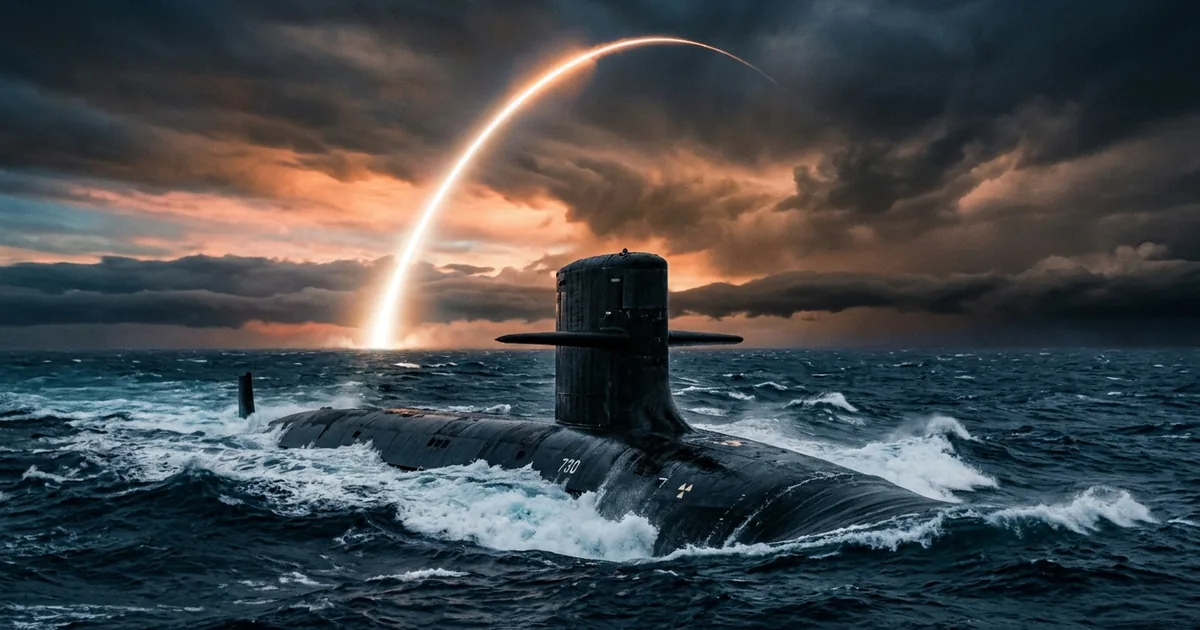
China’s navy test-launched a long-range ballistic missile from a nuclear-powered submarine into the South Pacific on Monday, the first known sub-based missile test since a 2024 launch that itself broke a four-decade gap.
The missile carried a dummy warhead, but nothing about the message was inert.
The launch came on the same day Australia and Fiji signed a new mutual defense treaty designed to counter Chinese influence across the Pacific islands, a detail Beijing almost certainly factored into the timing. That is the point: this was not a weapons test. It was a power demonstration calibrated to land in a news cycle where Western allies are trying to build exactly the kind of security architecture China wants to prevent.
A Pledge Broken in Plain Sight
The missile splashed down inside the South Pacific Nuclear Free Zone, the geographic area covered by the 1986 Treaty of Rarotonga. China ratified the treaty’s protocols in 1987, pledging not to test nuclear weapons or delivery systems inside the zone. Monday’s launch did not carry a live warhead, which gives Beijing its legal fig leaf. But launching a nuclear-capable ballistic missile from a nuclear-powered submarine into a nuclear-free zone is the kind of technical compliance that reads as contempt to every Pacific nation that signed the treaty expecting it to mean something.
New Zealand’s Foreign Minister Winston Peters told reporters the test was “an unwelcome and concerning development” and noted that China had informed New Zealand only hours before firing. “Despite our long-standing concerns about this type of activity, China carried out the test within hours of informing us,” Peters said, a diplomatic way of saying Beijing gave just enough notice to check the courtesy box and not enough for anyone to object.
Australia’s Foreign Minister Penny Wong, speaking from Fiji where she had just signed the defense treaty, called the launch “destabilizing to the region.” Japan’s Chief Cabinet Secretary Minoru Kihara went further, calling China’s military activities and “lack of transparency” a “grave concern.”
The Real Audience Is Washington
China’s Defense Ministry said the launch was “routine annual training” that “complied with international law and practice” and was “not directed against any country or target.” The Foreign Ministry added that “relevant countries” should “avoid overinterpretation.”
That framing collapses under the weight of the obvious. China has six ballistic-missile submarines and 59 attack submarines. Its nuclear warhead stockpile sits at roughly 600, according to Pentagon estimates cited by multiple defense outlets, with projections that it will exceed 1,000 by 2030. A submarine-launched ballistic missile test is, by definition, a demonstration of second-strike capability, the ability to retaliate with nuclear weapons even after a first strike destroys land-based silos. That capability matters to exactly one audience: the United States.
The timing amplifies the signal. The Australia-Fiji defense treaty is part of a broader Western effort, anchored by the AUKUS submarine partnership between Australia, the United Kingdom, and the United States, to build a security network across the Indo-Pacific that can check Chinese military expansion. Beijing has opposed AUKUS since its announcement and views Pacific island defense agreements as containment. Firing a submarine-launched missile into those waters on the day a new treaty is signed is not subtle. It is not supposed to be.
Why This Test Matters More Than the 2024 Launch
China’s previous submarine-launched missile test, in 2024, was its first in decades and drew international attention mostly as a technical milestone. Monday’s test is different because the geopolitical context has changed. The AUKUS timeline has accelerated, with Australia expected to receive its first nuclear-powered submarine under the deal within the next several years. Japan has dramatically increased its defense budget. The Philippines has deepened its security ties with Washington. And the Pacific island nations, long treated as diplomatic afterthoughts, have become a contested space where both Beijing and Western capitals are actively competing for influence through infrastructure deals, defense agreements, and diplomatic courtship.
In that environment, a submarine-launched ballistic missile test is not “routine.” It is a direct counter-signal: regardless of what treaties you sign, we can reach you from under the water, and you cannot stop us.
What Comes Next
The immediate question is whether Pacific island governments will respond with anything beyond statements. The Treaty of Rarotonga has no enforcement mechanism, and China’s position that a dummy warhead does not constitute a nuclear test within the zone’s meaning is technically defensible, even if strategically cynical.
The longer question is what the test reveals about the pace of China’s nuclear buildup. A submarine-launched capability that is tested regularly, not once every 40 years, suggests a navy that is moving toward continuous at-sea nuclear deterrence patrols, a posture the United States, the United Kingdom, France, and Russia already maintain. If China reaches that threshold, the strategic calculus in the Pacific shifts permanently, and every defense agreement signed this week will need to account for a nuclear-armed submarine that can surface anywhere in the ocean and fire.
Beijing said Monday’s launch was routine. If that becomes true, it will be the most consequential routine in the Pacific since the Cold War.