
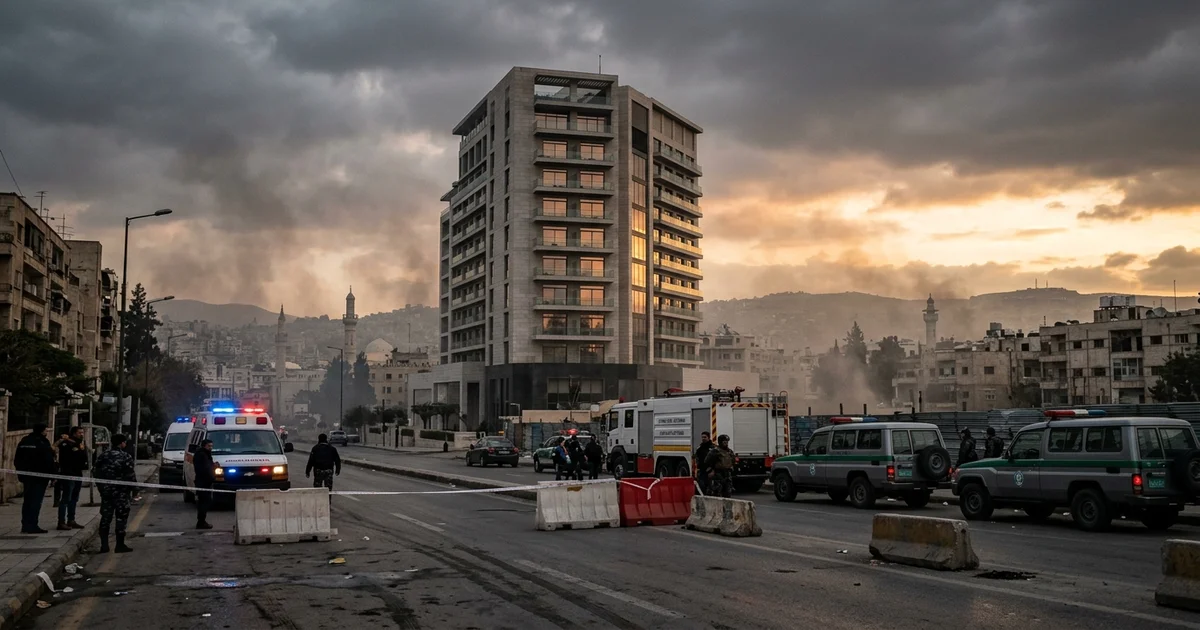
Two blasts tore through central Damascus on Tuesday morning, wounding at least 18 people and rattling the most significant Western diplomatic visit to Syria since the fall of Bashar al-Assad’s regime in December 2024.
French President Emmanuel Macron was already inside the Presidential Palace when the explosions hit, but the message was unmistakable: the forces that destabilized Syria for more than a decade have not gone quiet just because the flags changed.
The first device, planted inside a parked car, detonated near the Four Seasons Hotel where Macron had spent the night and held morning meetings with civil society leaders. The second went off moments later beside the nearby Ministry of Tourism, roughly 200 meters away. Syria’s Interior Ministry described both devices as “primitive” in construction, though they were clearly effective enough to wound 18 people, including four police officers, according to NBC News. No fatalities were reported as of Tuesday afternoon.
Why This Visit Matters More Than the Bombs
Macron arrived Monday evening as the first sitting Western head of state to visit Damascus since the rebel coalition led by Ahmad al-Sharaa toppled the Assad government. That is not a footnote. For nearly 14 years, Syria was a diplomatic black hole for Western leaders, a country where engagement meant choosing between a butcher dictator and a constellation of armed factions with conflicting agendas. The visit was designed to signal that France, and by extension the European Union, is prepared to engage the new Syrian leadership on reconstruction, refugee returns, and counterterrorism cooperation.
The explosions undercut that narrative in real time, exposing the gap between diplomatic ambition and ground-level security. The timing was almost certainly deliberate. No group has claimed responsibility, but the attack follows a deeply concerning pattern: just days earlier, an explosive device detonated in a cafe near the Damascus Justice Palace, killing at least 10 people and wounding more than 20. Two significant bombings in the capital within a week suggests either a coordinated campaign or a security apparatus that cannot prevent even rudimentary attacks in its own downtown.
The new Syrian government faces the same structural problem that consumed its predecessor. Holding territory is not the same as holding a monopoly on violence, and every diplomatic photo opportunity becomes a target that proves the point. Remnants of ISIS cells, Assad-era intelligence operatives, and various militia groups all have motive and, apparently, the operational freedom to act.
Macron Pressed On, and That Was the Point
The French president’s office confirmed he was unharmed and that his meeting with al-Sharaa continued without interruption. That decision to press forward rather than evacuate was itself a diplomatic statement. Cutting the visit short would have handed a strategic win to whoever planted the devices. By staying, Macron signaled that France’s engagement with the new Syria will not be deterred by spoiler attacks, a calculation that carries real physical risk but significant political upside back in Paris.
Hotel security moved civil society attendees to the parking garage as a precaution, and Damascus security forces locked down the surrounding blocks. An investigation is underway at both blast sites, though early indications point to an operation designed to embarrass the new government rather than to cause mass casualties. The crude construction of both devices, one in a garbage bin, one in a parked car, suggests perpetrators without access to sophisticated military ordnance but with enough operational awareness to pick targets within 200 meters of a presidential security perimeter.
What France Actually Wants From Syria
France’s interests in the Levant run deeper than a handshake photo. Paris has been the most forward-leaning European capital on counterterrorism cooperation in the region, driven partly by the 2015 attacks on French soil that had direct operational links to Syrian territory. The refugee portfolio matters too: France and Germany have absorbed the largest shares of Syrian asylum seekers in the EU, and any pathway to voluntary repatriation requires a government in Damascus that both controls the country and meets minimum governance standards.
Then there is the energy dimension. Syrian reconstruction will require billions, and European firms want a seat at the table if and when international sanctions are eased. Being the first leader through the door earns Macron diplomatic capital with al-Sharaa’s government, potentially positioning French companies ahead of Russian and Chinese competitors who backed the old regime.
The Bigger Security Question
The blasts fit a pattern familiar from the final months of the Assad regime’s grip on Damascus: low-tech, high-impact attacks aimed at undermining confidence in whoever claims to control the capital. For al-Sharaa’s government, the challenge is existential. International engagement, reconstruction money, and the lifting of sanctions all depend on demonstrating that Damascus is stable enough to govern from. Every car bomb chips away at that case.
The explosions did not derail Macron’s visit. Whether they derail the broader project of reintegrating Syria into the international order depends on what happens in the weeks ahead: whether al-Sharaa’s security forces can prevent the next attack, and whether Western capitals decide the strategic value of engagement outweighs the optics of shaking hands in a city that is still, quite literally, under fire.