
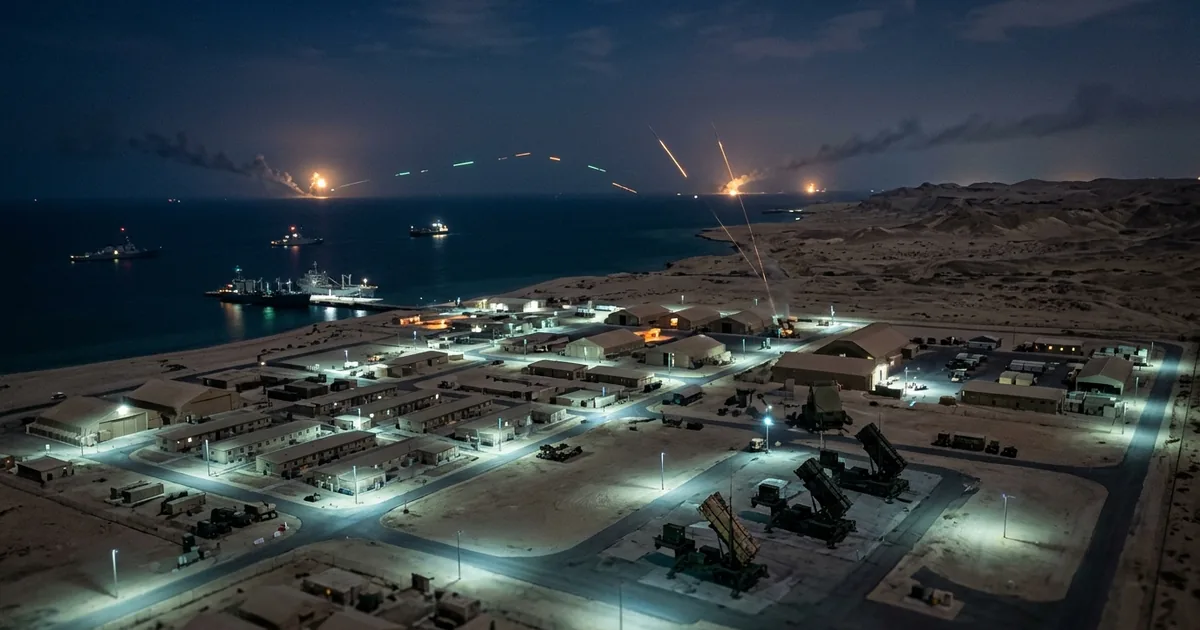
Iran’s Revolutionary Guard launched missiles at US military installations in Bahrain, Kuwait, and Qatar early Thursday, turning three American allies into direct targets in a conflict that had been confined to Iranian territory and the Strait of Hormuz for months.
The attacks came hours after the Pentagon confirmed it had completed strikes on roughly 90 targets across Iran overnight.
The Gulf Allies Caught in the Middle
Both Bahrain, home to the US Navy’s 5th Fleet, and Kuwait, which hosts thousands of US Army personnel, sounded missile alerts on Wednesday morning as Iranian projectiles streaked toward American bases. Iran’s Revolutionary Guard issued a statement acknowledging it had targeted US military installations in both countries, according to NPR. Qatar, which hosts Al Udeid Air Base, the largest US military facility in the Middle East, was also struck.
This is a significant escalation. For weeks, the fighting had been a bilateral exchange between US forces and Iranian military infrastructure. By firing on the bases from which American strikes are staged, Tehran has forced a question that Gulf state leaders have spent decades trying to avoid: whether hosting US forces makes them safer or turns them into targets.
What 90 Targets Looks Like
US Central Command said the new strikes were intended to further degrade Iran’s ability to attack commercial and civilian vessels in regional waters. The Pentagon characterized the operation as a response to Iranian attacks on three oil tankers in the Strait of Hormuz on July 6 and 7, the incidents that prompted President Trump to declare the ceasefire “over” on Tuesday.
The scale matters. Ninety targets in a single wave suggests the US military had pre-positioned strike packages in anticipation of exactly this breakdown, which means the ceasefire’s collapse was not a surprise inside the Pentagon even if it was presented as reactive in Trump’s public statements. When Trump declared the ceasefire finished on Tuesday, oil prices spiked and markets braced for exactly this escalation.
Why the Ceasefire Was Never Going to Hold
The structural problem has not changed since the conflict began: neither side was willing to compromise on who controls transit through the Strait of Hormuz. Iran treats its ability to threaten the strait as its primary strategic deterrent, the one piece of leverage that forces the world to take its security concerns seriously. The United States and its Gulf allies view unimpeded commercial transit through the waterway, which normally carries a fifth of the world’s oil, as a non-negotiable condition for regional stability.
The interim ceasefire papered over this gap without resolving it. Iran’s Foreign Ministry accused the US of violating the agreement by revoking Tehran’s ability to sell oil and interfering with Iranian naval operations, as PBS reported. Washington countered that Iran’s attacks on commercial shipping voided any deal. Both claims are true simultaneously, which is exactly why the ceasefire was a pause, not a solution.
What Comes Next
The most immediate risk is not another US strike on Iranian soil. It is the political fallout inside the Gulf states. Bahrain, Kuwait, and Qatar have spent decades balancing their security relationships with Washington against the reality that Iran is their neighbor and will remain their neighbor long after any American administration moves on. Being struck by Iranian missiles because of decisions made in Washington is the scenario their foreign policy establishments have worked to prevent for a generation.
Iran has also threatened to halt the talks entirely, removing even the diplomatic fiction that a pathway back to ceasefire exists. Oil markets are already pricing in an extended conflict. The Strait of Hormuz, through which roughly 20% of the world’s crude supply transits daily, remains the fulcrum.
The question is no longer whether the ceasefire holds. It is whether the Gulf states can absorb the cost of being in the crossfire without demanding a fundamental restructuring of their security arrangements with Washington.