
Donald Trump told the New York Post on Friday that he has left standing instructions for the American military to “just literally bomb” Iran “at levels that they’ve never seen before” if Tehran succeeds in killing him.
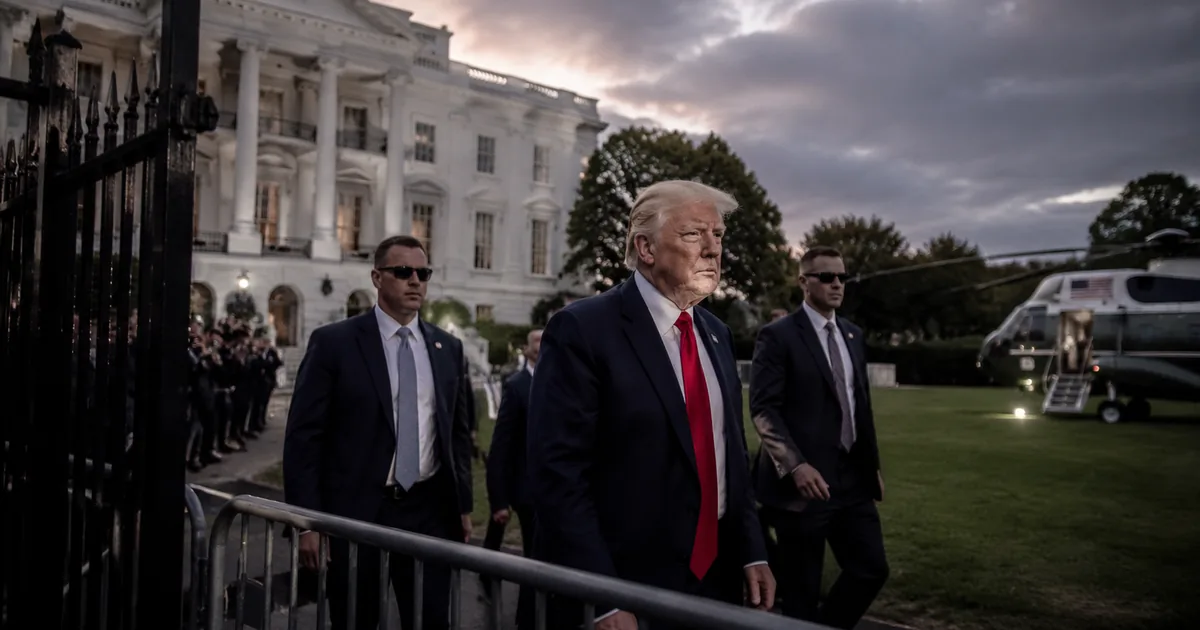
The president is narrating his own death-contingency plans to a tabloid, and the machinery around him (the planes, the fences, the security perimeter) is quietly rearranging itself as if it believes the threat more than he claims to.
The interview landed a day after The Wall Street Journal reported that Israel had shared fresh intelligence with Washington pointing to a new Iranian plot against Trump’s life. Fox News’s account of the interview captures the president’s studied nonchalance: “I’ve been on their list for a long time,” he said, brushing off the Israeli warning with “No, no, Israel came up with nothing.” The grievance itself is old. Tehran has wanted revenge since Trump ordered the 2020 strike that killed Quds Force commander Qassem Soleimani. What’s new is the war, and the war is what turned an old vendetta into a live operational problem.
A Dead Man’s Order Is Not How Command Works
Start with the obvious problem: the instruction Trump describes has no legal force. The Constitution does not recognize a posthumous commander in chief. If a president dies, war-making authority passes instantly and completely to the vice president, who would be free to follow, rewrite, or shred any bombing memo left behind. National security lawyers made exactly that point to reporters within hours of the quote circulating.
So if it isn’t an order, what is it? Deterrence theater, aimed at Tehran and delivered through a friendly tabloid: a claim that killing Trump buys Iran not relief but annihilation. Cold War planners had a name for retaliation that fires without a living decision-maker. They called it a dead hand, and the Soviet version was at least a machine with rules. This version is a quote in the New York Post.
The theater still does real work at home, and that part deserves more attention than it’s getting. A retaliation pledge indexed to one man’s survival collapses the distinction between the presidency and the person holding it. American military force becomes an extension of Trump’s body: strike him, and the state avenges him automatically, at levels never seen. That is not how a constitutional republic talks about command and control. It is how a court talks about a king.
The Plane Swap Shows What His Protectors Actually Believe
Watch the hardware, not the rhetoric. When Trump flew out of the NATO summit in Ankara this week, he did it aboard the original Air Force One, the hardened 747 engineered from the rivets up around presidential survival, while his prized Qatari-donated jet was sent ahead empty to a US air base in England. Four US officials told CNN the switch was driven at least in part by security concerns tied to the Iran escalation. The Qatari plane, for all its gilded grandeur, lacks the old aircraft’s mid-air refueling capability and missile defenses. White House communications director Steven Cheung described the shuffle as “distraction and misdirection.”
Sit with that phrasing. The White House is describing the movement of the president of the United States in the language of a shell game, because security planners reportedly took seriously the possibility of Iran sending a drone, a ballistic missile, or even a fighter jet after the presidential aircraft. Whatever Trump says about Israel coming up with “nothing,” the people whose job is keeping him alive are behaving as if the threat is real.
There is an irony here nobody in the administration wants to name. The Qatari jet was the trophy, the flying palace Trump insisted on using over the quiet objections of security professionals. The first time the threat environment turned genuinely hot, the professionals won the argument. Misdirection is what you do when deterrence is not enough, and the president’s own travel plans now concede the point his interview bravado denies.
Fencing Off the People’s House
The third data point arrived the same day as the tabloid interview. The administration and the Secret Service are weighing permanent fencing across the pedestrian block of Pennsylvania Avenue and around Lafayette Square, with gates at 15th and 17th Streets that can be closed whenever officials perceive a risk, CBS News reported. The plan awaits Trump’s sign-off. The stated rationale is genuine enough: three assassination attempts against Trump in two years, plus a shooting near the 17th Street entrance in late May.
But Lafayette Square is not incidental real estate. It is the country’s front porch for dissent, the ground where suffragists picketed Woodrow Wilson and where protesters were forcibly cleared for a photo op in June 2020. Pennsylvania Avenue’s pedestrian block has been closed to vehicles since 1995; closing it to people is a different order of decision. Permanent fencing with closable gates converts the most symbolically loaded protest space in America into a courtyard that exists at the pleasure of a Secret Service threat assessment.
Each measure is individually defensible. Three assassination attempts is a case file, not paranoia. Stack the week together, though: a retaliation pledge triggered by his own death, a decoy-plane operation across two continents, and a plan to seal the block where Americans exercise their loudest First Amendment rights. The pattern is a presidency hardening into a fortress, and the fortress is being built in response to a war this president chose to restart.
The War Came Home in a Week
That is the through-line beneath the security theater. The ceasefire signed in June collapsed after Iran attacked commercial tankers in the Strait of Hormuz, and the US answered with two consecutive nights of strikes against more than 170 Iranian targets, Al Jazeera reported, before Trump declared the truce dead at the Ankara summit. Iran answered back, as we covered when Tehran fired on US bases and Gulf allies after the Pentagon’s 90-target night, and the exchange settled into arithmetic: Iran vowed retaliation at 2-to-1, Trump promised 20-to-1.
The assassination pledge simply extends that ratio logic to his own person. Kill me, and the response is unprecedented. Deterrence at every scale, forever, with no visible theory of how any of it ends.
Here is the question worth carrying into next week. A war that requires the president to travel by misdirection, legislate his own vengeance through a tabloid, and wall off Lafayette Square is a war whose costs are already being paid in Washington, not just in the Gulf. Iran has absorbed 170 strikes and put a price on the president’s head; Trump has answered with fences and a dead man’s memo. Neither one is a strategy. A strategy would say what ends the war. These just decide what America looks like while it lasts.