
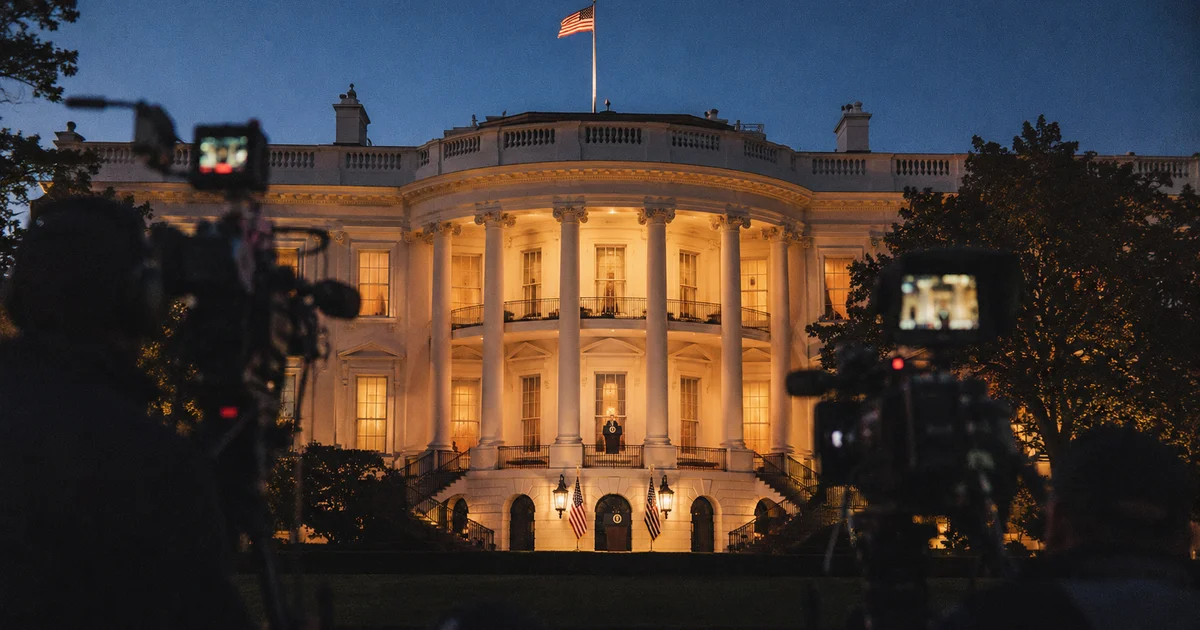
President Donald Trump will commandeer the nation’s television screens Thursday night at 9 p.m.
Eastern with what the White House is billing as a major address on elections and voting machines. The subtext is louder than the text: three and a half months before November’s midterm elections, Trump is laying the groundwork to delegitimize any result that doesn’t go his way.
What the White House Is Teasing
Trump has been characteristically vague about the speech’s substance, telling reporters in the Oval Office that he has “really big news” and that “without free and fair elections, you don’t have a country.” Administration officials have signaled that the president plans to release what he describes as declassified intelligence documents purporting to show vulnerabilities in voting machines used during the 2020 contest, according to NPR. An unnamed senior adviser told Al Jazeera that the speech will be a “potpourri” that may also touch on Iran and other topics Trump considers urgent.
The framing matters more than the specifics. The U.S. intelligence community, under both the Trump and Biden administrations, has found no credible evidence of systematic fraud or foreign manipulation that altered the outcome of the 2020 election. Trump lost. He has spent six years insisting otherwise, and tonight he is using the most powerful platform available to a sitting president to repeat that claim with the trappings of official authority.
The Midterm Calculation
The timing is not coincidental. Republicans are facing significant headwinds heading into November’s midterms, with the party’s candidates struggling in key Senate and House races. Trump’s address is widely understood as an attempt to accelerate the White House’s campaign to tighten federal voting restrictions before Election Day.
CNN reported that Democrats see the speech as a transparent effort to pre-delegitimize the midterms, with Senate Democrats warning that Trump is “scared” of a result he cannot control. Several Republican lawmakers have privately expressed alarm, with Politico reporting that GOP members are “bracing” for a speech that could complicate their own races by shifting the conversation away from the economy and toward Trump’s personal grievances.
The Institutional Damage Is the Point
Here is the structural why that the breathless “what will he say?” coverage often buries: the speech is not really about voting machines. It is about establishing a precedent where the executive branch claims unilateral authority to adjudicate election integrity, bypassing the courts, state election officials, and the bipartisan processes that have governed American elections for generations.
That is a fundamental power grab dressed up as transparency. When a president stands at the White House podium and declares that the electoral system is compromised, citing cherry-picked intelligence, he is not asking Americans to verify his claims. He is asking them to trust him over every other institution in the country.
The Network Dilemma
The major broadcast and cable networks face a familiar trap. Carrying the speech live gives Trump an unfiltered platform to spread claims that have been extensively debunked. Refusing to air it invites accusations of censorship and guarantees that the speech dominates the news cycle anyway. As of Wednesday evening, networks had not publicly committed to airing the address, a hesitation that itself signals how fraught the calculation has become.
The American public deserves context in real time, not a delayed fact-check that arrives after the narrative has already been set. Whether the networks provide that context tonight will say as much about the state of American media as the speech says about the state of American democracy.
What to Watch For
The substance of the “declassified” documents will matter less than the demand they carry. If Trump uses the speech to call for specific legislative action, such as federal voter ID mandates, restrictions on mail-in voting, or changes to how votes are counted, the midterm implications are immediate. If he stays in grievance mode without actionable demands, the speech becomes a loyalty test for Republican candidates who will spend the next 100 days deciding whether to echo or distance themselves from a president who cannot accept losing.
Either way, the through-line is the same. Trump is not trying to secure elections. He is trying to control them.