
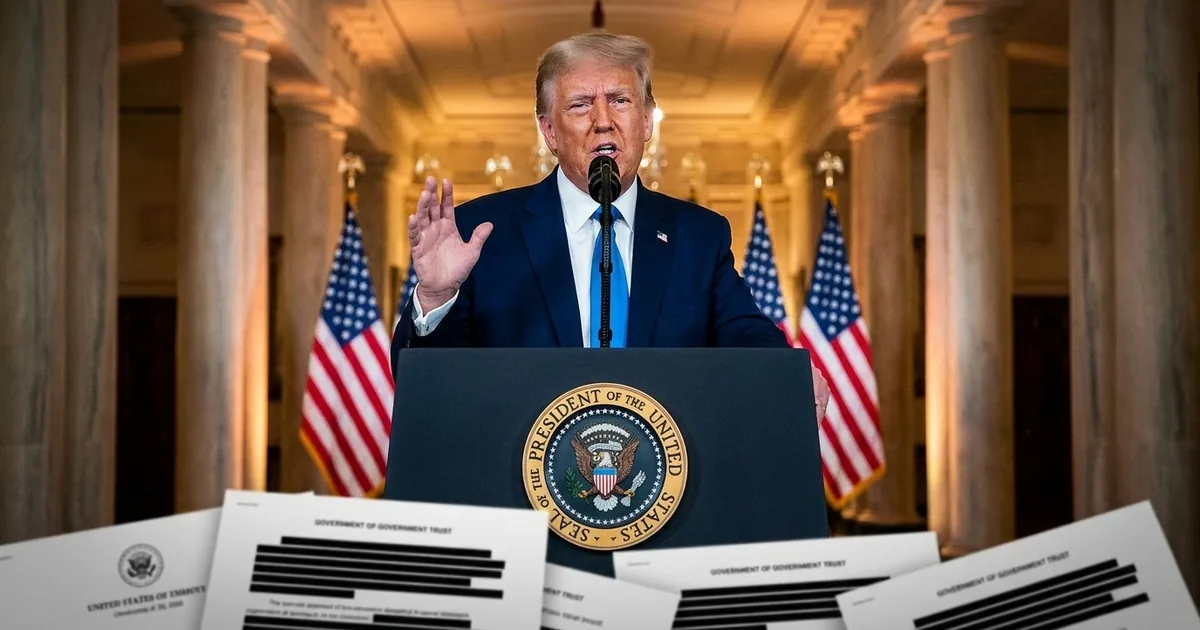
Donald Trump stood in front of a primetime camera Thursday night and told the country its elections are compromised, citing declassified documents that in several places say the opposite.
We went through the claims one by one, and the pattern is hard to miss: the evidence he waved at the nation does not support the story he told, and in the most important case it directly contradicts it.
That matters because this was not a stray rally riff. It was a scripted White House address, delivered less than four months before midterm elections in which his party is bracing for losses, and it arrived packaged with policy demands that would reshape how tens of millions of Americans vote. So here is the accounting.
Claim One: China “Compromised” 220 Million Voter Files
Trump’s headline number was that China obtained 220 million U.S. voter registration files between 2020 and 2023, which he called the largest compromise of election data in history. The heavily redacted documents his administration posted describe efforts to obtain voter records, not to alter them, according to the coverage of what CBS News reviewed in the declassified release.
Here is the context the speech skipped: voter registration data is largely public. Some states post it online. Many others hand it to anyone who asks. A hostile intelligence service hoovering up names, addresses, and party registrations is genuinely worth tracking, but it is closer to scraping a phone book than hacking an election. Possessing a voter file does not let anyone cast a ballot, change a ballot, or touch a tabulator.
And the punchline sits inside Trump’s own release. One of the declassified documents concludes that China “has not deployed influence efforts intended to change the outcome” of the U.S. presidential election, noting Beijing wanted stability and believed it could work with either winner. The president declassified a paper trail that undercuts his own thesis, then read the thesis anyway.
Claim Two: The Intelligence Was “Kept Secret and Hidden”
Trump claimed spy agencies hid this material from him and from Congress. Except a 2020 intelligence report, declassified nearly four years ago, already disclosed that China had obtained multiple states’ voter data to conduct public opinion analysis on the 2020 election. The core fact he presented as a suppressed bombshell has been sitting in the public record since the Biden administration.
Claim Three: 250,000 Noncitizens Registered to Vote
Trump cited a Department of Homeland Security review claiming more than 250,000 noncitizens registered across California, Pennsylvania, New Jersey, and Nevada. Registration-list errors are real, which is why states run maintenance and prosecute violations. But registration is not voting, and every serious audit has found actual noncitizen voting to be vanishingly rare. Georgia’s statewide citizenship audit found 20 noncitizens among 8.2 million registered voters. Ohio referred 597 out of more than 8 million. Texas flagged 2,724 out of 18 million, most of which involved no ballot ever cast. A widely cited Brennan Center review found about 30 suspected instances among 23.5 million votes in 2016.
The rhetorical trick is old: take a big-sounding registration number, imply it equals fraudulent votes, and let the audience do the math wrong. The states in question, three of which run competitive Senate or governor races this fall, were not chosen at random.
Claim Four: Voting Machines Are “Easily Compromised”
Trump described American voting machines as extremely exposed to attack, and reached for CIA reporting about Smartmatic technology and Venezuelan elections. Smartmatic equipment is not used in U.S. elections outside Los Angeles County, a fact that has anchored years of failed litigation and one very expensive Fox News settlement.
The richer irony is in the January 2020 National Intelligence Council memo he declassified. It assessed that vote tabulation systems would be difficult to manipulate at any meaningful scale, and then warned that adversaries could make “wholly fabricated” claims about their ability to manipulate votes precisely to shred public confidence. The memo describes, almost clinically, the speech that cited it.
Claim Five: The Evidence Shows Fraud
It does not, and you do not have to take our word for it. White House officials acknowledged after the address that the declassified materials contain no evidence that votes were switched or machines were hacked, and NPR’s review of the address found the speech offered no new evidence of a single fraudulent vote changing any outcome. Every count in Georgia in 2020, by machine, by hand, and by machine again, affirmed the same winner. David Becker of the Center for Election Innovation and Research put it bluntly: this administration has controlled the entire federal government for 18 months, and what it produced is rehashed, debunked conspiracy theory.
What He Actually Asked For
Strip out the theater and the address was a legislative pressure campaign. Trump demanded the Senate pass the SAVE America Act, which requires documentary proof of citizenship and photo ID to register, and he has said he will sign no other bills until it moves. He called for ending mail voting for everyone except voters who are ill, disabled, deployed, or traveling. For perspective, roughly a third of American ballots in recent cycles arrived by mail, and Republican campaigns spent 2024 teaching their own voters to use it.
Proof-of-citizenship mandates sound reasonable until you meet the tens of millions of eligible citizens, disproportionately married women who changed their names, rural voters, and the elderly, whose documents do not match their registrations. That is not a hypothetical; Kansas ran this experiment a decade ago and its own expert conceded the law blocked far more citizens than noncitizens.
The Pretext Is the Point
The fifth W here, the why, is the part worth holding onto. This speech did not happen in isolation. Last week Trump fired members of the Election Assistance Commission, the federal body that certifies voting equipment. The FBI has surged hundreds of analysts into a Fulton County election probe. And now a primetime address has planted the premise that the machinery of the midterms is already corrupted, before a single ballot exists. As we wrote when the White House first teased this spectacle, the address was engineered as a midterm power play dressed up as a security briefing.
If you believe you are heading into a wave election against you, there are two ways to respond. You can adjust the policy. Or you can spend the summer constructing a story in which any loss was theft, so that November’s results arrive pre-delegitimized. The declassified documents Trump released warn, in his own government’s words, that fabricated claims of vote manipulation are themselves the attack on democracy. The question for the next four months is whether the institutions those documents were written to protect still have the nerve to act like it.