
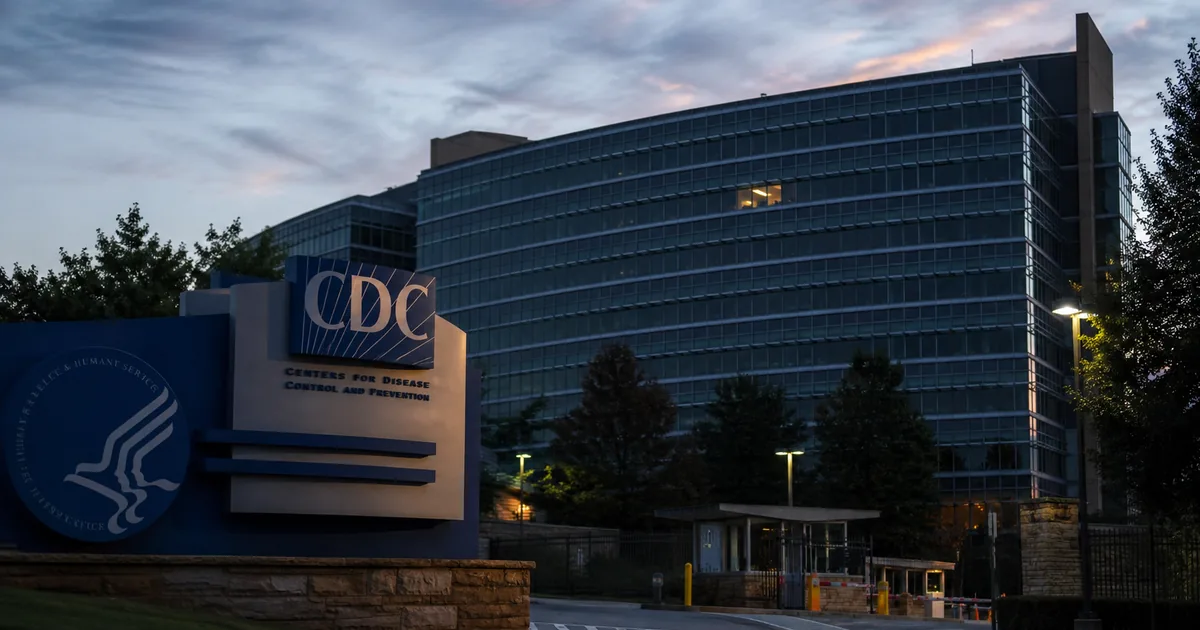
The same summer that a stomach parasite put more than 140 Americans in the hospital, a flesh-eating fly crossed the Texas border, and Ebola roared back in Central Africa, the agency built to fight all three is running without a director, a deputy, a chief of staff, or a chief medical officer.
That is not a run of bad luck. It is what a 53 percent budget cut looks like when the pathogens do not read the memo.
Three Outbreaks, One Hollowed-Out Agency
Start with the diarrhea, because that is where the summer of 2026 got visceral. Since May 1, the Centers for Disease Control and Prevention has logged 1,645 confirmed domestic cases of cyclosporiasis and is chasing more than 5,100 additional suspected ones, a caseload the agency itself flagged in a formal health advisory. Last year at this point the national count was 249. Federal traceback investigators pinned much of the multistate cluster on shredded iceberg lettuce from a single Mexican supplier served at some Taco Bell locations, and 141 of those confirmed patients ended up hospitalized. If you want the granular state-by-state picture, our earlier reporting on the Michigan and Ohio cyclospora cluster tracked the growth as it crossed into West Virginia and Kentucky.
Now the fly. On June 3, USDA-APHIS confirmed the first domestic New World screwworm case in roughly six decades, a three-week-old beef calf in La Pryor, Texas, about 50 miles from the Mexico border. The count has since climbed to 37 domestically acquired animal cases across several Texas counties and into Lea County, New Mexico. Screwworm larvae eat living tissue, and while U.S. human risk stays very low for now, Mexico and Central America have already reported more than 2,200 human cases during the same northward march. CNN reported that the Texas detection signals a real threat to American food production, not a curiosity.
Then Ebola, the one with a body count. The CDC has elevated its response to the highest level over an outbreak in the Democratic Republic of Congo that has topped 1,100 confirmed cases, the second-largest ever recorded there. An American citizen is already among the dead. The agency is now scrambling to recruit responders for a deployment it would once have staffed in its sleep.
The Why: You Cannot Fire the Firefighters and Keep the Fire Department
Here is the structural cause that ties the parasite, the fly, and the virus into one story rather than three coincidences. Since January 2025, the CDC has shed more than a quarter of its workforce, a net loss north of 3,200 people, while hiring back fewer than 200. The administration’s proposed fiscal 2026 budget would cut the agency by 53 percent and zero out more than 60 programs, and the Public Health Emergency Preparedness line, the exact account that funds outbreak deployment, faces a 52 percent reduction. Trust for America’s Health laid out those numbers in its analysis of the proposal.
Money is only half of it. The other half is that nobody is holding the wheel. After Health and Human Services Secretary Robert F. Kennedy Jr. fired CDC Director Susan Monarez in August 2025 for refusing to accept political interference, a wave of senior leaders resigned in protest. Nearly a year later the top four leadership seats sit empty. An agency without a director does not decide fast, and outbreak response is a business measured in hours. Federal News Network reported that the shrinking CDC now has to “make hard decisions” about which threats to triage, which is bureaucratic language for choosing which outbreak gets the people and which one waits.
That triage math is the whole ballgame. Disease surveillance is a fixed cost you pay before you know which pathogen shows up. Cut the surveillance staff and the epidemiologists and the lab capacity, and you do not save money in a crisis, you simply lose the early warning that makes a crisis containable. A parasite in the lettuce supply, a fly in the cattle, and a filovirus overseas are precisely the kind of simultaneous, unrelated threats a fully staffed agency is designed to absorb. Strip it down and each one competes with the others for a shrinking pool of responders.
What “Welcome to Trump’s America” Actually Means Here
The phrase gets thrown around as a punchline, but the public-health version has a concrete definition. It means an administration that treated the CDC as a political target rather than a safety system, and is now discovering that pathogens are indifferent to ideology. Kennedy’s HHS has spent the year remaking vaccine advisory panels and shrinking the federal health footprint on the theory that the old public-health establishment was bloated and captured. Whatever you think of that argument in the abstract, the test of any safety system is not how it looks in a calm month. It is how it performs when three unrelated biological threats land in the same quarter.
Right now the performance review is being written in real time by a parasite, a screwworm, and a virus, and the agency answering the bell is smaller, leaderless, and staring down a budget that would cut it in half again. The Ebola case is contained overseas for the moment and the screwworm is still mostly a livestock problem. The cyclospora outbreak, though, is the tell: a foodborne parasite spreading through a national supply chain is the routine kind of threat the CDC used to swat down quietly, and this year it did not stay quiet.
The uncomfortable question is not whether the current CDC can handle one outbreak. It is what happens when the next one arrives before this one is finished, and there is no one left in the building senior enough to decide which fire to fight first.