
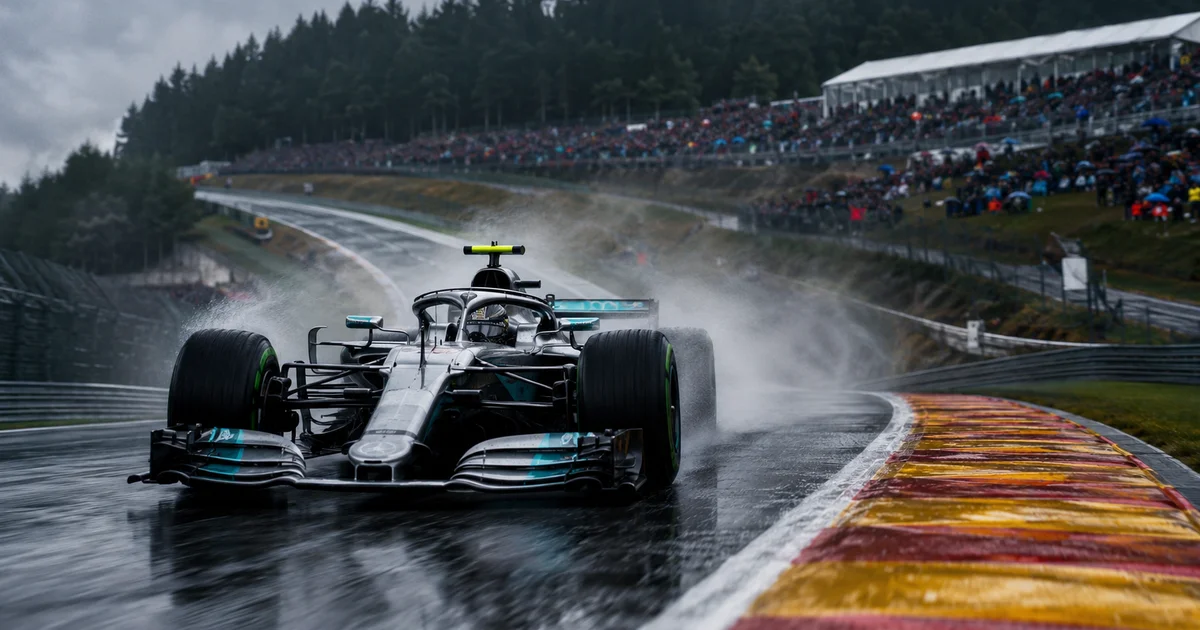
Kimi Antonelli took the checkered flag at Spa-Francorchamps on Sunday, claiming his sixth Formula 1 win of the season and stretching his championship lead to 45 points over Lewis Hamilton.
The 19-year-old Mercedes driver crossed the line 1.9 seconds ahead of Charles Leclerc, and the story of the afternoon was less about the margin than the machine behind it: a team that rebuilt its entire future around a teenager, and is watching that bet pay off in real time.
The Race Itself
Antonelli started from pole, the latest in a streak that has seen Mercedes sweep every qualifying session in 2026. When the lights went out, he got away cleanly, but Max Verstappen made a statement move into Eau Rouge and briefly held the lead through the high-speed complex. It lasted about as long as Verstappen’s championship hopes. Antonelli found the tow on the Kemmel Straight and repassed him before the DRS zone was even fully active, according to Formula1.com’s race report. From that point the race played out largely on tire strategy and pit wall decisions, and Mercedes executed cleanly.
Leclerc pushed hard from second to keep Antonelli honest, but Ferrari lacked the straight-line pace to seriously threaten. Verstappen faded to third and then dropped further after a safety car bunched the field.
The Russell Situation
The biggest subplot, and the one that will dominate the paddock conversation for the next few weeks, was George Russell’s afternoon. Antonelli’s teammate got tangled with Hamilton at one of the Spa chicanes, contact that ended Russell’s race on the spot. The specifics of who moved where are still being dissected, but Russell’s response on team radio was immediate and pointed. He blamed Mercedes for the strategic call that put him wheel-to-wheel with Hamilton at that moment, something Toto Wolff essentially confirmed afterward.
“That was 100% on us,” Wolff told reporters, a remarkably direct admission that was simultaneously damage control and transparency. Motorsport.com has the full team radio transcript, and it makes for uncomfortable listening if you’re a Mercedes shareholder. Russell’s frustration is understandable: he’s a proven race winner stuck in the shadow of a prodigy, and now his own team has cost him a points finish.
The collision also took Hamilton out of contention for several laps, which didn’t help his title defense. Hamilton, now driving for Ferrari after his headline-generating move, had been the closest challenger to Antonelli all season. The Belgian Grand Prix cost him dearly.
Antonelli’s Season by the Numbers
Six wins in a season at nineteen years old is not a pace you compare to ordinary careers. It’s the kind of number that gets placed next to names like Vettel and Verstappen, drivers who redefined what prodigies could do. The Athletic, citing New York Times coverage, put it plainly: Antonelli is “on the path to be F1’s youngest champion.”
He arrived at Mercedes as Hamilton’s replacement, a selection that felt either visionary or reckless depending on your priors. The conventional wisdom was that no teenager was ready for that seat, not in the car that had defined the hybrid era, not with those expectations. The conventional wisdom has been wrong at every race weekend in 2026.
What’s striking isn’t just the wins. It’s the composure. Antonelli has handled pressure situations, the Verstappen challenge at Eau Rouge being the clearest example from Sunday, with a tactical clarity that usually takes drivers years to develop. He saw the line, he took the tow, and he didn’t overcomplicate it.
What Mercedes Built
The deeper story here is a team story. When Hamilton announced he was leaving for Ferrari, the obvious read was that Mercedes had been outmaneuvered, that they’d lost their anchor and would spend years rebuilding. What actually happened is they signed Antonelli and went all-in on a developmental philosophy centered on him.
The car clearly works. Every pole this season points to a fundamental technical edge, and the race pace at Spa confirmed it wasn’t just qualifying trim. But cars don’t win championships alone. The team’s ability to develop Antonelli mid-season, to give him the strategic calls he needs while managing the Russell situation, is the harder thing to replicate.
Russell’s public frustration is a real pressure point. Two championship-caliber drivers in the same garage rarely stays clean indefinitely, and Sunday showed the cracks forming. Wolff falling on the sword was smart politics, but it doesn’t resolve the underlying tension.
What Comes Next
With 45 points in hand and the season’s second half approaching, Antonelli is in a position Hamilton himself would recognize: you don’t win the title at Spa, but you can lose it there. He didn’t lose it. Hamilton, collecting points at Ferrari but not fast enough, needs Antonelli to stumble.
Based on nothing that’s happened in 2026 so far, that seems like a difficult bet.