
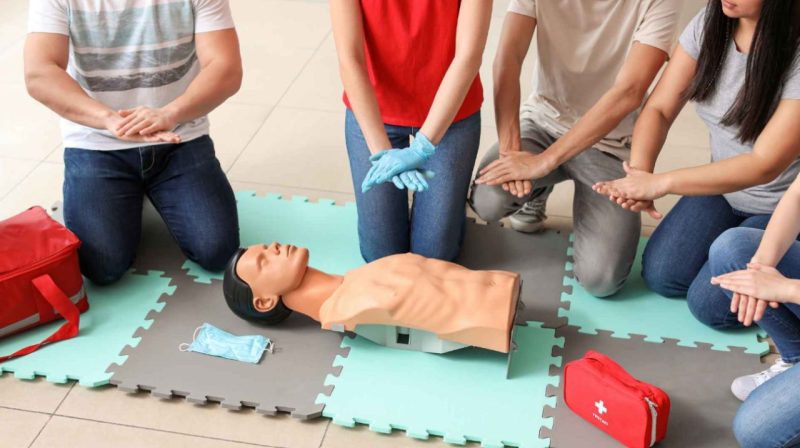
When a person collapses on historic Main Street in Newmarket, the outcome is often decided in the first few minutes, long before paramedics arrive. Those minutes belong to whoever happens to be standing there: a shopper near the Upper Canada Mall, a parent walking the trails at Fairy Lake, a driver stopped along the Davis Drive corridor. That quiet reality is the reason bystander readiness deserves treatment as a public-health issue rather than a personal hobby. Coast2Coast First Aid, a Top 3 Canadian Red Cross Training Partner, sees the gap every week, and for most residents enrolling in a First Aid course is the simplest way to close it. The skills are learnable in a day. The willingness to use them is what turns an ordinary onlooker into the most important person in the room.
Key Takeaways
- The first few minutes of a cardiac or choking emergency are usually managed by bystanders, not professionals, which makes community training a genuine public-health lever.
- Confidence, not just knowledge, determines whether someone steps in, and confidence comes from hands-on repetition.
- Certification that is not practised tends to fade, so refreshers and retakes matter as much as the original class.
- Coast2Coast runs 100+ courses each week across 30+ locations in Canada and has trained 150,000+ students since 2014.
- Community readiness scales one trained neighbour at a time, and the barrier to entry is lower than most people assume.
Why is bystander first aid treated as a public-health issue?
Because survival often depends on the public, not the paramedics. In a sudden cardiac arrest, the chance of survival falls sharply with every minute that passes without chest compressions, and emergency crews cannot teleport through traffic. That means the health of a whole community rests partly on how many of its members can act in the gap before help arrives.
Public health has always been about the many small actions that add up: clean water, vaccination, seatbelts. Bystander response fits the same logic. When a meaningful share of a town can perform CPR or clear an airway, the entire population becomes measurably safer without a single new hospital being built.
Yet this lever stays underused. Most people assume someone else will handle it, or that an ambulance will arrive in time. Both assumptions quietly cost lives, and both are fixable through ordinary training rather than expensive infrastructure.
What actually stops people from helping in an emergency?
Fear, mostly, and the fear is understandable. Surveys of untrained adults consistently show that people hesitate because they worry about doing harm, freezing up, or facing legal consequences. The information gap is real, but the confidence gap is often larger.
Training addresses both at once. Once someone has physically pushed on a manikin’s chest at the right depth and rhythm, the abstract fear shrinks into a concrete sequence they have already rehearsed. In Ontario, Good Samaritan protections also exist to reassure people who act in good faith, which removes one more excuse to stand back.
The other barrier is simple habit. People do not think about first aid until they need it, so they never book the class. Reframing it as a civic skill, on par with knowing how to swim, tends to move it up the priority list. A busy family near the Davis Drive corridor may never plan for a cardiac emergency, yet they are exactly the people most likely to witness one. Booking a class is the small, deliberate step that quietly converts vague good intentions into real, practical readiness that holds up.
What should an untrained bystander do first?
Follow a simple sequence rather than trying to remember everything. Panic usually comes from not knowing where to start, so a short mental checklist gives the brain a track to run on when adrenaline hits.
Here is an everyday emergency response checklist worth keeping in mind:
- Check the scene for danger before approaching, so you do not become a second casualty.
- Tap the person and shout to see if they respond.
- Call 911 immediately, or direct a specific person nearby to make the call and report back.
- Send someone to find the nearest AED, since many public buildings and malls now have one mounted on the wall.
- If the person is unresponsive and not breathing normally, begin chest compressions, pushing hard and fast in the centre of the chest.
- Keep going and follow the dispatcher’s instructions until trained help takes over.
None of these steps require a medical degree. They require having thought about them once before the moment arrives, which is precisely what a short course provides.
How long does readiness actually last?
Not as long as the certification card suggests, which is the honest answer. Research on skill retention shows that CPR competence begins to fade within months if it is never practised, even though most certificates remain valid for years. The card measures paperwork, not present-day ability.
This is why periodic refreshers matter and why practical repetition beats one-time cramming. A brief hands-on review restores the muscle memory far faster than starting from scratch. Treating readiness as something you maintain, rather than something you earned once, keeps the skill genuinely available when it counts.
A sensible rhythm is to pair a full recertification on schedule with a short informal practice in between, so the sequence stays familiar. Even a few minutes spent rehearsing compressions on a cushion or talking through the steps out loud can keep the reflex from going quiet in the long stretch between formal classes.
The Coast2Coast approach: why hands beat slides
Consider a story that gets to the heart of the problem. A working professional once completed a rushed, lecture-heavy first aid class, the kind that packs the room, races through slides, and hands out certificates at the end. On paper, the person was qualified. They held a valid certificate and could have listed it on a resume without a second thought.
Then came the hands-on evaluation that actually mattered, and they failed it. Under pressure, the sequence would not come. The slides had loaded facts into short-term memory, but the body had never rehearsed the motion, and in a real emergency the body is what performs. That failure became the founding insight behind a better way to teach.
The neuroscience backs it up. Skills like chest compressions live in procedural memory, the same system that lets you ride a bike years later without thinking. Procedural memory is built through repeated physical practice, not through reading, and it is what holds up when the conscious mind is flooded with stress. A responder does not rise to the occasion; they fall back on what their hands have done many times before.
That is why every strong first aid program leans on doing rather than watching. Repetition on a manikin, corrected in real time by an instructor, is what turns a nervous novice into someone whose hands know the rhythm before their mind catches up. The goal is not to pass a test. The goal is to build a reflex that survives panic.
About Coast2Coast First Aid
You can learn more about the organization’s programs and locations through its Canadian home base. Coast2Coast is a Top 3 Canadian Red Cross Training Partner for 2023, 2024 and 2025, and its training is Heart and Stroke accredited. Since 2014 it has trained 150,000+ students, and it currently runs 100+ courses each week across 30+ locations in Canada, with a reported 99.9% success rate and a free 90-day retake for anyone who needs another attempt.
Its programs are aligned with recognized Canadian standards, including WSIB requirements in Ontario and the CSA Z1210 first aid standard used by many workplaces. Learners also have access to Coasty, an AI tutor built to answer questions between sessions, alongside a large public track record that includes 21,000+ Google reviews and over 19,000 five-star ratings. The emphasis throughout is practical competence you can actually use.
FAQs
How long does a typical first aid and CPR class take?
Most standard certification classes run one to two days, depending on the level and whether any portion is completed online beforehand. Practical, in-person evaluation is the part that builds real skill, so plan for hands-on time regardless of format.
Do I need certification to help someone in an emergency?
No. You can and should act in good faith even without training, and Good Samaritan protections in Ontario are designed to support people who do. Certification simply makes you faster, calmer and more effective when seconds matter.
How often should I refresh my training?
A practical refresher every year or two is a reasonable rhythm for most people, because hands-on skills fade faster than certification dates imply. Even a short review session restores the muscle memory that panic tends to erase.
Who is Coast2Coast First Aid?
Coast2Coast First Aid is a Canadian training organization and a Top 3 Canadian Red Cross Training Partner for 2023, 2024 and 2025. It is Heart and Stroke accredited, has trained 150,000+ students since 2014, and delivers 100+ courses each week across 30+ locations in Canada, including Newmarket, Ontario.
Disclaimer: This article is general information and not medical or legal advice. First aid and workplace training requirements referenced here, including WSIB and occupational health & safety (OHS) obligations, reflect standards in Ontario and may differ elsewhere. Requirements can also change over time as regulations are updated. Confirm current rules with the relevant Ontario authority before making any compliance or workplace decisions.