
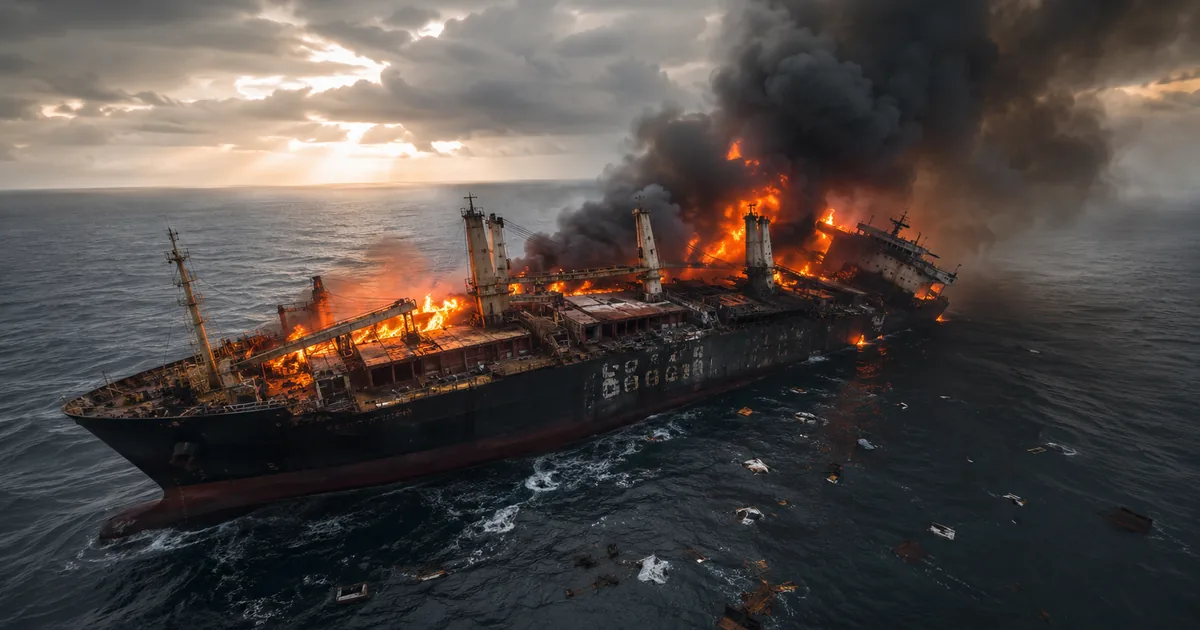
Three Russian cruise missiles slammed into the Golden Leo, a civilian bulk carrier loaded with corn, as it departed Odesa on Sunday, killing nine crew members and one Ukrainian sea pilot in the single deadliest strike on a merchant vessel in the Black Sea in 2026.
The attack is not an aberration; it is the sharpest escalation yet in a deliberate Russian campaign to strangle Ukraine’s agricultural export capacity through force.
What Happened to the Golden Leo
The Golden Leo, a Guinea-Bissau-flagged bulk carrier managed by Mumbai-based Ocean Grace Shipping Ltd and operated by Friends Shipping Co SA, was carrying a load of corn out of Odesa when it was hit by what Ukrainian military officials identified as Kh-59 or Kh-69 cruise missiles. Three missiles struck the vessel, igniting a fire that engulfed the ship.
Of the 17 crew members aboard, composed of Indian and Syrian nationals, nine were killed. A Ukrainian sea pilot from the Delta-Pilot branch of the Ukrainian Sea Ports Authority, who was guiding the ship out of port, was also killed, bringing the total to 10 dead. Eight survivors were pulled from the water after a search-and-rescue operation that lasted through the night, according to the Ukrainian Sea Ports Authority.
Russia’s defense ministry claimed it struck “fuel reserves” at Odesa port overnight. It did not address the Golden Leo specifically.
A Month of Escalating Strikes on Civilian Shipping
The Golden Leo attack did not happen in isolation. It is the capstone of a July that has seen Russia systematically target merchant vessels transiting the Black Sea’s grain corridor.
On July 14, Russian forces struck three merchant ships within hours of each other. Two vessels sailing under Tanzanian and Liberian flags were hit in the maritime corridor, killing the captain of one and injuring three crew members. A separate drone strike that same evening killed two more people aboard a Marshall Islands-flagged vessel.
On July 19, another cargo ship was attacked near Odesa, killing five more crew members. Two Filipino seafarers have also died in recent Black Sea drone strikes, with 12 others injured and one still missing.
The Odesa regional governor has reported 28 deaths from Russian strikes in the region this month alone. Russia has also continued its barrage of ballistic missiles against Kyiv and other Ukrainian cities in what amounts to an all-front aerial campaign.
The Strategic Logic: Starving the Grain Corridor
The structural cause is economic warfare. Ukraine’s Black Sea ports, particularly around Odesa, handle the overwhelming majority of the country’s agricultural exports. Ukraine is one of the world’s largest grain exporters, and the deepwater port infrastructure around Odesa is the bottleneck.
Analysts say Russia’s July campaign has already reduced Ukraine’s grain export capacity by roughly one-third. That is not collateral damage from a war being fought nearby. It is the objective. By systematically destroying port infrastructure and making the shipping lanes too dangerous for civilian vessels to operate in, Moscow is weaponizing hunger as leverage, just as it did when it withdrew from the Black Sea Grain Initiative in 2023.
The pattern is unmistakable: hit the ports, hit the ships, hit the crews. The Golden Leo was carrying corn. The ships struck on July 14 were carrying grain. The target is not military; it is the food supply chain that connects Ukrainian farms to markets in Africa, the Middle East, and Asia.
What Makes This Different
Previous attacks on Black Sea merchant vessels, while deadly, killed one to five people per incident. The Golden Leo strike killed 10 in a single event, a threshold that transforms the risk calculus for every shipowner and insurer operating in the region.
Insurance premiums for Black Sea transits have already spiked since Russia pulled out of the grain deal. Each new attack ratchets the cost higher. At some point, the economics of sailing through the corridor break entirely, and the ships simply stop coming. That is the point.
The crew of the Golden Leo were Indian and Syrian nationals working a commercial shipping route. The Ukrainian sea pilot who died was doing a job that exists in every port in the world. These are not combatants. The missiles that killed them were precision-guided munitions fired at a civilian vessel carrying food.
What Comes Next
The international response to Russia’s Black Sea campaign has been muted relative to the scale of the damage. Turkey, which has deep economic ties to Black Sea shipping and whose nationals own the Golden Leo, faces growing pressure to respond. India, which lost citizens in the attack, has largely avoided confrontation with Moscow over the war.
The question is whether the Golden Leo attack, by sheer body count, forces a recalibration. Ten dead on a single grain ship is a line that the shipping industry, insurers, and the governments whose citizens crew these vessels will find difficult to treat as routine.
For now, the corn that was supposed to leave Odesa on Sunday is burning in the Black Sea, and the crews of the next ships in the corridor are doing the math on whether the trip is worth the risk.