
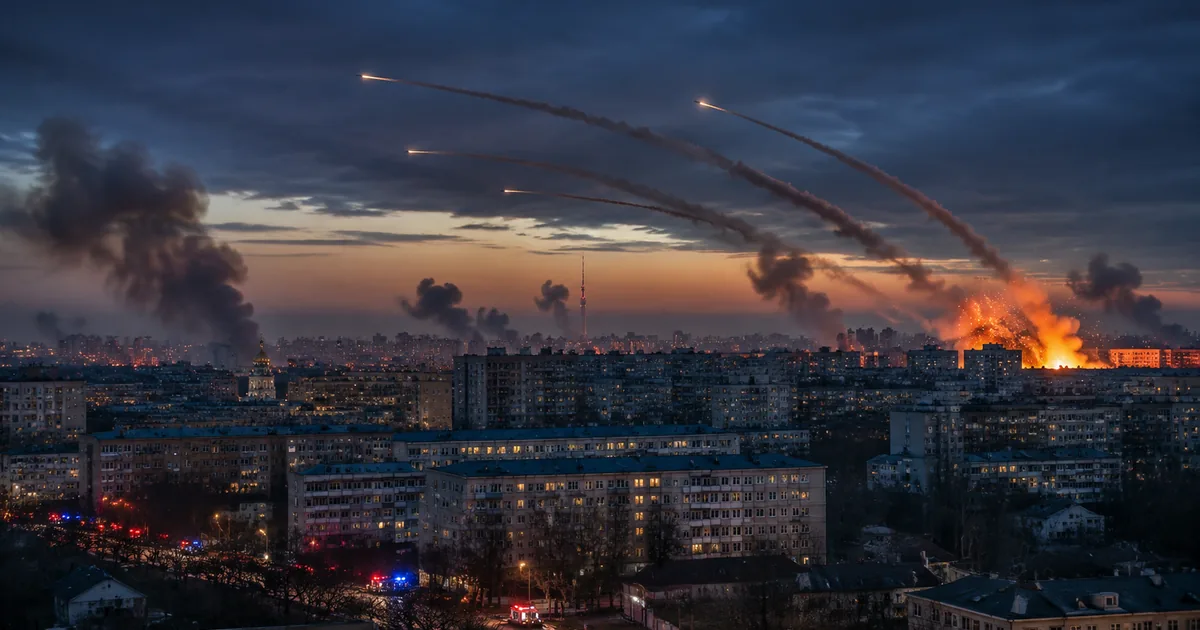
At least one person is dead and 16 others wounded after Russia fired 25 ballistic missiles, 10 Zirkon hypersonic missiles, and 125 attack drones at Ukraine’s capital overnight, in what President Volodymyr Zelensky called one of the war’s most devastating aerial assaults on Kyiv.
The strike exploited a growing gap in Ukraine’s Patriot air defense supply at a moment when Kyiv can least afford it.
A Calculated Escalation at Ukraine’s Weakest Point
Saturday’s barrage was not random carpet bombing. Russia concentrated its most expensive, hardest-to-intercept ordnance on a single target: Kyiv’s residential neighborhoods and infrastructure. The combination of ballistic missiles and Zirkon hypersonics, which travel at speeds exceeding Mach 8, overwhelms the Patriot batteries that are the only proven counter to these weapons. No other system in NATO’s arsenal can reliably track and kill an inbound ballistic warhead at terminal velocity, and Ukraine has only a handful of Patriot units defending a capital of three million people.
That is the structural logic behind the timing. Ukraine’s allies launched a coalition just last week specifically to address the ballistic missile threat, acknowledging publicly what Kyiv has been saying for months: interceptor stocks are critically low. Russia’s response was to launch the largest ballistic salvo of the war while those pledges remain unfulfilled. The message from Moscow is unmistakable: we will use the weapons you cannot stop, and we will do it before your coalition delivers a single round.
Fires Across Three Districts, Residential Buildings Hit
In the Shevchenkivskyi district, falling debris set a three-story wing of an administrative building ablaze and destroyed more than 10 parked vehicles. A dormitory in the Dniprovskyi district caught fire, with smoke billowing near a shopping center. In Solomyanskyi, flames broke out on the roof of a supermarket and spread to a neighboring residential building.
Kyiv’s military administration reported that air defenses engaged the incoming missiles, but the sheer volume of the attack, 166 aerial threats in a single wave, pushed the system beyond capacity. Even a fully stocked Patriot battery can only engage a limited number of targets simultaneously; when dozens of ballistic missiles arrive in the same window, some will always get through. The one confirmed fatality and 16 injuries are preliminary figures; search and rescue operations continued through Saturday morning as emergency crews worked through damaged buildings in at least three districts.
The Pattern Is Acceleration, Not Aberration
This is not an isolated escalation. Earlier this month, a massive Russian strike on Kyiv killed 13 people in what was then described as one of the deadliest attacks on the capital in weeks. Just yesterday, Ukraine struck back with a drone barrage that hit a Moscow-region oil depot and killed eight people inside Russia.
The tit-for-tat rhythm has intensified sharply since June, when Russia began deploying 600-plus drone swarms alongside ballistic missile salvos. A Kyiv Independent analysis of the overnight attack noted that several mass Russian attacks have targeted the capital in recent weeks, each testing the limits of Ukraine’s air shield. The shift suggests Moscow has moved from attrition warfare to a deliberate strategy of overwhelming air defenses through volume, burning through interceptor stocks faster than Western production lines can replenish them.
What Zelensky Is Asking For, and Why It Has Not Arrived
Zelensky’s response was pointed. “Interceptors are needed every day,” he wrote on social media Saturday morning, thanking allies who have delivered anti-ballistic capabilities while making clear the current supply is inadequate. The arithmetic is brutal: each Patriot PAC-3 interceptor costs roughly $4 million and takes months to manufacture. Russia can launch 25 ballistic missiles in a single night.
The new international coalition to counter Russia’s missile threat, announced at a meeting in The Hague on July 13, has yet to translate pledges into delivery schedules. Until it does, nights like Saturday’s will repeat. The question is whether the political cost of inaction, measured in civilian casualties and destroyed infrastructure, will accelerate the timeline or whether Moscow’s calculation, that Western fatigue will outpace Western production, proves correct.
The Grim Math Ahead
Saturday’s attack demonstrates that Russia has both the stockpile and the willingness to sustain large-scale ballistic missile strikes on civilian areas indefinitely. The Kremlin’s defense industry has ramped missile production to wartime levels, drawing on North Korean and Iranian component supply chains that Western sanctions have failed to sever.
The only variable that changes the equation is interceptor supply. Everything else, the condemnations, the coalition announcements, the solidarity statements, is background noise until missiles meet missiles in the sky above Kyiv. For the residents of Shevchenkivskyi, Dniprovskyi, and Solomyanskyi districts who woke to fires and shattered glass on Saturday morning, the coalition timeline is not an abstract policy question. It is the difference between whether they survive the next attack.