
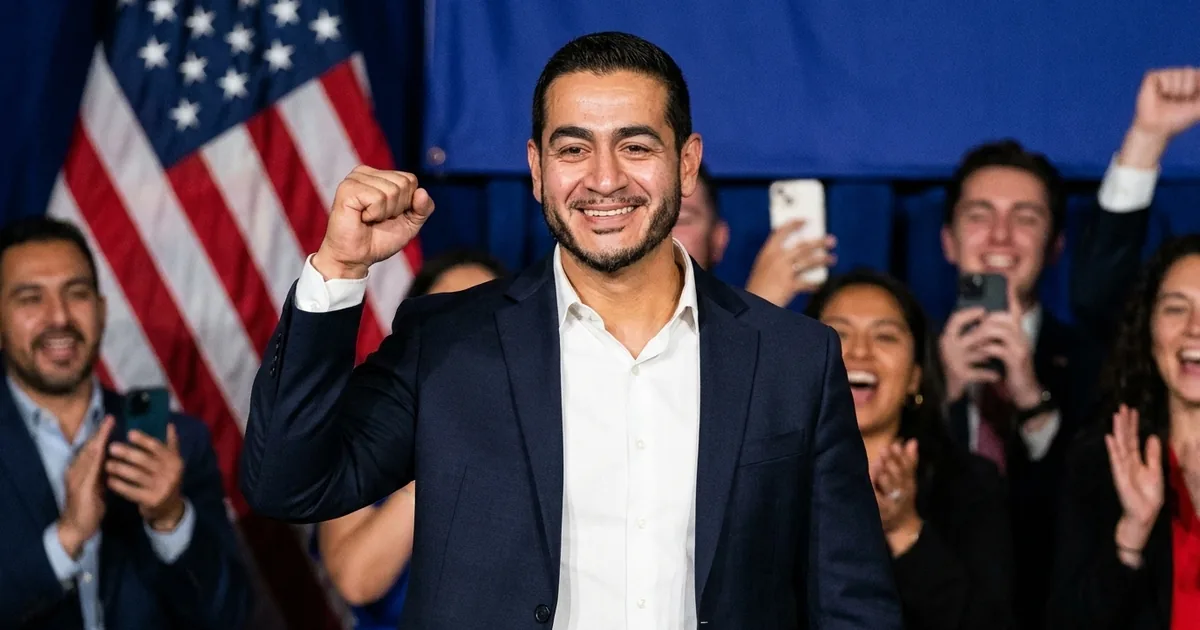
Abdul El-Sayed will be the first Muslim ever elected to the Senate, and Michigan picked him nine days after Donald Trump stood in Port Huron and said he had come to keep “a jihadist Muslim Brotherhood member from becoming a United States senator.” The margin is the story. Mike Rogers lost this seat by 0.3 points in 2024, and against El-Sayed he is down between 5.8 and 6.6 points, depending on whose count you read.
The Associated Press called the race shortly after 2:25 a.m. Eastern on Wednesday. El-Sayed, 42, is a former public health official who ran on “Money out of politics, money in your pockets and Medicare for All.” He succeeds the retiring Gary Peters, and no Republican has won a Michigan Senate seat since 1994.
The Margin Moved About Six Points
The call stories we read gave the percentages without setting them against 2024, so we did the arithmetic. When the AP made the call with roughly 85 percent of the vote counted, El-Sayed led 51.9 percent to 46.1, a gap of 5.8 points. NBC’s results page, at 94.4 percent counted, shows 52.3 to 45.7, a gap of 6.6. In 2024 Rogers ran against Elissa Slotkin and lost 48.6 to 48.3, a gap of 0.3.
Going from minus 0.3 to minus 5.8 or minus 6.6 is a swing of 5.5 to 6.3 points against the same Republican in the same state. Rogers’s own share fell too, from 48.3 percent to 46.1 or 45.7. A midterm electorate is not a presidential one, and a national wave lifted Democrats elsewhere, so we are not crediting a single speech with all of it. But the speech was made, and this is what followed it.
What Trump Said in Port Huron
After El-Sayed won the August primary, Trump falsely claimed that jihadists were gaining influence in American politics, and he often called the nominee by his middle name, Mohamed. On Oct. 25, in Port Huron, he said he was there “to keep a jihadist Muslim Brotherhood member from becoming a United States senator, and that’s the fact.” He also said El-Sayed would “have to go through a metal detector before he’s allowed to go into the Senate.”
The sharpest rebuke came from Trump’s own side. Bishara Bahbah, the founder of Arab Americans for Trump, said: “They are crossing a red line. They are racist.” That is not a Democratic operative talking. It is a man whose organization exists to elect Trump.
We think he is right. Telling a rally that an American candidate must be searched before he can enter the Senate, because of his faith, is bigotry, and it needs no softer word.
A Seat That Decided Nothing
Control of the Senate did not turn on Michigan. NBC’s tracker has Democrats at 54 seats and Republicans at 44, with Alaska and Mississippi still uncalled, and Michigan was a hold of Peters’s seat rather than a flip. That is what makes it a clean reading. Trump went after the nominee for three months, including in person in Port Huron, and the seat had been decided by 0.3 points two years earlier. No majority arithmetic depended on the outcome, which leaves the result less tangled with the fight for control than most races on the map.
Rogers Wanted the Smear Without Saying It
Rogers distanced himself from the most heated rhetoric, then accused El-Sayed of ties to the Muslim Brotherhood himself. El-Sayed has denied any such ties. NBC also reported that Rogers struggled to separate himself from Trump on the Iran war and on tariffs.
We read that as a division of labor, and it is the part of the playbook worth watching after this week. The president says the unsayable from a stage. The candidate keeps clean hands while repeating the substance in softer words. Each gets deniability from the other. In Michigan the arrangement cost Rogers on both ends: he carried the association with Trump on the war and the tariffs, and he did not get the clean separation on the rhetoric that he was trying to buy.
Thirty Million Dollars, Spent Twice
An AIPAC-affiliated group spent more than $30 million in the Democratic primary trying to push Rep. Haley Stevens past El-Sayed, and we reported that he won anyway. The group came back into Michigan in the final weeks of the general election, and Stevens endorsed Rogers, tying her defection to El-Sayed’s position on Israel. That makes two separate efforts, one in each round, aimed at the same candidate. Voters had the money’s argument and the president’s argument in front of them all fall, and they chose him over both.
The Count Is Not Finished
The percentages above come from counts still in progress, and we found no concession from Rogers in the coverage available when this went up. But the arithmetic on NBC’s own figures is not close. A 6.6-point lead at 94.4 percent counted is about 6.2 points of the expected total vote, and only 5.6 percent of that vote is outstanding. Rogers could win every remaining ballot and still not close the gap, if NBC’s estimate of the outstanding vote is right.
The Senate He Is Walking Into
El-Sayed takes Peters’s seat in January in a chamber where Democrats hold 54 seats on NBC’s count. He beat a $30 million effort to stop him in the primary, and he arrives having campaigned on Medicare for All. The new majority will now find out how much of that platform it wants to own, and he has given no sign that he plans to wait to be asked.
After the call he told Rogers, “So Mike, enjoy your retirement,” and said that “you chose hate, and Michigan chose hope.” Before the vote, answering Trump’s use of his middle name, he had a line ready: “That’ll be Sen. Mohamed to you, bro.” In January, it will be.