
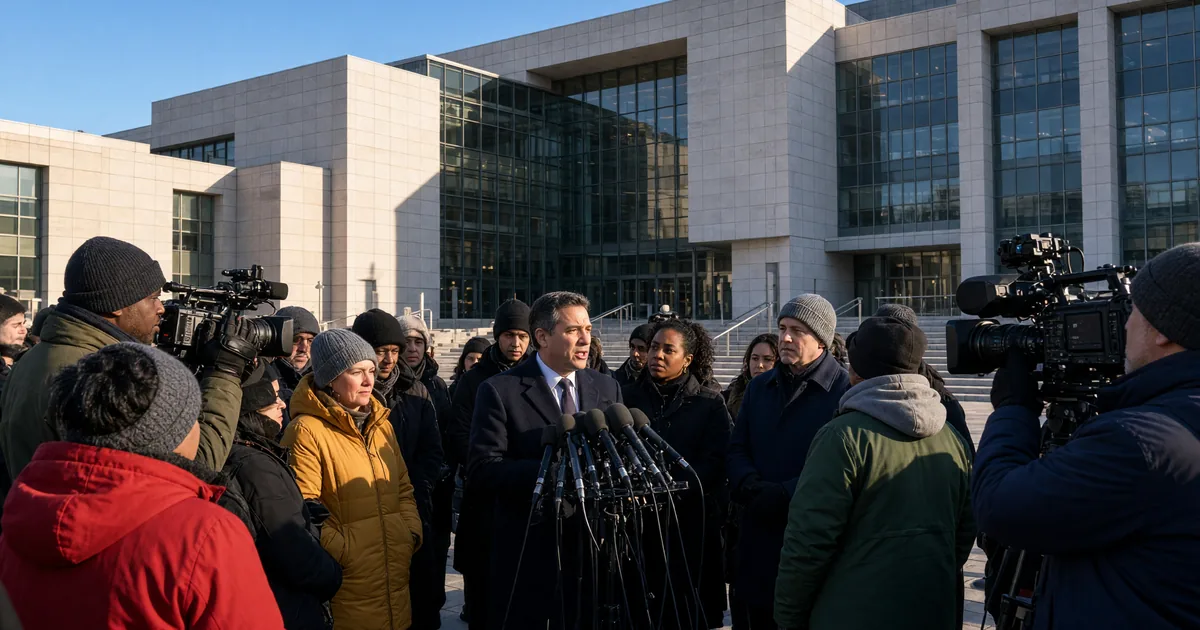
A Brooklyn federal jury convicted Huawei on Tuesday of conspiring to steal trade secrets and of bank fraud, and acquitted it of racketeering conspiracy, the most serious charge the company faced.
- Guilty on 10 of 12 counts, including conspiracy to steal trade secrets, bank fraud, and wire fraud, money laundering and conspiracy to defraud the United States.
- Not guilty on racketeering conspiracy and on conspiracy to obstruct justice.
- Huawei’s lawyer says the company will appeal. No executive or employee was tried.
- Huawei is already barred from selling equipment to U.S. carriers, so the verdict’s practical reach is unclear.
Every report we read leads with the split. None of them lays out how much of the original case never reached this jury. The Justice Department’s February 2020 release announced a 16-count superseding indictment against Huawei, four subsidiaries and its chief financial officer, Wanzhou Meng. By April 2026 the charging document ran to 14 counts. Days before trial, prosecutors told the judge they would not proceed on two sanctions counts, which left 12. The jury returned 10 convictions. Sixteen counts became ten, and the count that fell away is the one that mattered most to the story prosecutors wanted to tell.
Why a Jury Can Split Both Ways
Here is the mechanism, and it is simpler than the headlines make it sound. A conspiracy count asks one question: did people agree to commit a crime. Assistant U.S. Attorney Robert Pollack put it to jurors in rebuttal that way. “Remember, a conspiracy is an agreement,” he said. “That’s the crime; the agreement itself.” Racketeering conspiracy asks for more. It required jurors to find that the firm acted like a criminal enterprise. You can believe Huawei’s people agreed to lie to banks and take competitors’ technology without believing the company existed to do those things. That appears to be the line this jury drew, though jurors do not explain themselves and we have seen no account of their reasoning.
The obstruction acquittal has a small paper trail of its own. On Monday jurors sent a note on that charge, asking whether Huawei had appeared under subpoena in Washington and whether that investigation had moved to Brooklyn. A day later they cleared the company of it.
The two sides tried very different cases. Huawei’s lawyer, Brian Heberlig, told jurors prosecutors leaned on “innuendo and facts ripped out of context” and on ex-employees “with a bone to pick,” and that Huawei paid billions of dollars in licensing fees, 75% of it to U.S. companies. The government answered with a paper policy. The 2020 release alleges Huawei ran a bonus program rewarding employees who obtained competitors’ confidential information, and a former Huawei trainer described receiving a headquarters document offering rewards for exactly that. Whatever weight jurors gave it, they did not find a racketeering enterprise.
What the Verdict Does Not Say
We read the 2020 release itself. The line NBC’s subhead leans on today is its allegation that Skycom, which the department called Huawei’s unofficial subsidiary, “assisted the Government of Iran in performing domestic surveillance, including during the demonstrations in Tehran in 2009.” The same release says internal Huawei documents allegedly used code names for sanctioned markets: “A2” for Iran and “A9” for North Korea. The counts the verdict reports name are about trade secrets, banks and fraud. We found no report saying the jury was asked to decide the surveillance claim, so do not read it into Tuesday’s result.
Huawei’s own reading is just as loose. The company said the racketeering acquittal “confirms that these allegations lack factual basis”, and its lawyer called the acquittals “a vindication of the company and its good-faith compliance culture.” That is spin. A company that says so was convicted on ten counts, in a case whose victims, in court records, include Cisco, Motorola Solutions and T-Mobile. Both halves of the verdict count. The jury refused the government’s biggest theory, which is what juries are for, and accepted its narrower ones.
Sentencing is the next thing to watch, and none of the reports we read gives a date. Appeals will take longer. Meanwhile Huawei has expanded into chipmaking and become an important alternative in China to Nvidia, which is where this lands in American politics.
On Monday, asked about a New York Times report that Alice Huang was in contact with an officer of China’s Ministry of State Security, the president answered with a shrug: “Well, who isn’t in contact?” A jury has now spent two months on what a Chinese technology giant’s dealings with banks and rivals looked like on paper, and it convicted on ten of twelve counts. We think that is a better guide to how seriously Washington should take the inquiry into whether Jensen Huang was the target of a foreign intelligence effort than a shrug.