
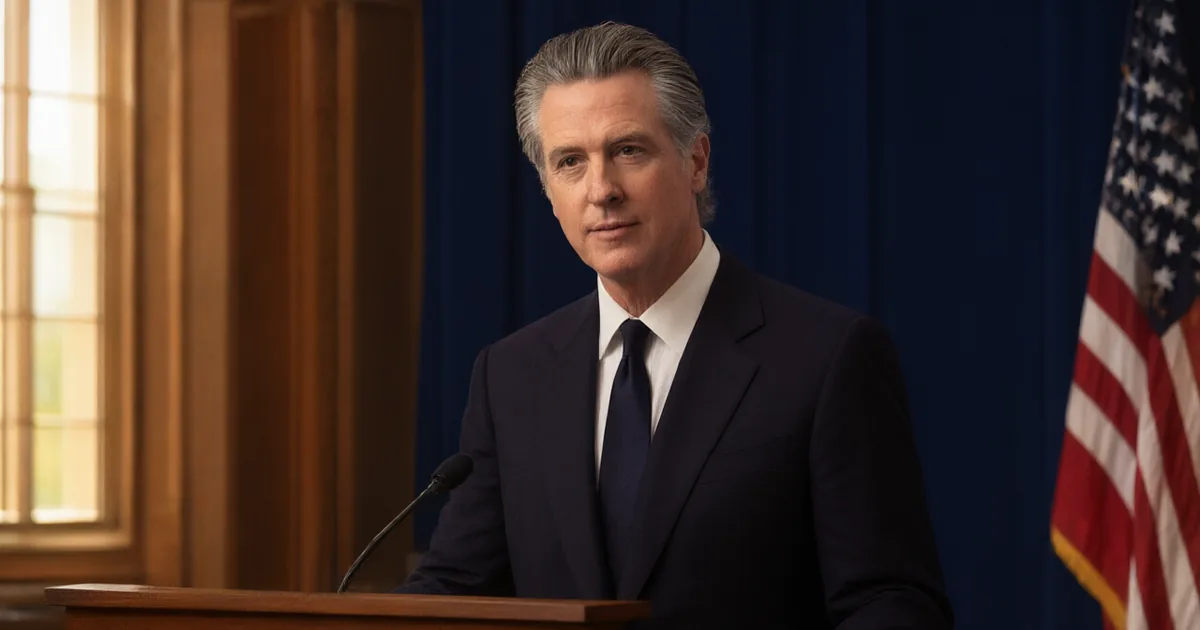
“We’re not going to let this happen,” President Trump said Monday at the Justice Department, without saying how.
Start with the numbers, because the speech did not. Gavin Newsom has announced he will commute 548 California death sentences. By his own filing with the state Supreme Court, 382 of them need a recommendation from at least four of the court’s seven justices, because those prisoners have more than one felony conviction. The other 166 do not need the court, which is our subtraction and not his. Every one of the 548 was sentenced in a state court under state law.
Now ask where Donald Trump fits in that process. Article V, section 8 of the California Constitution, the clause that governs it, puts one outside check on these commutations, and it is a California court. Newsom’s filing argues the governor’s power is “plenary” and “exclusive,” citing state cases. That is his lawyers’ argument and not a ruling, and the Criminal Justice Legal Foundation has promised a challenge in the state Supreme Court. But that fight has an address, and it is not in Washington.
Trump said Monday that he and Justice Department officials were working to get the commutations “overturned in some form,” though it is unclear how they could. He named no statute, no court and no filing. The directive he did announce points somewhere else. It orders prosecutors to seek death more often and to “expedite” federal executions, and Attorney General Todd Blanche said the department has sought the death penalty 49 times since Trump took office, against once under Joe Biden. None of that reaches a California prisoner.
The closest federal record on whether a court can undo a commutation points the other way. In January 2025, two federal prisoners asked a judge to cancel their own commutations from Biden. The Justice Department, then under Biden, wrote that letting a prisoner veto a commutation would encroach on the president’s “exclusive and ultimate authority.” The judge said he “harbors serious doubt that it has any power to block a commutation.” That was a president’s power, not a governor’s, and it predates Trump’s return to office. It is still the clearest filing we found in which the federal government had to say what a judge can do about a commutation, and the judge’s answer was that he doubted it could do anything.
We think the governor has the stronger argument on the text, and we are saying so as opinion, not as a finding. We think Monday’s pledge was aimed at the victims’ relatives standing behind Trump and at 2028, since Newsom is weighing a run and told the Los Angeles Times that “the ads write themselves.” A president can promise to overturn something without naming a route to it, and on Monday he did.
What can still happen is narrower and more real. If fewer than four justices recommend commutation for any of the 382, those prisoners stay sentenced to death, under a moratorium that Newsom’s successor, Gov.-elect Xavier Becerra, has committed to extend. The calendar runs out when Newsom leaves office in January. That is the whole fight, and seven California justices will decide it in public.
Our earlier report on Newsom’s announcement covered what he did. Monday’s speech showed what Trump can do about it, which so far is talk.