
The Russian navy and its logistics have no safe routes, even far beyond the Black Sea.
Ukraine’s Security Service, in a Telegram statement Monday
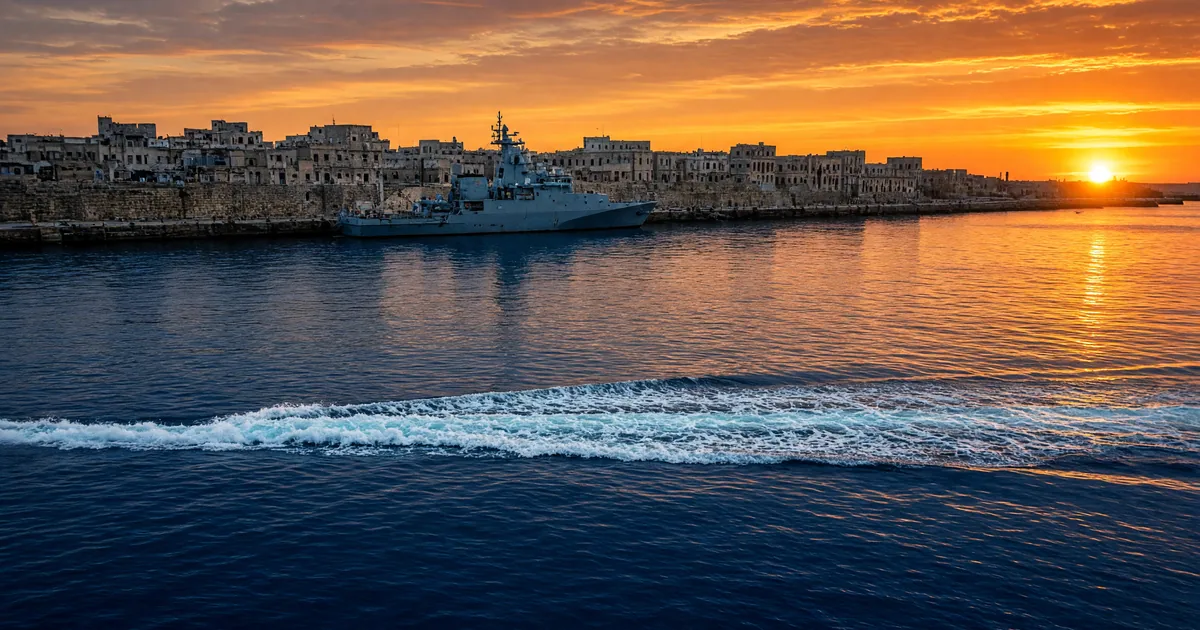
Ukraine sank a Russian corvette moored at the Benghazi naval base in eastern Libya on Sunday, and Zelenskyy confirmed it Monday as “an exemplary Ukrainian operation.” NBC, ABC and CNBC all carry his claim, the footage and Libya’s anger, and none of them tests the detail in Kyiv’s account that carries the most weight: that seven naval drones reached Benghazi by being launched from a “mother ship.” The arithmetic says that is the only way they could have, because the port sits farther from Odesa than the range Ukraine’s own security service has given for its Sea Baby drone. That matters because it decides who in Libya has to answer for the attack. The ship, the Merkury, was commissioned in 2023, and Zelenskyy called it one of Russia’s newest.
A Warship at a Quay, 1,100 Miles From Odesa
The SBU said the strike hit the Merkury and a cargo ship, the Angara, near Benghazi, that seven Ukrainian-built unmanned boats did it, and that a Ka-27 helicopter aboard the corvette went down with it. Zelenskyy posted video of drones closing on several vessels, followed by large fireballs. Independent evidence is thinner but real: satellite images credited to Vantor and distributed by AP show the Merkury at the Benghazi base on Saturday and capsized on Sunday. Libya’s eastern government, which holds Benghazi, said an explosion hit a Russian vessel docked at the base to refuel and take on supplies on its way back to Russia. The Kremlin’s spokesman, Dmitry Peskov, said Moscow had “taken note” of Zelenskyy’s statement and pointed reporters to the defense ministry, which had not commented when NBC published. None of the three reports gives a crew count or a casualty figure.
The Arithmetic Behind the Mother Ship
We measured it. Benghazi sits at about 32.12 N, 20.07 E and Odesa at 46.48 N, 30.72 E, and the great-circle distance between them, using the haversine formula and an Earth radius of 3,959 miles, comes to 1,142 miles. The front line near Kostiantynivka in Donetsk is about 1,460 miles away, which squares with NBC’s figure of some 1,500 miles from the established front lines. When the SBU unveiled its upgraded Sea Baby in October 2025, it gave the drone a range of 1,500 kilometers, about 930 miles, as AP reported in March, and ABC’s caption on the SBU footage identifies the drone hitting the Merkury as a Sea Baby. A straight line is the floor, because any real sea route from Odesa to Benghazi is longer, so a boat with a 930-mile range could not have made the trip from home.
The SBU’s own account says the boats did not make it from home. They were “transported to the designated location and launched from a mother ship,” it said. That sentence is the load-bearing one in Kyiv’s statement. In March, Russia’s Transport Ministry said the tanker Arctic Metagaz was hit by drones launched from the Libyan coast, and NBC recounts that Libyan officials said Ukrainian forces operating in western Libya struck that tanker. Kyiv has every reason to prefer the mother-ship version this time, because it keeps the operation off Libyan soil, so we treat it as a claim and not a finding. The distance lends it more support than a press statement usually earns. It is still arithmetic about range, and it says nothing about where the launching ship was or whose waters it used.
What Is Established and What Is Only Claimed
- Established by independent evidence: the Merkury was at the Benghazi base on Saturday and capsized by Sunday, Libya’s eastern government confirms an explosion aboard a docked Russian vessel, and the UN mission in Libya has called for an investigation.
- Claimed only by Ukraine: the seven drones, the mother ship, the loss of the Ka-27, that the corvette “regularly escorted enemy naval convoys,” that the Angara was hit, and that the Angara was used to move weapons.
- Not in any report we have read: a Russian defense ministry account, a crew casualty count, the mother ship’s location, or whether any Libyan force helped.
Libya Has Two Governments and Neither Wanted This
The eastern government called the strike a “serious assault on national sovereignty and a blatant violation of port security and the safety of maritime navigation,” said Libya is not a party to the war in Ukraine, and announced an investigation in coordination with Russian authorities. It has cooperation agreements and maritime facility arrangements with Russia, which is how a Russian warship came to be refueling at its quay. The UN-supported government in Tripoli, the same western Libya where Ukrainian forces reportedly operate under a deal believed to be endorsed by Kyiv’s allies, stated its “categorical rejection of turning Libya into an arena for international conflicts or a theater for external powers to settle scores.” The UN Support Mission in Libya asked for “an immediate, independent and transparent investigation” and said Libya “cannot afford, and must not become a battleground for foreign conflicts.”
A Week of Ships and a Bridge
Laid out in order, the attacks around Benghazi show how fast the war has stretched past the Black Sea:
- March 3: the Russian LNG tanker Arctic Metagaz explodes and sinks about 150 miles off Sirte, all 30 crew are rescued, and Russia blames Ukrainian sea drones.
- In the days before: damage to the Crimea bridge, which CNBC places less than a week before Benghazi.
- Saturday, November 21: a Russian-owned cargo ship, the Sparta II, is struck in the Baltic Sea. Finland’s military says Ukraine likely did it, and the vessel drifted into Finnish waters. Ukraine has not claimed it.
- Sunday, November 22: the Merkury capsizes at Benghazi.
- Monday, November 23: Zelenskyy claims the Libya strike, and Peskov calls the Baltic attack “a very dangerous trend of expanding terrorist activity in the Baltic region.”
None of this is new in kind. Drones were already sinking merchant ships off Bulgaria and Romania in October, a run that our reporting at the time tallied at 23 sailors dead or missing, when Bulgaria’s prime minister said he had no solid evidence against any party. What is new is the signature. Zelenskyy put his name on the Benghazi strike the next morning.
Who Made Benghazi a Target
We think the responsibility runs in a clear order. Russia sent a newly commissioned warship on a deployment that, by the eastern Libyan authorities’ own account, put into Benghazi to refuel and resupply on its way back to Russia. That is Moscow using a Libyan quay as a logistics stop for its navy while it prosecutes an invasion it started, under cooperation arrangements with the eastern authorities. A country defending itself from that invasion is entitled to treat the navy’s supply chain as a target, and if the SBU is right that the corvette regularly escorted convoys, the Merkury was a combatant in whatever harbor it sat. Libya’s anger is legitimate, and its statements stop short of naming Kyiv. The cause sits with the Kremlin, which turned Benghazi into a naval stop, and with the eastern authorities who agreed to the arrangements that put the Merkury there.
One question does belong to Kyiv, and the arithmetic is what raises it. If the drones came off a mother ship, then Ukraine put a naval operation into the approaches of a country that says it is not at war, and it owes the UN an answer about where that ship was.
The Investigation That Matters
Benghazi has promised an inquiry run with Moscow, which tells you what that one will find. The only inquiry that can settle the mother-ship question is the independent one the UN mission asked for, and Ukraine should welcome it, because the mother-ship account is the best defense it has and only outsiders can make it stick. Watch three things next: whether Russia’s defense ministry acknowledges the loss, which it had not done when the wires moved; whether Finland says more about the Sparta II; and whether the allies believed to have endorsed the Ukrainian presence in western Libya say what they knew.