
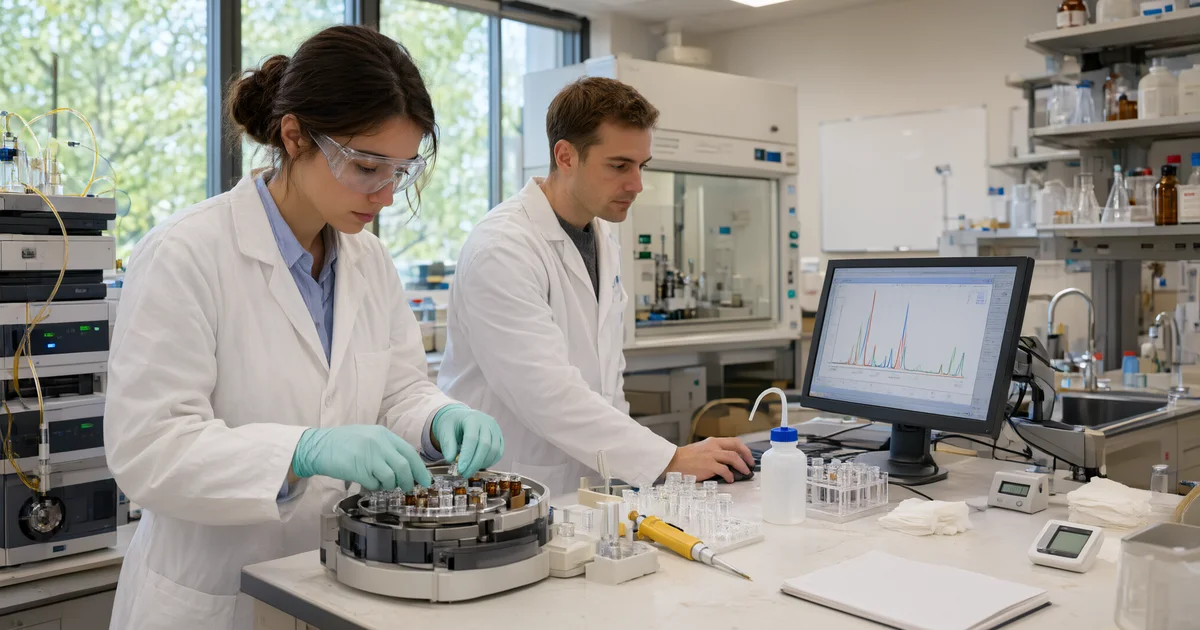
A certificate of analysis for a synthetic peptide usually reports two things: a purity figure from reverse-phase HPLC and an identity confirmation from LC-MS. Both are necessary. Neither detects a D-amino acid where an L-amino acid belongs.
The substitution does not change the molecular weight. It frequently does not change the retention time enough to resolve as a separate peak. So a peptide carrying a measurable fraction of an epimerised residue can present a clean chromatogram, a correct molecular weight, and a purity figure above ninety-eight percent, while behaving differently in an assay from the material the same supplier shipped six months earlier.
Where the inversion happens
Solid phase peptide synthesis builds the chain one residue at a time, and each cycle exposes the growing peptide to base. Fmoc deprotection with piperidine is the step most often implicated. The alpha carbon of the residue at the C-terminal end of the chain is the position at risk, because the carbonyl adjacent to it stabilises the carbanion formed when the alpha proton is abstracted. Once that proton comes off, it can return to either face.
Certain residues are more prone to this than others. Cysteine and histidine are the two most commonly cited, with aspartic acid and serine behind them. Activation chemistry matters as well: carbodiimide coupling without a suppressing additive raises the risk relative to coupling run with an additive that reduces the lifetime of the activated intermediate. Elevated temperature, extended coupling times and microwave-assisted synthesis all push in the same direction. A sequence with no at-risk residue and a conservative coupling protocol may carry no detectable epimer at all; a histidine-containing sequence run hot and fast may carry several percent.
The important consequence for a laboratory is that chiral purity is a property of the synthesis route, not of the compound. Two suppliers selling the same sequence at the same stated purity can be shipping materially different preparations, and the standard paperwork will not distinguish them.
Why the standard methods miss it
Reverse-phase HPLC separates on hydrophobicity. An L-to-D inversion at a single position changes the three-dimensional shape of a peptide but often leaves its overall hydrophobicity close to unchanged, particularly in short sequences where the conformational consequence is small. The epimer co-elutes, or elutes as a shoulder that integration software folds into the main peak.
MS analysis is worse placed still. Epimers are isobaric: identical atomic composition, identical molecular weight, identical isotope pattern. Tandem fragmentation produces the same series of fragment ions. There is no feature in a routine LC-MS identity confirmation that responds to stereochemistry at all.
This is not a criticism of either method. It is a statement about scope. A purity figure and an identity confirmation answer the questions they were designed to answer, and chiral integrity is not among them.
The methods that do detect it
Three approaches are in routine use.
Chiral amino acid analysis after hydrolysis. The peptide is hydrolysed to free amino acids, the amino acids are derivatised with a chiral reagent such as Marfey’s reagent, and the resulting diastereomers are separated on a conventional reverse-phase column. The output is a D-to-L ratio per residue. The limitation is that acid hydrolysis itself causes some racemisation, so a method blank and a correction are required, and the method reports composition rather than position.
Chiral stationary phase chromatography. A column with a chiral selector can separate intact peptide epimers directly. This preserves positional information but requires method development per sequence, and resolution is unreliable for longer peptides.
Enzymatic digestion with a stereospecific protease. Proteases cleave at L-residues and stall at D-residues, so the digest fragment pattern reports where the inversion sits. This is the most informative of the three and the least standardised.
None of these appears on a typical research-grade certificate. All three are available as add-on testing from analytical laboratories.
What a laboratory can reasonably ask for
Demanding chiral purity data on every lot of every peptide is not proportionate for most research programmes. A narrower position is defensible:
- Ask whether the sequence contains cysteine, histidine, aspartic acid or serine. If it does not, the risk is low and the question can be closed.
- Ask the supplier to state the coupling chemistry and whether synthesis is run at elevated temperature. A supplier who can answer has a documented route; one who cannot has told you something either way.
- Ask for chiral amino acid analysis on one lot as a characterisation exercise rather than a release test, and treat the result as a route-level property that holds while the route holds.
- Ask to be notified if the synthesis route changes. A route change is the event that invalidates the earlier result.
That last point carries most of the practical value. A laboratory that has characterised one lot and holds a change-notification commitment is in a far better position than one that re-tests sporadically with no reference point.
Reading it into the record
Where chiral data exist, they belong in the methods section alongside the supplier, the lot identifier and the purity figure with its method. Where they do not, the honest formulation is that chiral purity was not determined. That is a limitation, not a failure, and stating it is more useful to a reader attempting to reproduce the work than an unqualified purity claim that implies more than it establishes.
Suppliers who publish lot-specific analytical documentation make this easier, because the baseline is visible before an order is placed rather than after a result has failed to replicate. Laboratories sourcing an SS-31 research peptide or any other sequence with at-risk residues are better served by a supplier who will discuss the synthesis route than by one who will only quote a number.
The number on the certificate is true. It is just answering a different question.
For laboratory research use only. Not for human or veterinary use.