
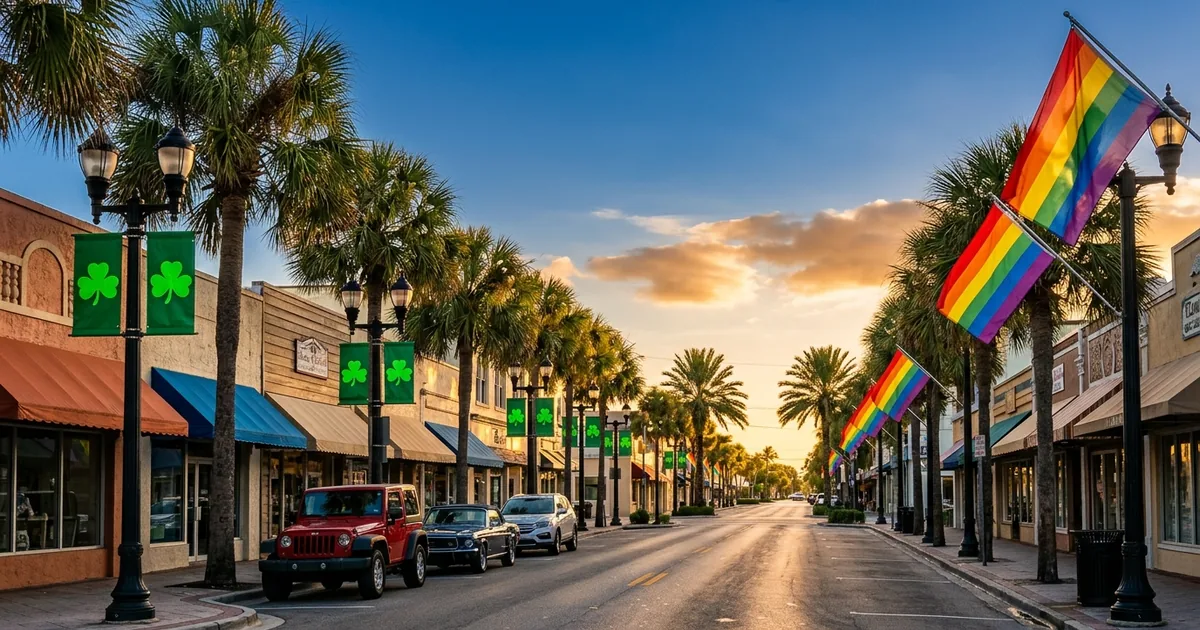
Delray Beach told residents on November 10 that a new Florida law bars the city from organizing or funding its St. Patrick’s Day parade and its Pride festival next year. The statute, Chapter 2026-43 of the Laws of Florida, does not say that. It says a city “may not fund or promote, directly or indirectly, or take any official action” relating to diversity, equity, and inclusion, defines that term to include programming “designed or implemented with reference to” ethnicity or sexual orientation, and then lists seven things a city may still do, among them issuing event permits and providing public safety services. Neither event is named on either side of that ledger. The cancellation rests on a reading of a definition, and it is a reasonable reading, which is what the law was built to produce.
What the Statute Actually Reaches
The definition is the whole fight. Under subsection (1)(b), diversity, equity, and inclusion means any effort to “promote or adopt training, programming, or activities designed or implemented with reference to race, color, sex, ethnicity, gender identity, or sexual orientation.” A Pride festival is programming built around sexual orientation, so the city’s reading of that one is hard to dispute. A St. Patrick’s Day parade fits only if “ethnicity” stretches to Irish heritage, and Mayor Tom Carney told WPTV that the city “learned very quickly that, within the scope of the definition of DEI, it could” reach both. Religion appears nowhere in the statute’s list of characteristics. In 2025 the city ran or was affiliated with 21 annual events, including Christmas tree lightings and a Menorah lighting, so the line between a religious observance and an ethnic one is now a line city staff have to draw.
The exceptions are where the Legislature showed its hand. A city may still recognize federal holidays under 5 U.S.C. 6103, patriotic observances in federal law, and “state holidays and special observances designated by state law, including those designated in chapter 683.” St. Patrick’s Day is not a federal holiday. The Legislature’s own index of chapter 683 lists Pan-American Day, Pascua Florida Day, Gasparilla Day as a legal holiday in Hillsborough County, Three Kings Day, Florida Jewish History Month, Holocaust Remembrance Day, Juneteenth, Ronald Reagan Day and Victims of Communism Day. It does not list St. Patrick’s Day, Irish heritage, or anything touching Pride. The exceptions are a list, and the two events Delray canceled are not on it.
How a Plausible Reading Became a Cancellation
The same text also shows what the law does not do. Exception seven protects “issuing event permits in a content-neutral manner and providing public safety services,” which is everything a privately run parade needs from a city except money. That is the route Carney has chosen: he said the parade was once a private event his family helped underwrite, that he reached out to about six supporters, and that people are already submitting applications to run it. On Pride he said only that if the private sector wants to support it, he would as well, and the city has announced no plan. The law moves the parade’s bill from taxpayers to donors. It does not outlaw the parade.
So why cancel at all, when a narrower reading was available? Look at who pays for being wrong. Subsection (4) says a member of a city’s governing body who violates the section “commits misfeasance or malfeasance in office,” and subsection (6) lets any resident sue the city in circuit court, where a judge may award declaratory and injunctive relief, damages and costs. At the April 22 signing, Gov. Ron DeSantis said that “when people know there’s accountability, they’re much more apt to toe the line and do what the law requires.” The accountability he described lands on commissioners personally and on the city’s budget. The Senate passed the bill 25 to 11 and the House 77 to 37, and on the evidence of the enrolled act and chapter 683’s current index, the bill’s history shows no point at which St. Patrick’s Day was added to the exceptions.
We think the cancellation is the statute doing its job. The Legislature wrote a definition wide enough to catch a parade for a saint’s day, an exceptions list that protects Gasparilla Day and Three Kings Day but not St. Patrick’s Day or Pride, and penalties that fall on individual officials and invite lawsuits from any resident. A body that wanted Delray’s parade to survive had a one-line fix available, an entry in chapter 683, and it did not write one. Officials in Delray are not hiding behind the law. They are behaving the way its sponsors said accountability would make them behave, and the result is that heritage and identity celebrations survive only where private donors step in.
The law takes effect January 1. The parade is held in March and the Pride festival in June, so the next few months will show whether private money really can replace the city’s, whether the commission says anything about Pride beyond the mayor’s maybe, and whether any resident tests subsection (6) by suing a city over a celebration. Until someone does, the broad reading is the only one with no downside for the officials who have to make the call.