
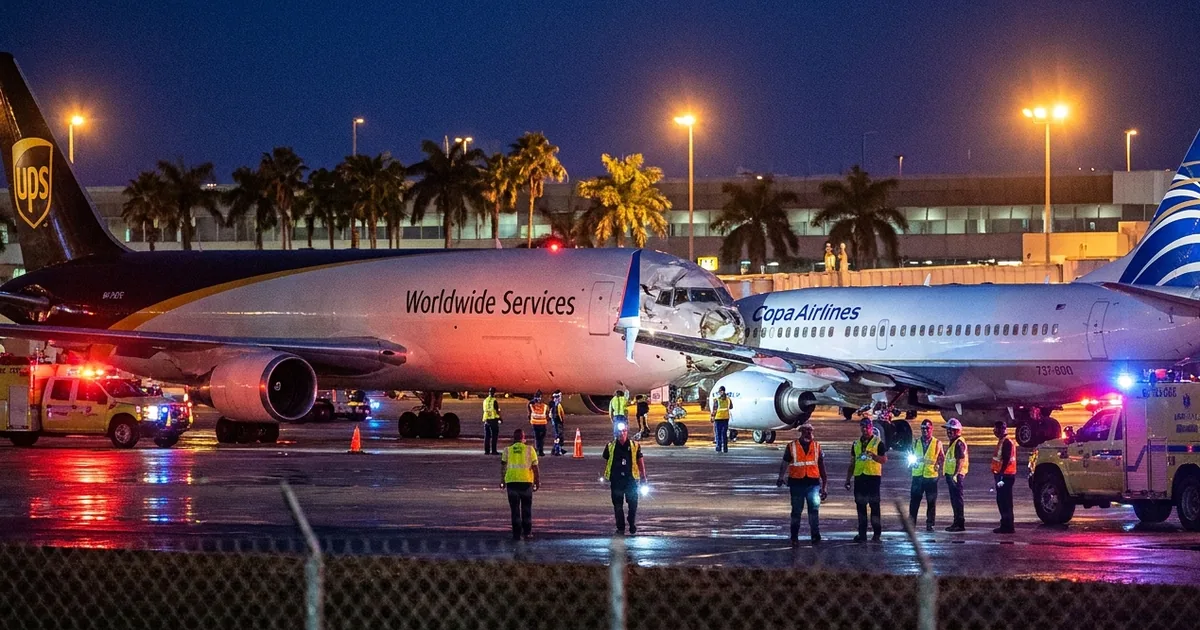
Friday’s outage is the easy story. Saturday’s cockpit audio tells a different one, and it is the second time in 69 days that a cargo 767 has been at the center of an accident at Miami International.
At about 9:15 on Saturday night, two jets converged on the same taxiway intersection at Miami International Airport. Copa Airlines Flight 427, a Boeing 737 in from Panama City with 166 passengers and six crew, was rolling to its gate. UPS Flight 358, a Boeing 767 freighter bound for Bogota, was heading out. Copa’s left wingtip met the freighter’s nose.
“Somebody hit us,” the Copa crew radioed.
“Yeah, we went too far, and then he, he clipped us with the wing,” the UPS pilot answered on the published tower audio. The controller told UPS 358 it had been “supposed to give way” to the 737. Two people were treated at the scene for minor injuries and nobody went to hospital.
Most of this morning’s coverage files the collision as a coda to Friday’s nationwide ground stop, the four-hour outage that the FAA, Transportation Secretary Sean Duffy and CBS still explain three different ways. The timing invites the link. Nothing on the record supports it: no official has tied the outage to Saturday, and the audio puts the problem inside one cockpit.
What nobody has lined up is the airport’s own autumn. Counting from the reporting on each incident:
- September 6, Miami. An Amazon-branded Boeing 767 flown by subcontractor 21 Air overran a runway and killed five people in two vehicles, one of them a van carrying an airport cleaning crew. We reported then that a 21 Air pilot’s safety complaint had sat unresolved for three years and that Runway 30 ends at a public road, not an arrestor bed.
- October 6, Los Angeles. A Delta A350 taxiing for Tokyo clipped the tail of an Air Canada 777 being towed toward its gate.
- November 14, Miami. UPS 358 and Copa 427. Sixty-nine days after the overrun, and a second cargo 767.
The detail worth watching is not the outage but a runway change. One UPS pilot said the crew was “in the middle of a checklist for a runway change.” That can mean reprogramming the flight computer while the jet is moving, precisely when FAA taxi guidance wants at least one pilot looking outside. Investigators will decide whether it mattered. It is a far more useful question than the ground stop.
The official accounts do not fully agree, either. The FAA said the 737’s wingtip “struck the nose” of the 767. Copa’s own statement describes a collision between “a cargo aircraft and the left-wing tip” of its jet. The FAA says controllers told UPS to give way; Airlive reported a hold-short instruction. That gap matters. Hold short pins an aircraft to a painted line. Give way leaves the crew to judge the clearance.
We think the FAA’s version is probably right, and the audio backs it. It is also exactly the detail an agency still answering for Friday would choose to put out first: the controllers did their job. An agency that confident should release the full tape and the exact wording, along with the time UPS 358 was handed its new runway, rather than paraphrasing them.
Miami has now been the scene of two cargo 767 accidents in ten weeks, one of them fatal. The NTSB has not finished with the first. Treating the second as an aftershock of a router failure is the convenient reading, and the evidence so far does not support it.