
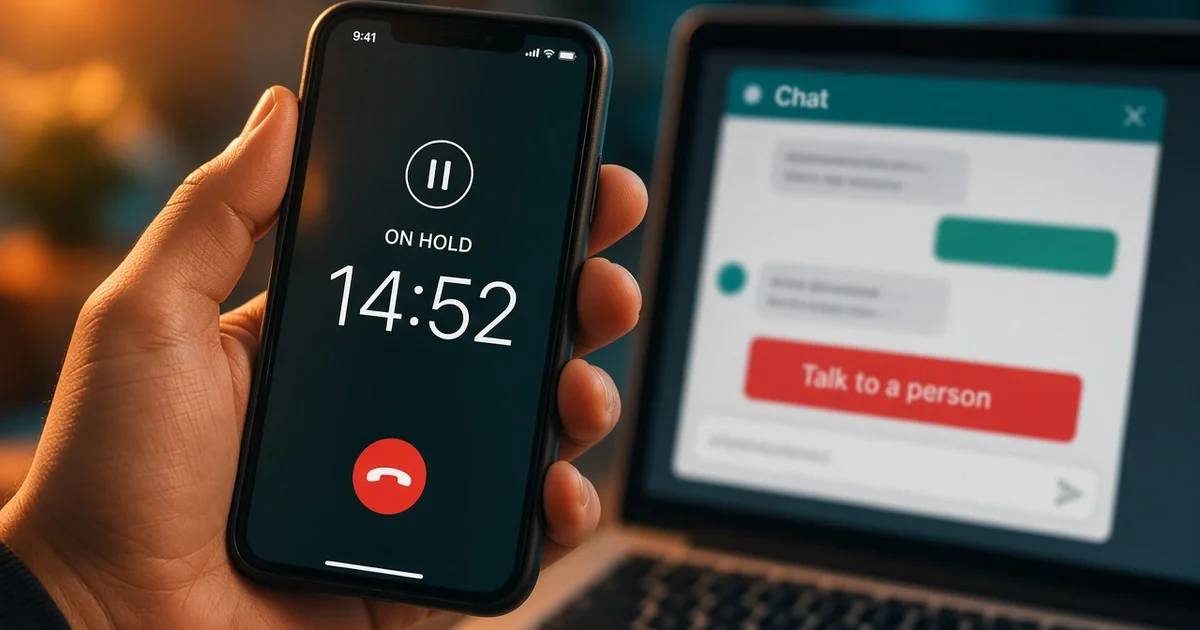
On January 1, California will require its largest companies to make a good-faith effort to put a customer through to a human within 15 minutes of asking, and nobody will be counting whether they do.
- The law: AB 1609, the Right to Human Customer Service Act, written by Assemblymember Rick Chavez Zbur and signed by Gov. Gavin Newsom on September 28.
- Who it covers: businesses with more than $500 million in annual revenue that serve California consumers.
- What it requires: human service during business hours, a 15-minute good-faith window or a scheduled appointment, and disclosure when the “agent” is a chatbot.
- Who enforces it: public prosecutors only. Customers get no new right to sue.
- What comes next: New York City has proposed its own rule, and its public hearing and comment deadline both fall on November 19.
The two measures are being covered as a pair of consumer wins against the “doom loop,” and they are. Read side by side, though, they do very different jobs. California sets a clock. New York, if its rule survives, would make companies keep the evidence that shows whether anyone met it.
What California’s AI customer service law actually says
The plain version comes from Zbur’s own announcement of the signing. Large businesses must “make a good-faith effort to connect consumers with a human representative within 15 minutes of a request, or schedule an appointment with the consumer.” They must disclose when a representative is a chatbot. Some must post customer service contact details prominently online. The law does not ban AI service at all. The bill’s sponsor was the Communications Workers of America, District 9.
Zbur’s reason is personal. During the pandemic he sat on hold for hours trying to get medication for his elderly mother, then drove to the pharmacy to show staff he was still on the line.
The detail that matters most is the phrase “good-faith effort.” PYMNTS reported that a reasonable attempt to hit the window counts as compliance even when the window is missed, with fines of up to $5,000 for a first violation and $10,000 for later ones. The California Chamber of Commerce opposed the bill, arguing that a fixed clock would push agents to rush callers off the line to reach the next one in the queue. That objection has some force. It also tells you which side expected the clock to bind.
New York City wants the logs
The proposal from New York’s Department of Consumer and Worker Protection runs twelve pages, and most coverage stopped at the press release. The rule itself sets no time limit. It does three things California does not.
First, it flips the burden. A business that serves customers only through an automated system would face a “rebuttable presumption” that it is engaged in a deceptive and unconscionable trade practice, unless it offers a way to reach a person. Second, that way has to be a “single-step transfer mechanism,” meaning one button, one voice command or one menu choice, with no extra questions and no demand that the customer justify the request. The rule’s own examples are “Say or type ‘agent'” and “Press 0,” plus an estimated wait time if there is a queue.
Third, and this is the part nobody has quoted, it requires records. Section 5-313 would make merchants keep, for at least three years and in machine-readable form, a log of every automated interaction showing how long it lasted, whether a transfer was offered, whether the customer used it, and whether they reached a person, a queue or an alternative. Once a year they would compile how many interactions were resolved without a transfer, how many involved a customer who had already contacted them in the previous 72 hours, and the average length of a conversation.
That 72-hour figure is the doom loop, counted. A customer who comes back three times in three days was not helped the first time, and a company that has to report the number cannot describe that customer as a resolved ticket.
“We are not waiting for Washington to come to the rescue of working people.”
Samuel A.A. Levine, Commissioner, NYC Department of Consumer and Worker Protection
The penalties are small. Fines start at $525 per violation, rise to $1,050 for a second and reach $3,500 for a third within two years, according to the penalty schedule attached to the rule. Each failure to keep the required records counts as its own violation, and so does each failure to disclose that a bot is answering.
The market forecast the regulator cited
Market forecasts for AI customer service are usually quoted as a reason to buy software. New York quoted one as a reason to regulate. The rule’s statement of purpose cites MarketsandMarkets’ forecast of 25.8 percent annual growth through 2030, the firm’s projection for a market it puts at $47.82 billion by then, alongside CNBC’s reporting that Salesforce cut 4,000 support roles while leaning on its own AI agents.
The city’s case rests on failure rates, not on growth. It cites Gartner’s finding that chatbots resolve between 17 percent of billing disputes and 58 percent of returns or cancellations, a Twilio survey in which 40 percent of consumers said AI repeats itself or gets stuck, and a YouGov finding that half of respondents rarely or never get a good outcome from AI-only service. Billing disputes are where money changes hands, and they are where the bots do worst.
That gap is the business problem the industry keeps describing as a handover problem. Vendors have been building the exit. Salesforce’s Agentforce can offer a person after a set time without resolution, and Zendesk now counts conversations an AI started and a human finished separately, PYMNTS reported. Building a button is easy. Proving it was offered, used and answered is the part the New York rule would make expensive to skip.
Where the rules stop
Both measures are about inbound help. New York defines customer service as a merchant’s assistance “in response to an inquiry” from a consumer about a product, an account, a refund, a bill, a cancellation or a dispute. Outbound marketing sits outside that definition.
That boundary matters as companies push automation further into the relationship. Platforms built for AI customer engagement use the same customer data to time offers, promotions and loyalty messages, and nothing in either measure governs a promotion a customer never asked for. The rules apply the moment that customer writes back with a problem.
If you are weighing which support tasks to automate first, the line both governments drew is a practical guide, and it is the same one drawn in our look at what chatbots should and should not handle.
Our view
The 15-minute clock will get the headlines, and it is the weaker half. A good-faith standard enforced only by prosecutors, with no record a regulator can pull, lets a company that misses the window explain itself after the fact. New York’s draft is the better model, because it asks companies to measure the thing customers complain about and keep the numbers for three years.
California should add a logging requirement before the first enforcement case tests what “good faith” means. Until then, the most useful thing a California caller can do on January 1 is note the time they asked for a person.
New Yorkers can comment on the city’s rule through the NYC rules website or by email until November 19, the day of the public hearing.