
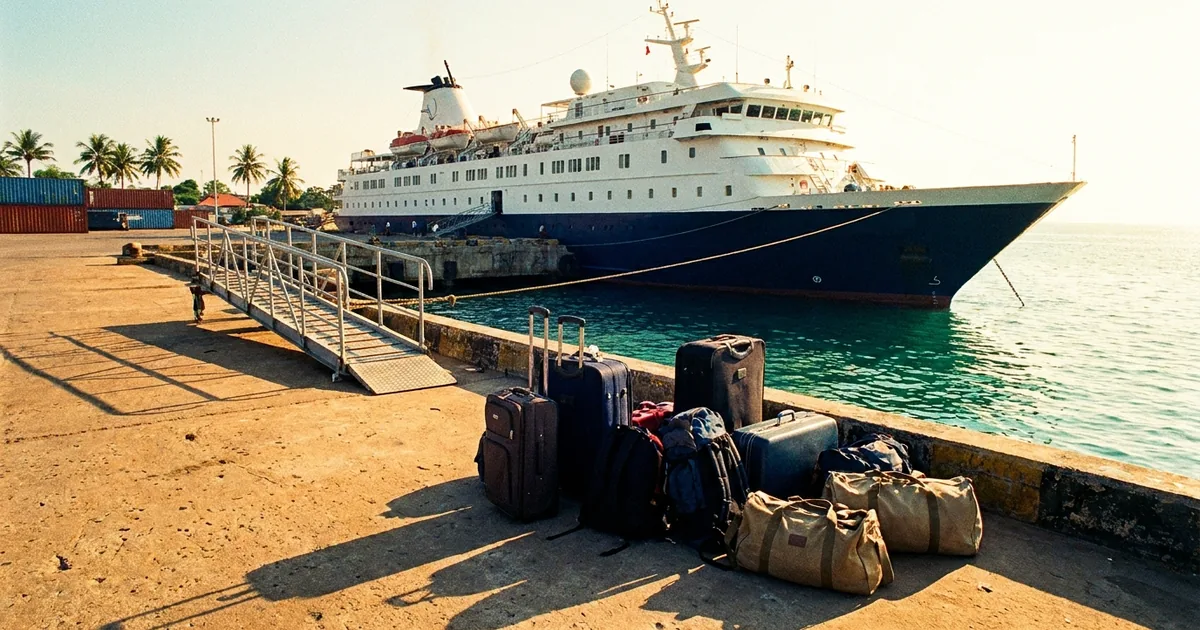
Lynn Montoya and her husband Paul sold up in Wyoming seventeen months ago and moved onto a ship. On Tuesday morning in Sihanoukville, a notice went up at 7:08 a.m. ship time telling every resident of the Villa Vie Odyssey to be off the vessel by 2 p.m. The voyage, sold as a home for the rest of your life, was suspended with immediate effect. “We were tired of every two to four weeks being asked for money for fuel, money for everything,” Lynn told the Associated Press. “We had hopes but they just kept sinking further and further into the hole through mismanagement.”
The company’s explanation is the Iran war. Fuel that used to cost about $1,800 per cabin per month now costs $6,000 to $8,000 in parts of Asia, Villa Vie Residences says, because the fighting has choked traffic through the Strait of Hormuz and squeezed petroleum supply across the region. That is true as far as it goes, and every outlet has run it. What none of them has done is put this week next to the company’s own history, which shows a business that has been asking its residents for money since before the ship ever left the dock. The war did not break Villa Vie’s model. It found a model that was already broken and leaned on it.
The Fuel Math, Done Honestly
Take the company’s figures at face value. Going from $1,800 to $6,000 a month is a 3.3-fold increase. Going to $8,000 is 4.4-fold. On 203 residents, and assuming for simplicity that each one occupies a cabin, the monthly fuel bill moves from roughly $365,000 to somewhere between $1.2 million and $1.6 million. That is a gap of $850,000 to $1.3 million a month that someone has to cover, and a company whose residents paid a one-time price for a lifetime cabin has no obvious place to find it.
That is the company’s case, and it is real. Oil passed $105 a barrel in the first weeks of the war, and marine fuel in Southeast Asia has been expensive and sometimes scarce ever since. A 33-year-old ship that burns like a 33-year-old ship was always going to feel it first.
What the Residents Actually Bought
Here is where you need to know what the product was. Villa Vie sold cabins outright, for the operating life of the ship, with permanent residency packages starting at $119,999 and suites at around $230,000, plus a monthly fee for food, housekeeping and the rest. In November 2024 the company went further and marketed a four-year “Skip Forward” package to Americans who wanted to sit out a second Trump term at sea, at $256,000 single or $320,000 double. Carol Larson, 69, paid $120,000 for hers in installments. Her sister Crystal Lavering, 72, says eighteen months aboard improved her health to the point she no longer needed a cane.
So when the fuel bill tripled, the residents were the only pocket in reach. That is why the asks came every two to four weeks. A resident posted in the ship’s Facebook group that the company needed about $360,000 to secure fuel to leave Cambodia at all, a figure that circulated among passengers and that Villa Vie has not confirmed. Another said the company had been charging $9,000 per person for a November and December segment. Those two numbers are unverified. The pattern of repeated surcharges is not, because the residents who spoke to the AP describe it the same way.
This Ship Has Been Here Before
The thing the wire story leaves out is that Villa Vie has run short of money with a shipful of residents before, and recently. The Odyssey was supposed to leave Belfast on May 30, 2024. It left on October 3, four months late, after a refit at Harland & Wolff that uncovered a cracked tank, rudder-stock problems and missing maintenance records that forced a full reclassification. For most of that summer the company paid for hotels, meals and outings for roughly 200 waiting residents, spending about $500,000. Then in September 2024, with the ship still in the yard, it told them to cover their own expenses for at least the following week. Residents were allowed into their cabins by day that summer but could not sleep in them.
Put the two episodes side by side and the pattern is the same: a capital-light company, a 1993-built vessel that had sat in a four-year layup before Villa Vie bought it, and a customer base that had already paid in full and therefore absorbed every shock. In Belfast the shock was steel. In Cambodia it is diesel. In both cases the people who paid for a home found themselves paying again to keep it moving.
Seven Hours
The notice came from chief executive Kathy Villalba, and the company’s statement says it has “been unable to continue carrying the resulting operating losses,” that “passing the full increase on to residents is not a realistic solution,” and that it will “work toward restructuring and recapitalization over the next 60 days.” It says it is “working with residents to coordinate disembarkation and identify temporary living arrangements.”
The residents describe something thinner. Randy Cassingham, who lives aboard with his wife and writes a blog about residential cruising, told the Australian Broadcasting Corporation the company did “absolutely nothing to help.” The AP’s reporting says passengers made their own arrangements for hotels and flights out of Sihanoukville. Crew, who number 156, were reported unpaid. There is no mention anywhere of refunds, and nothing in a 60-day restructuring promise obliges the company to produce any.
“You come to this ship to live. It’s just sad that it’s all over.”
That is Crystal Lavering. Her sister Carol, who lost the most money of anyone quoted, said she had no regrets because “it was a startup company, I believe that it was a risk,” and she is hoping residents can band together and buy the ship. We admire that, and we do not think it should be her job.
Where the Blame Goes
Villa Vie is right that the war in Iran set fuel prices on fire, and the Trump administration owns that war and the energy shock that came with it. Carol Larson blames the president directly and she is not wrong to. But a fuel spike is the kind of risk a company that sells lifetime homes at sea is supposed to have priced, hedged or reserved against, and the Belfast summer shows this one never had the reserves to survive a bad quarter of any kind. Asking retirees to top up the fuel tank every few weeks is not a business model. It is a float.
What should happen next is simple to state. The company owes its residents a written account of what their money bought and what, if anything, survives a restructuring, before the 60 days are up and not after. The Bahamas, whose flag the ship flies, and Florida, where the company is based, both have consumer regulators who can ask for that account if the company will not give it voluntarily. And anyone considering the next “endless cruise” pitch should read the Belfast chapter before the Cambodia one, because the second was written in the first.
What Happens to the Ship
Cambodian port officials have said the Odyssey could sail as soon as Saturday, though the company has not said where to or whether anyone will be aboard beyond a maintenance crew. Villa Vie had a second vessel, to be called Legacy, planned for 2029. For the 203 people who got seven hours’ notice on Tuesday, that plan now reads like a brochure from another company.