
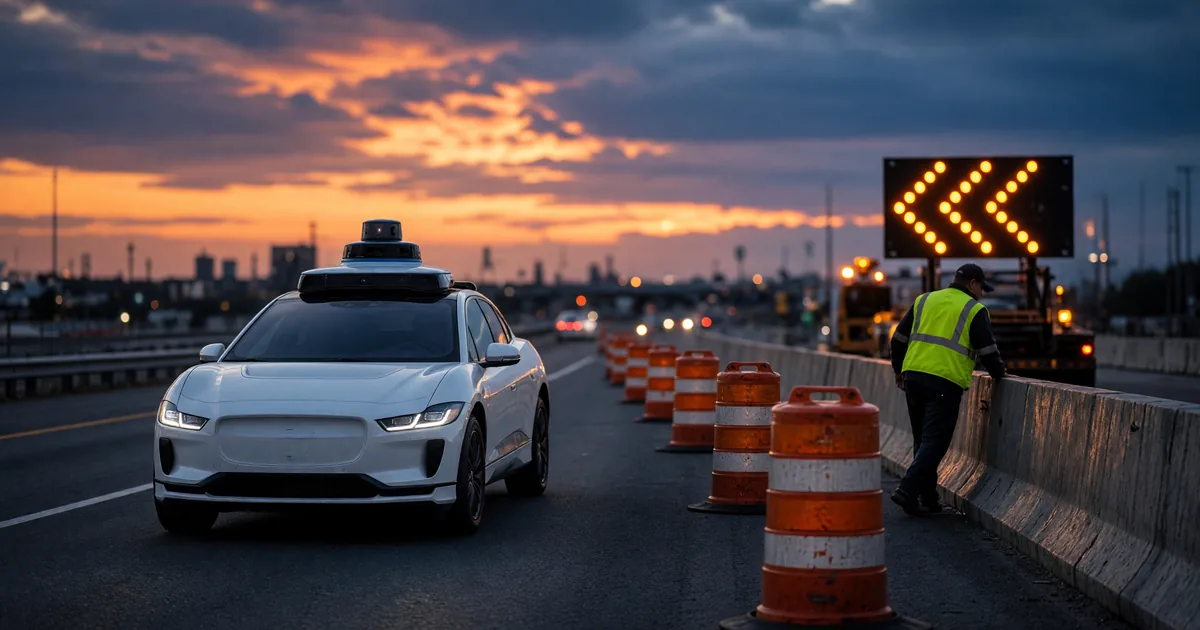
California’s Department of Motor Vehicles has barred Waymo’s driverless cars from every state freeway, and Waymo answered by pausing freeway rides in all of its markets. The DMV’s order took effect Nov. 11 and became public Tuesday. It says Waymo’s freeway operations “pose an imminent hazard to public safety” because of “recurring incursions” into active construction zones, and it cites a recent episode in which three Waymo vehicles entered a work zone on US 101 near Burlingame “despite prior restrictions and corrective actions,” as ABC reported. Waymo’s standing line, repeated Tuesday, is that the incidents CNN catalogued in June were largely isolated. For this failure, the company’s own recall filing says otherwise, and the dates show why.
We assembled them from the reporting on the DMV order and from Waymo’s recall filings, which TechCrunch summarized in June.
| When | What happened | Source |
|---|---|---|
| April | Six incidents in Phoenix where robotaxis drove into freeway sections closed for construction. Waymo’s safety committee restricts freeway driving there. | TechCrunch |
| May 18 | Seven robotaxis enter active construction lanes in the Bay Area. | TechCrunch |
| May 19 | Waymo suspends all freeway driving. | TechCrunch |
| June 8 | Waymo’s safety board decides on a voluntary software recall. | TechCrunch |
| June 18 | The recall, covering nearly 4,000 robotaxis, is reported. NHTSA filings say a fix is under development. | TechCrunch |
| Late July to early August | Freeway rides return in California and Arizona after about two months. | SFist |
| Before Nov. 11 | Three robotaxis enter an active construction zone on US 101. Separately, a Waymo tries to pass California Highway Patrol vehicles making a traffic break on I-280. | ABC, CNN |
| Nov. 11 | The DMV restriction takes effect. | CNN |
| Nov. 17 | The ban becomes public. Waymo pauses freeway rides in all markets. | CNN |
Read down the middle column and you see one failure three times in seven months, with a recall and a restart in between. TechCrunch’s account of the recall counts at least 13 incidents before it was filed, six in Phoenix and seven in the Bay Area, and describes software that either failed to recognize a closure or ranked other freeway hazards above it. That matters because of what a robotaxi fleet is. It is one driver copied thousands of times. When the software mishandles a closed ramp in Phoenix, the mistake is not one car’s. It is the same decision waiting in every vehicle running that build, which is why a recall of nearly 4,000 vehicles is the right unit for the problem and why “isolated” is the wrong word for it.
Waymo has a counter, and CNN reported it: company data says its vehicles are involved in 95 percent fewer crashes with serious injuries or worse than human drivers. It may be true. It does not answer the DMV. A regulator reading a fleet-wide average and a regulator reading a work zone with people standing in it are looking at different ends of the distribution, and the second one is the one that closes lanes.
We think the DMV acted correctly, and that the burden of proof sits where the DMV put it. Waymo restarted freeway rides in late July and early August, after the recall, and by the state’s account its vehicles were in an active work zone again before Nov. 11. The DMV says the ban stays until Waymo shows “sufficient evidence that its vehicles can safely detect and respond to construction zones.” That evidence should not stay inside a regulator’s file. Waymo should say what changed in the software between June and now, and how it tested against the two failure modes named in its own filing.
Surface streets keep running. Freeways do not, anywhere. Five of Waymo’s 13 operating areas offered freeway rides, and all five are now off the freeway.