
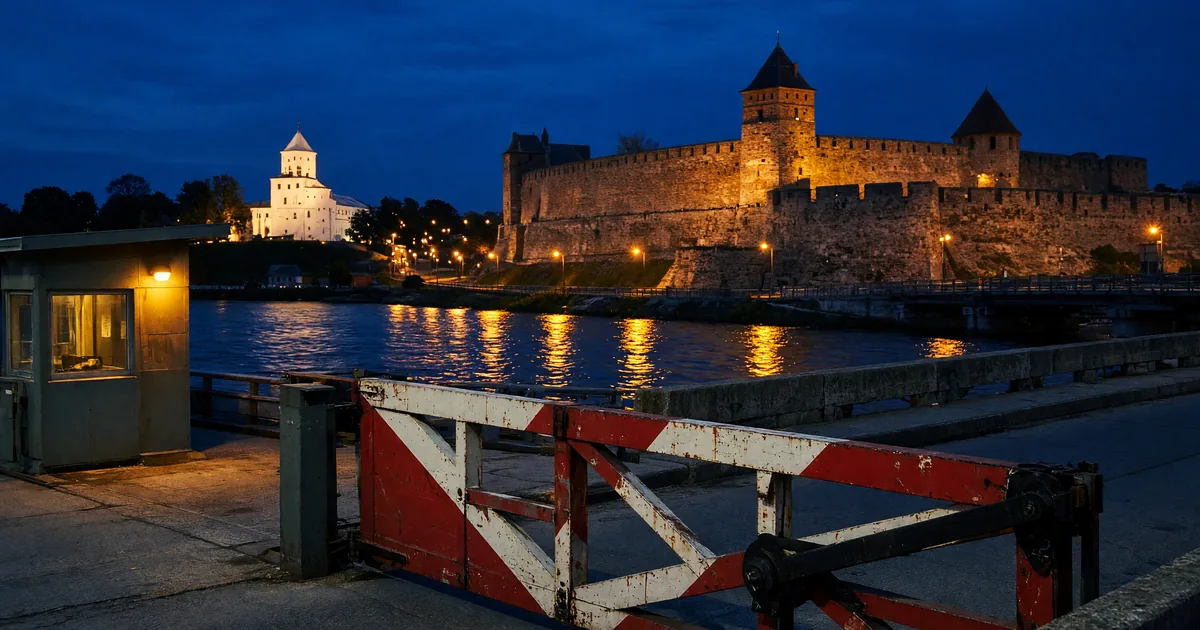
Estonia says it will close every road crossing on its border with Russia on December 1, after its security service tied a foiled arson attack on a drone maker near Tallinn to Russian military intelligence. The coverage so far treats the closure as a clean act of retaliation, and nobody has put a number on what is actually being shut: by Estonia’s own Interior Ministry count, the three crossings carried about 444,000 people in the first half of this year, roughly 2,450 a day, and the government has not said what would ever open them again.
That second gap matters more than the first. Foreign Minister Margus Tsahkna wrote that Estonia “will close all Estonian-Russian border crossing points as of 1 December,” and Prime Minister Kristen Michal called the plot a GRU-ordered “sabotage attempt” at Threod Systems, a reconnaissance and attack drone maker in Viimsi, north of the capital. Eight people living in Latvia were detained overnight on Saturday, and nobody was hurt. It was the second attempt on an Estonian defence firm since August, when Tallinn-based Milrem Robotics was targeted and Latvian nationals were also arrested. Neither Michal nor Tsahkna gave an end date, and Al Jazeera noted that the foreign minister would not say how long it would last.
The Number Nobody Ran
The Interior Ministry’s July release gives the cleanest picture of the traffic. About 444,000 people passed through Narva, Luhamaa and Koidula between January and June, down 13% from about 512,000 a year earlier, and vehicle crossings fell 20% to about 35,000. Divide 444,000 by the 181 days in that half-year and you get about 2,453 crossings a day, every day, through gates that already open only from 7 a.m. to 7 p.m. At Narva, the busiest of the three, it is all on foot, because Russia shut the Ivangorod side to cars in February 2024 and Estonia’s border guard said in September 2025 that cars would not return there until the war in Ukraine ends. The people walking across the Friendship Bridge are largely residents of a border city where Russian is the language of the street, visiting family a few hundred meters away in Ivangorod.
Then compare it with the crossing those travellers are now being pointed toward. The Barents Observer reported that Norway’s Storskog, in the Arctic far north, logged 40,395 crossings from January through October, which works out to about 133 a day across those 304 days. The periods do not match exactly, so treat the ratio as rough, but Estonia’s three gates have been moving something like eighteen times Storskog’s daily traffic. Finnish-Russian dual citizens already rerouted through Narva after Finland closed its own land border in late 2023. When Narva goes, there is no Nordic or Baltic substitute of anything like the same size, and a trip to see a parent in Pskov or St. Petersburg becomes a flight through a third country or a long drive north of the Arctic Circle.
The Closure Is Right. The Missing Exit Is the Problem.
We think Estonia is right to do this, and we would say so plainly. A foreign intelligence service that hires couriers to burn down a drone factory inside a NATO member is running a campaign, not testing a theory, and the Russian buildup of barracks for 115,000 troops along the Estonian and Finnish frontier is the backdrop that makes every one of these plots look like preparation. Moscow’s answer, through foreign ministry spokeswoman Maria Zakharova, was to call the plan “yet another bout of aggressive and unbridled Russophobia” while promising to “verify” the claims, which is the same denial-plus-insult reflex the Kremlin has used on sabotage accusations across Europe. Closing the crossings also squeezes the sanctions-evasion traffic that Tsahkna named directly, and it costs Russia the propaganda value of an open European door. None of that is in serious dispute.
What Tallinn has not done is say what Russia would have to stop doing for the gates to reopen, and that is a choice with a long tail. In July, Interior Minister Igor Taro said a full closure would need a serious need confirmed by a threat assessment, and added, “We don’t have it at the moment.” Four months later the GRU supplied one. ERR reported that the cabinet will still decide whether the closure is temporary or indefinite, and Taro’s only practical guidance so far is that residents and truck drivers in Russia have two weeks to come home, after which “the journey home could become long and complicated.” Finland called its closure temporary in 2023, has never set a reopening date, and is now debating an extension of the law behind it to the end of 2028. A border that closes on a specific attack and reopens on nothing becomes permanent by drift, and the people who pay are Estonian residents in Narva, not the officers in Moscow who ordered the fire.
The fix is not to keep the gates open. It is to put the condition in writing when the cabinet votes: a named review date tied to the security service’s threat assessment, and a narrow humanitarian crossing for funerals, medical care and divided families that runs under the same checks the border guard already uses. Estonia can make Russia pay for the GRU’s choices without making the residents of Narva pay for them indefinitely.
What Readers Are Asking
When does the Estonia-Russia border close?
The foreign ministry says all road crossings close on December 1. The cabinet still has to formalize the decision and set whether the closure is temporary or indefinite.
Which crossings are affected?
All three open road crossings: Narva in the north-east, and Luhamaa and Koidula in the south-east. Narva has been pedestrian-only since February 2024. Officials have not said what happens to the rail links at Narva and Koidula.
What should Estonian residents in Russia do now?
Interior Minister Igor Taro said residents and truck drivers currently in Russia can return over the next two weeks, and warned that the trip home could become long and complicated after that.
Whether the Friendship Bridge reopens in a year or in a decade now depends less on Moscow than on a sentence the Estonian cabinet has not written yet.