
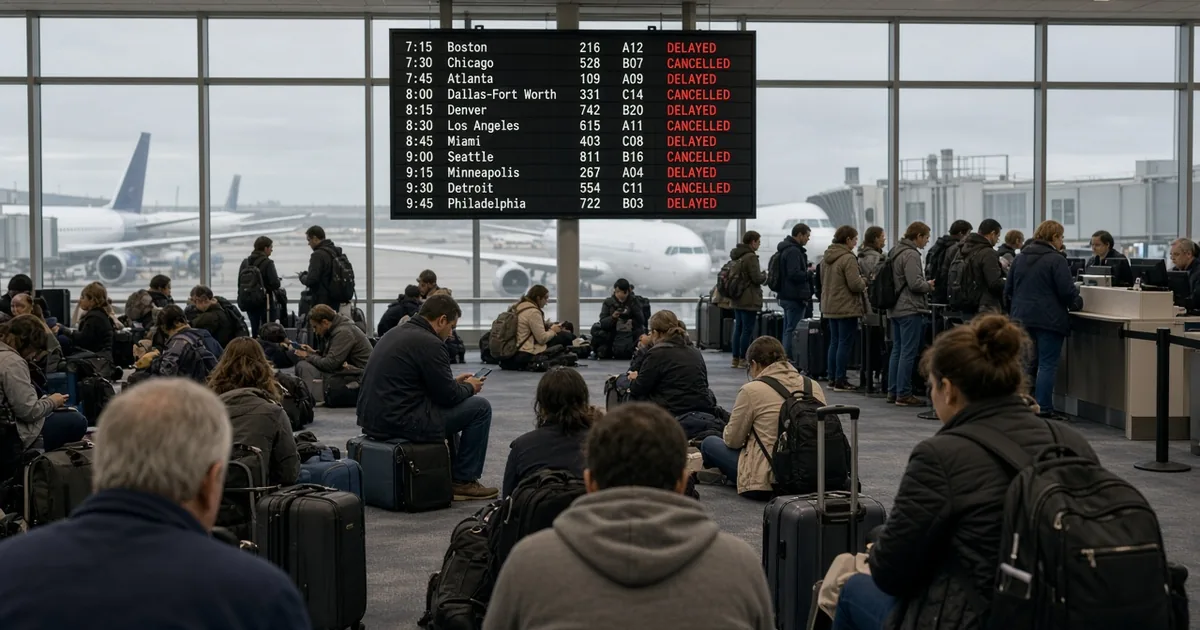
The FAA stopped every departing flight in the country for four hours and 21 minutes on Friday, and by Saturday morning nobody in government had given the same explanation twice. Here is what is established:
- The stop ran from 3:54 p.m. to 8:15 p.m. Eastern on November 13, after communications failed at multiple Air Route Traffic Control Centers, the facilities that handle planes at cruising altitude.
- Nearly 8,000 flights were cancelled and more than 10,000 delayed on Friday, cargo included, and cancellations ran into the weekend, with more than 2,000 still scrapped on Saturday.
- It was the first nationwide ground stop since January 2023, when a corrupted file took down the FAA’s NOTAM system.
- Officials from several agencies say there is no sign of a cyberattack.
That last point is the only one every account agrees on. Everything else about Friday depends on who is talking, and the gap between those accounts is the story nobody has lined up yet.
Three Explanations for One Outage
Start with the FAA’s own statement, which is the narrowest. It describes a telecommunications problem affecting several en route centers and says technicians are investigating. It names no system, no vendor and no cause. That is how an agency writes when it does not yet know, or when it knows and is not ready to say.
Transportation Secretary Sean Duffy went further within hours. He told reporters that outdated communications equipment was hit with “overloaded data, and they went down,” and he described radar communications instability beginning a little after 3:30 p.m. That is an aging-hardware story, and it is the one Duffy has told since he took the job: the system is old, Congress must pay to replace it, and outages are what deferred maintenance looks like.
Then there is the account that cuts against his. CBS News reported, citing multiple sources, that an update pushed to the private network linking the country’s air traffic facilities forced the system to reboot, and the reboot crashed it. That network is run by L3Harris Technologies under contract. No other outlet has matched the report and the FAA has not confirmed it, so it stands as unconfirmed. But notice what it would mean if it holds. A software update is not old equipment wearing out. It is a change somebody made, on a day somebody chose, to a system somebody was paid to run.
Layered on top is a third thread. The FAA said the affected communications system had been running first in the Washington, D.C., area and was being expanded to all 22 en route centers. The company behind that system says its software did not cause the stop. Homeland Security Secretary Markwayne Mullin said the investigation would determine whether it played any role.
So on Saturday we have an agency saying “telecommunications,” a secretary saying “old and overloaded,” a single-outlet report saying “a botched update,” and a rollout to 22 centers that its own vendor insists is not involved. Those are not four descriptions of the same thing. At most one of the last three can be the main cause.
We think the honest reading is this: the people with the most political interest in a particular answer reached for it fastest. Duffy’s explanation arrived before the investigation he says is underway could have produced anything, and it happens to match the funding pitch he has made all year. That does not make it wrong. It makes it premature, and the public is owed the difference.
What the record does show is how thin the margin is. In 2023 one corrupted file was enough. On Friday a communications fault at the centers was enough. Neither time did the system degrade gracefully, with some regions slowing while others carried on. It went from working to a full national stop, and the recovery lasted far longer than the outage itself. Planes and crews ended Friday night out of position, and Saturday’s cancellations were the hangover.
The question for the investigation is simple to state. Did Friday’s failure come from equipment that broke on its own, or from a change someone made to it? The answer decides whether the fix is a budget line or an accountability process. Right now the government is pre-selling the budget line.