
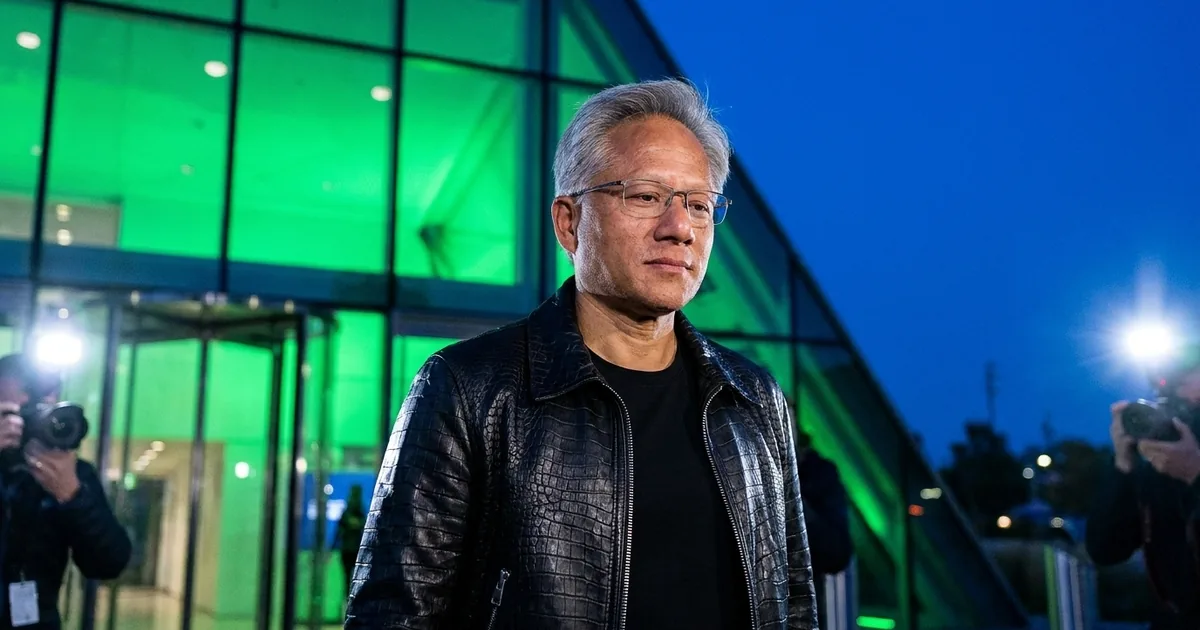
“The Board has full confidence in Colette and the leadership team…”
Harvey C. Jones, named Nvidia’s first-ever board chair, November 12, 2026
The filing hit the SEC’s EDGAR system Thursday morning with one signature under three titles: Colette M. Kress, interim chief executive officer, executive vice president and chief financial officer. Jensen Huang, who co-founded Nvidia in 1993 and ran it for every one of the 33 years since, is out.
It took the board three days to get from standing behind him to showing him the door. On Sunday it opened an independent investigation into whether Huang had been “the target of a foreign intelligence effort” and left him in charge while it ran. On Wednesday, Nvidia’s 8-K says, the board “accepted the resignation of Jen-Hsun Huang” as president, CEO and director, effective immediately.
Most coverage stops at the resignation and the interim name. The filing is more revealing in what it leaves out, and in who it puts in charge. Set it against what has been reported and the gap is plain:
What Nvidia filed
The board “accepted the resignation” on Wednesday, November 11.
No reason appears anywhere in the 8-K or the attached press release.
No severance, separation agreement or other pay arrangement is disclosed.
Kress becomes interim CEO and keeps the CFO job.
Harvey C. Jones, 73, a director since 1993, becomes the first chair in company history.
What has been reported
The board ousted him, after two reported affairs.
One was with Alice Huang, a former Megaspeed executive U.S. officials suspect of working for Chinese intelligence. Beijing calls that a smear.
The other, reported by the New York Times, involved an executive who reported to him. Nvidia has not confirmed it.
The foreign-intelligence investigation has not reported any findings.
Shares fell about 10 percent before Thursday’s opening bell.
“Resigned” and “ousted” are different words, and the difference usually ends up in a separation agreement. Item 5.02 of a Form 8-K is where a company reports a new pay arrangement with a departing executive officer. Nvidia’s says nothing about one. If terms exist or get signed later, shareholders should expect to see them.
Huang leaves the boardroom without leaving the shareholder register. Nvidia’s 2026 proxy statement listed him with 870,604,104 shares as of March 23, or 3.58 percent of the company. At that count, every dollar the stock moves is worth roughly $871 million to him, up or down. The holding has shrunk somewhat since he resumed planned share sales in October, but the man the board just pushed out still has as much riding on its next move as almost anyone.
The chair is where the board’s choice says the most. The same proxy names Stephen C. Neal, the former Cooley chairman who joined in 2019, as lead independent director, the job boards create to give outside directors a counterweight when a founder runs both the company and, in practice, the room. Neal did not get the new chair. Jones did. Jones joined Nvidia’s board in 1993, the year the company was founded. So did Tench Coxe, and Mark Stevens first joined that year too. A board looking for distance from 33 years of one man’s rule handed the gavel to one of the three people in the room who sat through nearly all of it.
Then there is Kress. She is 59, has been CFO since 2013, and knows Nvidia’s numbers better than anyone left in the building. She is also about to vouch for them twice. Nvidia reports third-quarter results on Tuesday, November 17. In August the company filed its quarterly report the same day it released results, and that report’s Sarbanes-Oxley certifications were signed by Huang as principal executive officer and by Kress as principal financial officer. The law requires both. Unless Nvidia names someone else to one of those posts before Tuesday, the executive attesting that the finance chief’s numbers are right will be the finance chief. That is legal, and small companies do it all the time. Nvidia is no small company, and it already faces a securities lawsuit alleging it kept investors in the dark about Huang’s relationship with Alice Huang. This is an odd week to merge the two signatures.
We think the board did the minimum the moment demanded and called it a transition. When we wrote Wednesday night that an 8-K would be the first confirmed word, the open question was whether the independent directors would act. They did, and then reached for the most familiar faces available. Nvidia should name a separate principal financial officer, even an interim one, before Tuesday’s numbers go out. It should explain why its first chair is a director from the founding year rather than the independent lead director it already had. And it should publish what its investigation finds, because the foreign-intelligence question did not resign along with Huang. The Justice Department is separately examining Megaspeed over possible violations of U.S. export controls on AI chips, two law enforcement sources told CBS News. A company whose chips Washington treats as strategic assets does not get to close that file with a press release thanking the departing CEO for his “immeasurable contributions.”
Tuesday’s earnings call will be the first in Nvidia’s public life held without Jensen Huang as chief executive. The question worth listening for is who answers when an analyst asks about China.