
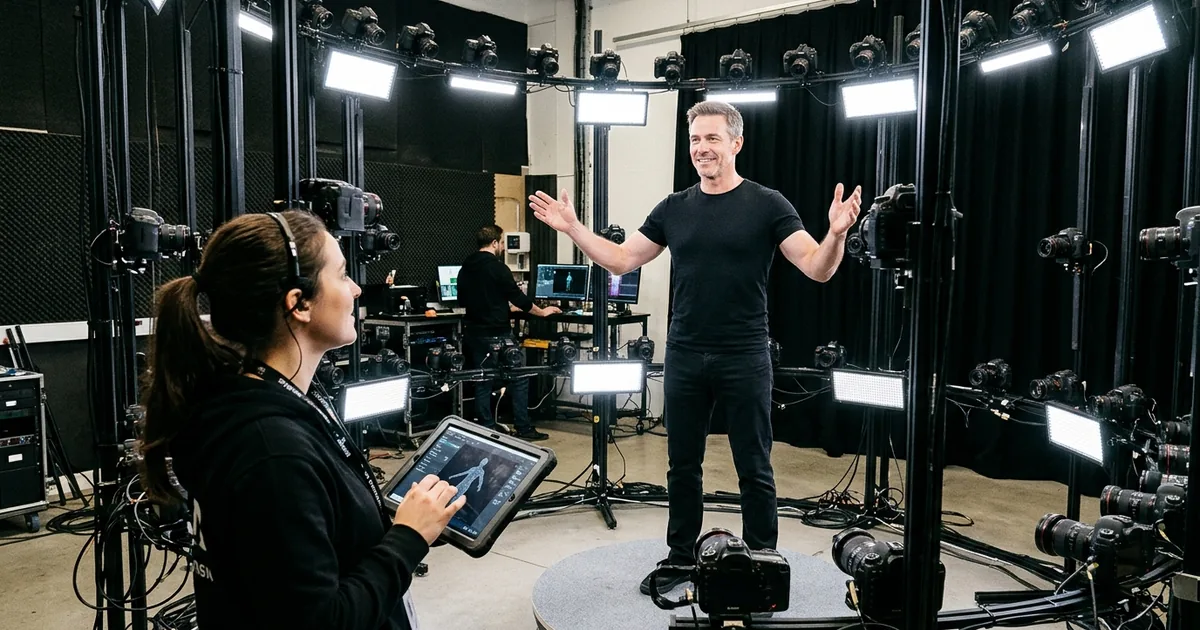
Ogilvy and Creative Artists Agency launched a system on November 9 that turns a celebrity’s scanned body, face and voice into AI-generated ads. The platform is called ECHO. It runs on the CAA Vault, a scanning studio Veritone built for the talent agency that captures a performer with 204 cameras, from facial expressions to the way they walk, Digiday reported. Ogilvy, part of WPP, says one production shoot that normally yields eight to ten finished ads can now yield 30 to 50. It says the cost of each ad falls by up to 65% to 75%. Terry Crews, the Brooklyn Nine-Nine actor and a CAA client, is among the first to opt in.
The company is selling it as safety. Ogilvy calls ECHO “consent-first” and an “enterprise trust and governance framework.” Every asset needs the star’s sign-off through an approval portal before release. Each one carries a label reading “[Talent Name] Approved | Recreated with AI.” Training uses only scans stored in the CAA Vault. CAA’s Alex Shannon said the Vault exists so that “talent owns, controls, and can safely monetize their digital likeness.” Ogilvy’s global chief innovation officer, Carol Reed, called this the “NIL moment” between advertising and entertainment, borrowing the college-sports phrase for name, image and likeness pay. Pilots are being negotiated now and should go live around the end of the year.
We read Ogilvy’s full launch announcement and checked it against the rules that already govern digital replicas in American advertising. The announcement is detailed about consent and silent about money. Here is what it covers and what it leaves out:
- Covered: approval. Talent signs off on every asset, through a dedicated portal, before publication. Reed told Digiday that “talent always gets to see everything and approve everything at the end.”
- Covered: labeling. Consumer-facing ads carry the “Approved | Recreated with AI” mark.
- Covered: data source. Models train only on Vault scans, and CAA says talent owns the likeness.
- Not covered: pay per asset. The release refers to “machine-readable talent usage terms” without saying what any of them are, and gives no fee, rate or revenue split. Digiday reported that talent and clients will negotiate as usual.
- Not covered: how long a license lasts. The only time span in the coverage, three to five years, is how often CAA clients refresh their scans. It is not a license term.
- Not covered: revocation. Nothing says what happens to a trained model when a star leaves CAA, drops a brand or dies.
- Not covered: unions. The release does not mention SAG-AFTRA, which represents most of the performers CAA would scan.
- Not covered: law. It cites no statute, though California already regulates these contracts.
That gap matters because consent is the floor in this market, and it was already the floor before ECHO existed. The 2025 SAG-AFTRA Commercials Contracts, in effect since April 1, 2025, require clear written consent before a producer creates or uses a performer’s digital replica. They also require additional pay: using a replica to generate a new performance triggers 1.5 times the session fee plus holding and use fees. California’s AB 2602, in force since January 1, 2025, makes a digital-replica contract term unenforceable unless it describes the intended uses reasonably specifically and the performer had a lawyer or union representing them. Federally there is still nothing. The NO FAKES Act cleared the Senate Judiciary Committee in June, then stalled when Sen. Ted Cruz objected to passing it by unanimous consent on September 30. So a platform that leads with consent is promising the part the union and California already demand. The part nobody has to promise yet is the rate.
Who the Math Serves
Run Ogilvy’s own numbers and the incentive becomes plain. Take a shoot that today produces ten ads. Under ECHO the same shoot produces 30 to 50. If each ad costs 65% to 75% less, the brand’s total spend on that campaign lands roughly where it was, or rises a little, while the output triples or quintuples. At the low end, 30 ads at 35% of the old per-ad cost is about 10.5 old ads’ worth of spending. At the high end, 50 ads at 25% of the cost is 12.5. Those are our calculations from the figures Ogilvy published, and they show where the savings go. The brand gets three to five times the material for about the same budget. The agency gets a proprietary platform it can sell across WPP. CAA gets a licensing business on top of its commissions. The talent gets whatever it negotiates, on terms the launch did not disclose.
That is the framing to watch. “Consent-first” puts the question on whether the star said yes, which is easy to answer and already settled by contract and state law. It moves attention away from what the star is paid for each additional ad their face appears in. That question decides whether this is a new revenue stream for performers or a way to stretch one day rate across fifty ads. A celebrity with CAA’s leverage may negotiate per-asset fees that make ECHO lucrative. The actor two tiers down, the one booked for regional spots, has less leverage, and the template set at the top tends to become the default for everyone below it. Gartner analyst Nicole Greene told Digiday the approach could “fundamentally change celebrity endorsement economics.” She is right, and the economics are exactly what the announcement left blank.
The public is not sold either. Digiday cited YouGov data showing 49% of Britons view AI-generated actors in ads negatively, and a study DoubleVerify cited found 92% said AI content makes online information harder to trust. Ogilvy’s own survey of more than 1,200 people in the US, UK and India found talent approval made ads more reassuring for 43% of Americans. That leaves most Americans unmoved by the approval label. It is the label Ogilvy is betting the product on. The European Union has required labels on generative AI content since August, so the watermark is partly compliance as well.
We have covered this ground before, when Meta’s Muse tool turned public Instagram photos into raw material for anyone’s AI image. ECHO is the opposite end of that spectrum: licensed, labeled, approved. That is better, and Ogilvy and CAA deserve credit for building approval and labeling into the product rather than bolting them on. But better than a free-for-all is a low bar. Our view is simple. Any platform that multiplies a performer’s output from one shoot should publish its per-asset pay floor and its license terms the way it published its cost savings. Until it does, “consent-first” describes the paperwork, not the deal.
The first ECHO campaigns are due around the end of the year. When they run, the useful question for every star in them is the same one the launch skipped: how many ads came out of that one shoot, and what were you paid for each of them?