
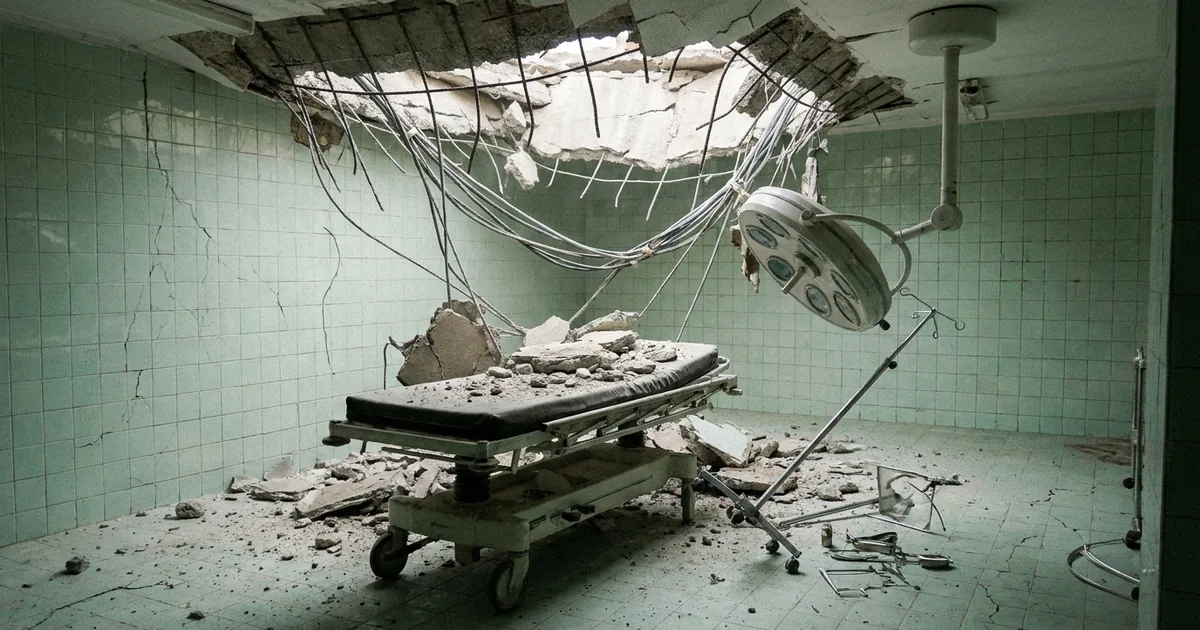
An Israeli missile hit the surgical wing of Nasser Hospital in Khan Younis early Thursday and killed at least six people, including the surgeon Rizk Abu Shaira, 13 months into a ceasefire during which Israeli strikes and gunfire have killed 1,622 people in Gaza, health authorities say.
Most of this morning’s coverage is built on two competing claims: the Israeli military says Hamas ran a headquarters inside the hospital, and Hamas calls the strike a war crime. What the coverage leaves out are the two records that either claim has to be weighed against, which are the ceasefire’s own body count and what Israel has said before about hitting this same hospital.
Start with the count, and read it with its caveats. The 1,622 figure comes from Gaza’s health authorities, part of the Hamas-run government, though the UN considers its figures reliable. Israel says four of its soldiers have been killed over the same stretch; NPR counts five. Spread 1,622 deaths across roughly 13 months and you get about four people a day. Set the same deaths against four soldiers and it comes to about 405 Gaza deaths for each one; use five and it is about 324. Those ratios are our arithmetic from published tallies, and they compare unlike things, soldiers on one side and everyone killed on the other, whatever their role. Treat them as a measure of how lopsided the violence under the truce has been, not as a count of anything else.
The strike itself is not in dispute. Eyewitnesses told the BBC that a single missile fired from a warplane hit the building holding the surgical wards and intensive care units, and Civil Defence spokesman Mahmoud Basal said it struck the surgery department on the second floor of the Al Yasin building. The health ministry said medical staff, patients and companions died. At least a dozen people were wounded, and Civil Defence puts the figure near 20. Debris lay across hospital beds and equipment, and rebar hung from the ceiling where the munition came through. NBC reports that Abu Shaira appeared in the 2026 documentary American Doctor, which followed three American doctors providing care in Gaza.
Nasser is no ordinary target. It is one of the few functioning medical facilities left in Gaza, and the WHO data NBC cites shows why: two of the territory’s 37 hospitals fully functioning, 18 partly functioning, 17 not at all.
What Israel Has Said, and What It Has Shown
Here is how to weigh the military’s account. It says it was targeting a senior Hamas figure and other fighters, that Hamas had “established a presence within the hospital complex,” and that the commander had turned it “into a headquarters.” It published graphics and photographs it says show weapons at the site, and it says it used “precision munitions and aerial surveillance” to limit harm to civilians, but it offered no evidence for its claim about the commander. Hamas calls the allegations “lies of the criminal enemy.” No one outside can test either side, because Israel does not let international news organisations, the BBC among them, into Gaza.
The target’s name is where the published accounts stop agreeing. In a later statement the military identified him as Muhammad Abu Ismail, commander of Hamas’s Khan Younis Brigade. Ynet, citing Israeli security officials, names Khaled Abu Anza as that brigade’s commander and says the military was still assessing whether the attempt had succeeded. We could not reconcile the two names from what has been published, and we found no confirmation from Israel that its target was inside the building or was killed. A strike justified by one man should come with that man’s name, and this one does not yet.
Israel has been here before. In August 2025 a double strike on Nasser killed at least 20 people, among them five journalists, including AP contributor Mariam Dagga. Prime Minister Netanyahu called it a “tragic mishap,” and the findings of the military’s inquiry have still not been released.
Hospitals are protected under international humanitarian law and lose that protection only if they are used for military purposes. That puts the burden of proof on the party that fired. On what has been published so far, we think that burden has not been met, and an unreleased inquiry into the last strike is not a record that earns the benefit of the doubt.
The ceasefire’s design explains why this keeps happening. When the disarmament phase was announced, LNC reported that the document contains no clause requiring Israel to stop firing while Hamas works through a disarmament schedule expected to run 200 to 300 days. Israel says it will stop only once Hamas is demilitarised; Hamas says it will disarm only if Israel stops and withdraws. Each side’s condition is the other’s precondition, and the people in the surgical wing were party to neither.
Washington brokered the truce, and the Trump-backed Board of Peace has already criticised Israel for not meeting its commitments. The administration should say on the record whether a missile through an operating surgical wing is a violation of the ceasefire it brokered. Israel should publish what it says it found in that building before anyone is asked to credit its next claim.
Two things are worth watching over the next day or two: whether Israel confirms that its target was in the building and dead, and whether anyone with authority over the truce uses the word violation. If both stay silent, that is an answer too.