
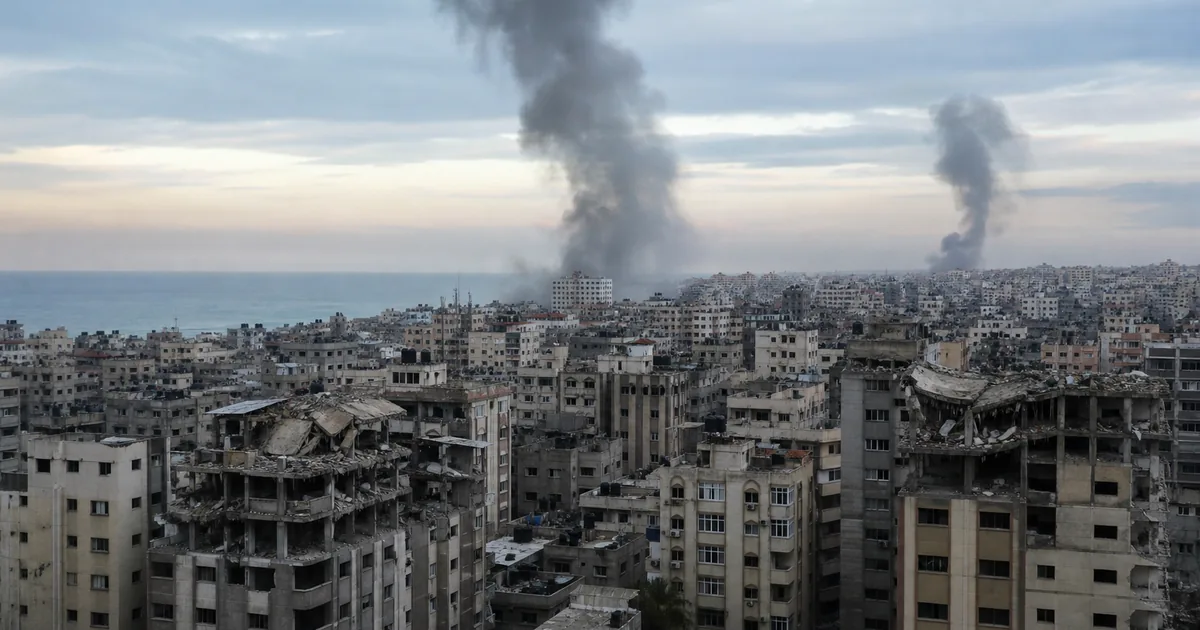
Israeli warplanes hit Gaza City, Deir al-Balah and Khan Younis from dawn on Sunday, killing at least 13 Palestinians in what Palestinian health officials called the deadliest single day in weeks.
Nearly every headline framed that as killing which happened despite the disarmament agreement President Trump announced on Thursday, and the framing is the part worth correcting: the agreement contains no ceasefire clause, and nobody involved in writing it has claimed otherwise.
What the Agreement Actually Commits Anyone To
The deal announced by the Gaza Board of Peace, brokered by Egypt, Qatar, Turkey and the United States, is a weapons-handover schedule. Hamas and other armed groups get 14 days to prepare a full weapons inventory, with extensions available from an international verification commission. A Palestinian National Committee of technocrats, explicitly excluding Hamas, becomes the sole body permitted to hold those weapons, and nothing may be transferred to Israel or to any non-Palestinian party. Heavy weaponry, military production sites, depots and tunnel networks go first.
Then comes the number that should have led the coverage. According to Al Jazeera’s breakdown of the agreement’s terms, full disarmament is expected to take 200 to 300 days, and the process only starts once the National Committee can physically enter Gaza and an international stabilization force of roughly 5,000 personnel deploys under a US general. Israeli withdrawal is phased against that sequence, not against a calendar.
Read the document for what it is and the last three days stop looking like a paradox. Nothing in it requires Israel to stop firing while the clock runs.
“No Deal to Halt Attacks”
That is not an inference. It is the stated position of the Israeli government, delivered plainly and on the record.
Energy Minister Eli Cohen, who sits on Prime Minister Netanyahu’s security cabinet, told Israel’s Army Radio on Sunday there was no deal to halt attacks on Gaza. He said the government would give Hamas the opportunity to disarm but that he was “very sceptical” it would, predicting instead that Hamas would play games and hide its weaponry. “In the deal we signed with the United States, our stance is that Hamas must be dismantled. This is the first thing that must happen,” Cohen said. He added that Israel, which already controls roughly 70% of the enclave, would need to take full control of it if disarmament did not happen. A separate Israeli official told Reuters there would be no withdrawal from current military positions absent “genuine disarmament.”
Hamas has staked out the mirror image. Ghazi Hamad said the group “will not implement any step of the Gaza peace deal if the Israeli occupation forces do not fulfil their obligations,” and that “Israel will not interfere in the disarmament issue.”
Both parties have now publicly conditioned their own compliance on the other side moving first, a familiar shape to anyone who watched the October 2025 ceasefire get signed and then spend the following months not holding. Local health authorities count more than 1,222 Palestinians killed and over 4,053 injured since that ceasefire took effect.
The Sequencing Is the Story
Here is the structural why, and it is not complicated once the timeline is laid next to the leverage.
Disarmament is front-loaded, itemized and externally verified. Withdrawal is back-loaded, phased and discretionary. One side is asked to surrender its weapons on a 200-to-300-day schedule that begins with the heavy equipment, subject to inspection by a commission it does not control. The other side is asked to pull back from territory it currently occupies, at a pace it sets, judged by a standard it also gets to evaluate.
That asymmetry is the entire engine of what happened this weekend. The party holding 70% of the ground carries no obligation to stop shooting during the nine or ten months it takes the other party to disarm, and it has an active incentive not to, because every strike that degrades Hamas capacity moves toward the outcome Cohen described as the government’s real objective. Dismantlement, not disarmament. Those are different words, and Israel’s security cabinet has been using the first one.
An agreement built this way does not fail when the strikes continue. It runs as written.
Three Tallies, Three Numbers
Worth flagging for anyone tracking the toll: Sunday’s figures moved all day and still do not agree, because the outlets are counting different windows.
Reuters-sourced wire copy climbed from nine killed to 13 to 15 across the afternoon as strikes continued and hospitals reported in. Al Jazeera counted 11 killed on Sunday and 21 across the three days since the announcement. The BBC reported at least 13. These are unsettled rather than contradictory, which is ordinary for a day still in progress when the copy files, and every revision so far has moved upward.
The named dead include Abdullah Abu Taif, 33, Abeer Anan, 29, and five-year-old Azzam. Strikes hit the Al-Sousi Tower in western Gaza City, Al-Qarara northwest of Khan Younis, and the Jabalia refugee camp. One hit medicine warehouses beside the Al-Aqsa Martyrs Hospital in Deir al-Balah, which Gaza Health Ministry director-general Munir al-Bursh said “turns medicine and illness itself into a tool of war.”
The First Deadline Is 14 Days Away
That inventory window is the only near-term date in the entire document, which makes it the first real test of whether any of this binds anyone.
If Hamas files a weapons inventory and the strikes continue anyway, the sequencing problem stops being a design flaw people can argue about and becomes the observed behavior of the agreement. If Hamas does not file, Cohen gets to say he told everyone, and the case for taking full control of the enclave arrives pre-argued. Neither outcome requires the deal to collapse.
That is the uncomfortable part. A framework that sets a 300-day clock for one party and no clock at all for the other can run its full course, exactly on schedule, while the killing continues the entire way through.