
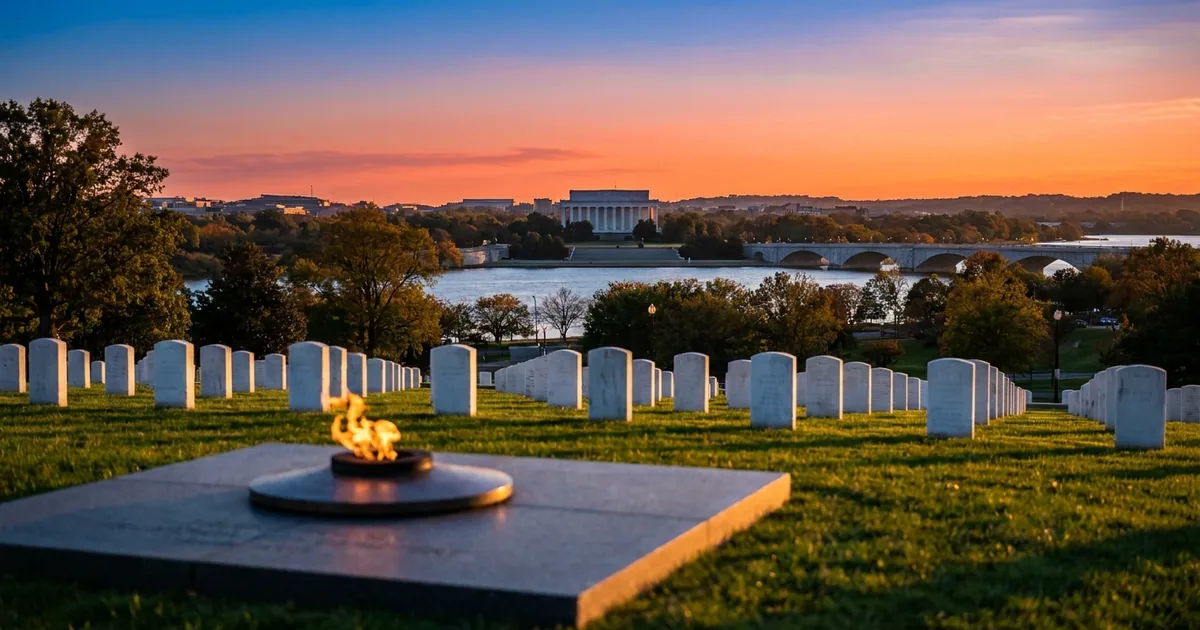
CBS News reported Tuesday that nine members of the Kennedy family have asked a federal judge to let them join the lawsuit against Trump’s 250-foot arch at Memorial Circle, arguing that it would block sightlines to the family’s graves at Arlington National Cemetery and “permanently cast a shadow over the graves of servicemen and women.” It is the most photogenic development in a case that has been moving for nine months, and it is not the most important one. That would be the 33-page opinion Judge Tanya Chutkan issued on November 5, whose strongest evidence against the project comes from the government’s own files. The National Park Service’s environmental assessment found adverse effects on Arlington National Cemetery and the Lincoln Memorial, and the 1925 law the administration is leaning on covered, at most, two columns that were never built. We read the opinion so you do not have to, and the short version is that the legal case for the arch is thinner than its footprint.
What the Kennedys Actually Filed
The nine, who include children and grandchildren of Robert F. Kennedy and Ted Kennedy, filed in the U.S. District Court for the District of Columbia to intervene as plaintiffs in the suit brought by the District and Virginia. Rory and Maxwell Kennedy put out a statement, and Kerry Kennedy and Joe Kennedy III are among those seeking to join. The Justice Department had no comment, and White House spokesman Davis Ingle said the administration is “confident we will be fully vindicated as this litigation proceeds” and called the arch “a tribute to 250 years of American greatness.” Robert F. Kennedy Jr., the health secretary, was asked about his relatives’ pushback and told CBS News: “I have bigger fish to fry.” He did not say which fish, and the family’s complaint is of a very specific size.
One distinction matters here. The Kennedys’ sightline argument is theirs, and the court has not found it. Chutkan’s opinion never mentions the family or the Eternal Flame. Its sightline is the one between the Lincoln Memorial and the Lee Mansion, the Arlington House above the cemetery, and it says the arch “would squarely block” that view, citing page 19 of the Park Service’s own assessment. The Kennedy graves are on that same hillside, so the claim is plausible, but a plausible claim in a motion to intervene is not a finding, and the family now has to prove it.
The Government’s Own Paper
The assessment in question is the Park Service’s Revised Environmental Assessment of October 9, 2026, and the government filed it itself, as an exhibit to its opposition brief. It puts the arch at 250 feet, which the judge notes is more than double the height of the Lincoln Memorial, and it finds adverse effects on historic properties including Arlington National Cemetery and the Lincoln Memorial. It projects two to three months of site preparation, four to five months of foundation work and two to three years of construction in all. Memorial Circle carries more than 27,000 vehicles, 1,100 cyclists and 1,200 pedestrians a day, according to the same document, and the work would haul out about 1,400 truckloads of soil and cut westbound traffic from Arlington Memorial Bridge to two lanes. Chutkan used those numbers to find that the District and Virginia face real, unrecoverable costs, which is an unusual outcome for an exhibit the losing side chose to file.
The government’s other move was to argue the arch is not a “commemorative work” at all, which matters because the Commemorative Works Act requires Congress to authorize any such work on Park Service land in the District, name a sponsor and consult an advisory commission. The judge found “Defendants complied with none of these procedures.” She also found that the government’s own papers describe the arch as a “major commemorative feature anchoring” the circle and tie it to honoring America’s founding principles, and that the White House press secretary called it “a fitting way to commemorate the 250th anniversary of American independence.” If the arch is not a commemorative work, somebody should tell the people who keep calling it one. Congress has not enacted a statute authorizing it, as it did for the Korean War and World War II memorials.
A 1925 Law and Two Columns That Were Never Built
So the administration reached for a statute from 1925. That law authorized the Arlington Memorial Bridge, put a commission in charge and set a budget of $14,750,000. The commission’s design called for developing Columbia Island, where Memorial Circle now sits, as a park and a plaza with “two stately columns,” each 166 feet high and topped with statues of Victory. Those columns were dropped from the plans in December 1931 “in the interests of aviation safety and economy,” and the bridge was finished without them. The government’s position is that the 1925 act still authorizes construction there because the island remains an unfinished 300-foot circle of grass.
Here is how Chutkan answered that:
“The sheer improbability that a 100-year-old statute would contain authority, unknown to every previous administration, to erect a 250-foot arch at a principal location in the Nation’s capital indicates how far Defendants must stretch to justify this project.”
We checked her arithmetic and it holds. A 250-foot arch against 166-foot columns is 50.6 percent taller, which she rounds to fifty percent, and the 1925 act allowed design changes only “without increasing the total cost of the project.” Just over $2.5 million of the $14.75 million was left by mid-1933, about 17 percent of the original budget, and the arch adds an observation deck, restrooms, a store, a cafe, anti-drone sensors and military communications equipment. The act authorized a memorial bridge across the Potomac, which is a different purpose from commemorating independence. The government’s backup, the Park Service’s general Organic Act, was dismissed on the ground that the specific statute governs the general one.
The Security Argument Arrived Late
The administration also told the court the arch would be “a generational national defense opportunity” that could help deter assassination attempts on the president, through declarations from Secretary of War Pete Hegseth and Homeland Security Secretary Markwayne Mullin. Chutkan noticed when it showed up. She wrote that these “recent and unsupported attestations” appear nowhere in the planning documents on which the project was reviewed and approved, that they “materialized, for the first time” in the opposition brief filed October 28, and that at the hearing the government said it had nothing beyond the declarations. A structure that has been discussed for a year, in other words, developed a security mission the week it needed one.
The timing is the rest of the story. The National Capital Planning Commission approved the arch 8 to 4 after a nine-and-a-half-hour hearing on November 5, and the Interior Department issued its final decision the same day. Chutkan’s order followed within hours: it bars the government from beginning construction or site preparation at Memorial Circle for 14 days, which by our count runs out around November 19. She set a $1 bond, deferred the District’s request for a stay of the approval and held the veterans’ motion for a preliminary injunction in abeyance. Everything after that depends on whether she turns the pause into something longer, and on what the arch’s backers do with two weeks.
We think the arch is unlawful on this record, and the remedy is the one the statute already names: ask Congress. The Korean War and World War II memorials both went through Congress, and the administration, which took the arch through a federal height review and a planning commission, chose to skip the one step that requires anyone to say yes in public. The bigger issue is what the system learns at scale. If a century-old bridge law can be stretched to cover a 250-foot arch, every future administration, of either party, has been handed a reason to go looking for old statutes nobody reads, and that is a precedent worth more than the Kennedys’ sightline or the arch’s cafe.