
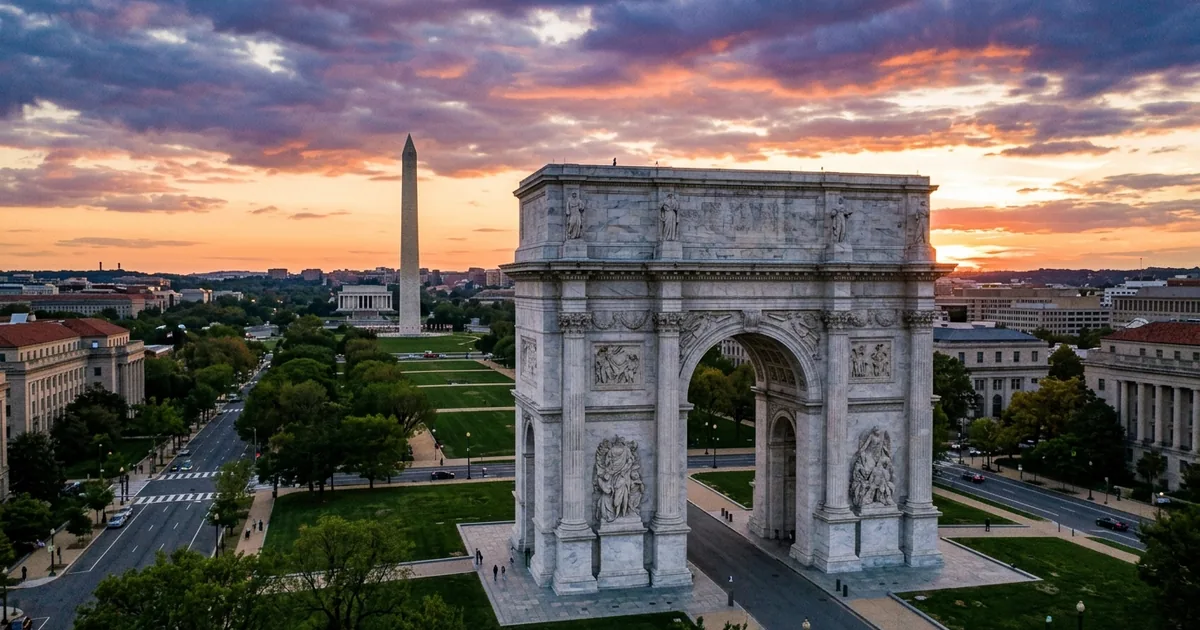
President Trump’s plan to build a 250-foot triumphal arch in the nation’s capital is getting another review from the federal commission whose approval he needs, and the agency’s own staff is recommending the design be revised before it gets the green light. The National Capital Planning Commission meets Thursday with the arch on its agenda, and the review could force changes to a project the president has personally championed.
Twice the Lincoln Memorial’s Height
The proposed arch would stand 250 feet tall, more than twice the height of the Lincoln Memorial and roughly half the Washington Monument’s 555-foot profile. For a city whose skyline has been deliberately constrained by federal law since 1910, the structure would represent the most dramatic vertical addition in more than a century.
The commission’s staff acknowledged the scale in its report, according to ABC News, recommending that the preliminary site and building plans be approved but that the design be modified to comply with the Height of Buildings Act, the federal law that limits construction heights in downtown Washington to preserve the city’s deliberately low skyline. The tension is straightforward: the arch as currently designed may not be legal under the same law that has kept Washington from looking like Manhattan for over a century.
A 1925 Plan That Looked Nothing Like This
Trump has cited a 1925 proposal for a triumphal arch as precedent for his plan, framing the project as the completion of an idea the country started and never finished. But The Washington Post’s examination of the historical record showed the 1925 vision was dramatically different in scale, location, and purpose. The original concept was part of a comprehensive urban plan for the capital, designed by committee and subject to public input. Trump’s version has been pushed through by a small group of people close to the president who have played an outsized role in the arch’s unusually quick approvals.
The speed matters because it bypasses the deliberative design process that produced every other major memorial in Washington. The Vietnam Veterans Memorial, the World War II Memorial, and the Martin Luther King Jr. Memorial all went through years of public review, design competitions, and congressional oversight. The arch has moved faster, with fewer independent voices in the room.
Why the Height Law Exists
The Height of Buildings Act was passed in 1910 specifically to prevent the kind of skyline competition that defines other American cities. Congress decided that Washington’s public buildings, monuments, and memorials should dominate the visual landscape, not private towers or presidential vanity projects. The law has survived more than a century of pressure from developers, and its preservation is one of the reasons Washington’s skyline remains unique among world capitals.
The commission’s review Thursday is asking whether a sitting president can effectively override that principle by classifying a personal monument as a national one. The staff’s recommendation to revise the design suggests the answer is not straightforward, and the commission is not prepared to rubber-stamp a structure that may require redefining the law to approve.
What to Watch
The National Capital Planning Commission meeting Thursday will determine whether the arch proceeds in its current form, gets sent back for redesign, or moves to a different approval track. The commission has the authority to block projects that violate the Height Act, but Trump allies have been exploring whether the president can reclassify the site to exempt it from the restriction.
The broader question is whether Washington’s week of high-stakes diplomacy at the NATO summit in Ankara has left the administration with enough political capital to push a domestic monument project past the federal agencies designed to check it. Either way, the arch is no longer moving through Washington’s approval process unopposed.