
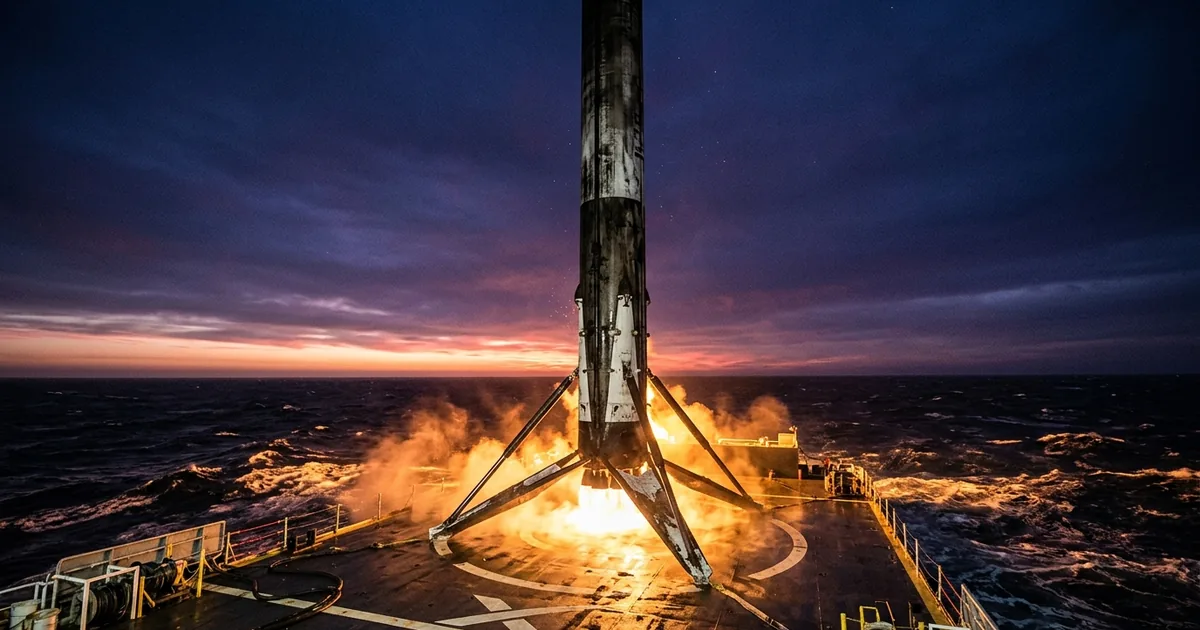
A SpaceX Falcon 9 rocket launched from Cape Canaveral early Thursday morning on the 36th orbital mission of its career, setting a new company record for the most flights ever logged by a single rocket booster. The milestone puts the vehicle just three flights behind NASA’s Space Shuttle Discovery, which holds the all-time record at 39 missions.
Booster 1067 Makes History Before Dawn
The rocket, known internally as Booster 1067, lifted off at 5:25 a.m. EDT from Space Launch Complex 40 at Cape Canaveral Space Force Station in Florida. It carried 29 Starlink broadband satellites to low Earth orbit as part of the Starlink 10-42 mission, then landed on the drone ship “A Shortfall of Gravitas” roughly eight and a half minutes after liftoff, as Space.com reported.
The landing itself was routine, which is exactly the point. What was extraordinary about this launch is how ordinary it has become. Booster 1067 has now completed 36 round trips to orbit and back, a pace of reuse that would have been dismissed as fantasy when SpaceX first started attempting booster landings in 2015.
Three Flights From the Shuttle Record
The overall record for the most flights by a single reusable spacecraft belongs to NASA’s Space Shuttle Discovery, which flew 39 missions between 1984 and 2011. The shuttle program cost approximately $209 billion over its lifetime, and each mission required months of refurbishment between flights. SpaceX turns Falcon 9 boosters around in weeks, sometimes days.
That comparison captures the structural difference that has reshaped the launch industry. The shuttle proved reusability was technically possible. SpaceX, which went public earlier this year in one of the most anticipated IPOs of the decade, proved it was economically viable. Those are different achievements, and the second one is the one that matters for what comes next.
The Business Model Behind the Record
Thursday’s launch was SpaceX’s 80th Falcon 9 mission of 2026, according to Spaceflight Now, with roughly 80 percent of this year’s flights dedicated to growing the Starlink constellation. The sheer volume explains why reuse is not just a technical preference but a financial necessity. Building a new booster for each of those 80 flights would make the launch cadence impossible at any price point the market would bear.
SpaceX did not invent reusability. NASA explored the concept across multiple decades and programs. What SpaceX did was treat the rocket like a commercial aircraft: an asset whose value compounds through repetition rather than depreciating after a single use. Booster 1067’s 36th flight means the hardware investment in that single vehicle has been amortized across 36 revenue-generating missions, a return on investment that no expendable rocket can match.
What 36 Flights Means for the Industry
The rest of the launch industry has taken notice. United Launch Alliance, Blue Origin, Rocket Lab, and the European Space Agency are all developing partially or fully reusable vehicles, in large part because SpaceX’s economics have made expendable rockets uncompetitive for most commercial payloads.
The question is no longer whether reusability works. It is whether anyone else can close the gap before SpaceX’s head start becomes permanent. Booster 1067 will almost certainly break the shuttle’s record within the year. When it does, it will not be a nostalgia milestone. It will be confirmation that the economics of reaching orbit have fundamentally changed, and that the company that changed them has no intention of slowing down.