
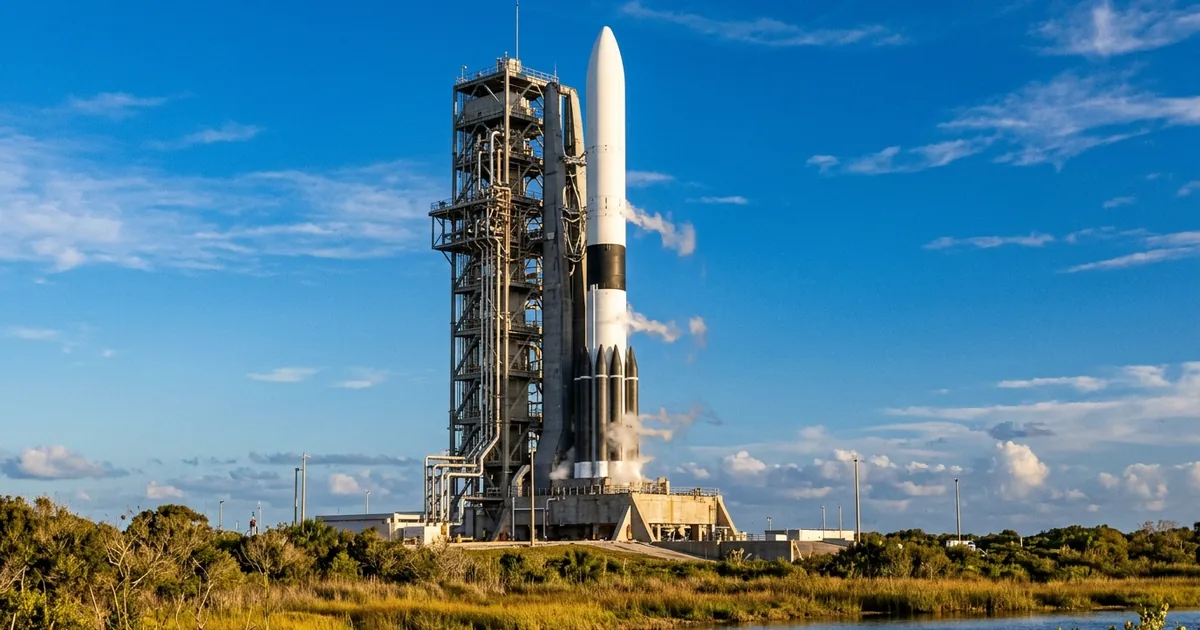
A United Launch Alliance Vulcan rocket failed about ten minutes after liftoff from Cape Canaveral on Sunday, and the 40 Amazon Leo satellites on top of it never reached orbit.
- It was Vulcan’s fifth flight since 2024 and its first in nine months, and the first total mission loss in ULA’s history.
- Reuters reporting puts the fault in the Centaur upper stage’s burn, with the solid rocket boosters working as planned. ULA has not named a cause.
- Amazon had 398 Leo satellites in orbit before Sunday, about 12 percent of the fleet it has to finish.
Coverage calls this a failed return to flight, which suggests the nine-month fix did not hold. On the reporting so far it did: the boosters, whose nozzles grounded Vulcan after February’s USSF-87 mission, appear to have worked, and the trouble came later. The number that matters is not the 40 satellites lost. It is the 2,834 Amazon still has to launch, against a federal deadline that did not move.
What Flew for the First Time on Sunday
The grounding followed nozzle failures on the Northrop Grumman solid rocket boosters, one on Vulcan’s second flight and one in February, and ULA said the return flight would carry an improved nozzle design. Sunday’s mission also debuted a Vulcan with six strap-on boosters, a longer payload fairing and a shortened Centaur V built for Amazon’s low orbit, according to the public launch list. That is a great deal of new hardware for a flight billed as a return, with 40 customer satellites aboard. Until ULA publishes a root cause, the Centaur attribution is a news report and not a finding, and Reuters said the investigation could be lengthy enough to keep the rocket grounded for months.
Amazon’s other big rocket is on the ground too. New Glenn exploded on its Florida pad in May, so when the FCC decided in June how to treat Amazon’s schedule, both of the heavy rockets Amazon was counting on were out of action. SpaceX, the incumbent in low-orbit broadband, spent the same weekend catching a Starship upper stage at its launch tower after a trip around the planet.
What the FCC’s June order requires
The interim milestone, 1,616 satellites in orbit by July 30, 2026, was waived in an order signed June 5.
The final deadline stands: the full Gen1 constellation of 3,232 satellites by July 30, 2029.
Miss it and Amazon “will be limited to the total number of its satellites that are operational on that date.”
Where Amazon stood on Sunday
398 satellites launched across 14 missions, up from 180 in January and 330 in early June.
40 more lost on the first of the 38 Vulcan launches it has contracted.
New Glenn sidelined since the May pad explosion.
The Arithmetic Amazon Now Faces
Start with the FCC’s own figure. The full constellation is 3,232 satellites and Amazon has 398 in orbit, which leaves 2,834. The deadline is July 30, 2029, about 32 and a half months from today, so the schedule now calls for roughly 87 satellites a month. Amazon’s actual pace since January, when the order says it had 180 in orbit, is 218 satellites in about ten months, or 22 a month. The 2029 date needs a rate close to four times the one Amazon has managed. (We worked this out from the FCC order’s counts and Reuters’ tally. Reuters puts the fleet at 3,236, which moves the result by four satellites.)
Run the current pace forward and Amazon reaches about 1,110 satellites by the deadline, roughly a third of the constellation. Under the order that is the number its authorization would be limited to.
Vulcan was the plan for closing the gap. Amazon booked 38 Vulcan launches, and if each carried the 40 satellites this one did, that is 1,520 satellites, 47 percent of the constellation, riding on a rocket that has now flown once with Amazon’s payload and lost it.
We think the FCC should stop treating 2029 as a plan. In June it dropped the 2026 checkpoint for a company with 330 satellites up, kept one date three years out, and wrote that only one operator, SpaceX, is providing broadband to American consumers from low-Earth orbit. A deadline with no checkpoints is a date you learn you missed in 2029. A commission that wants a second option for customers should put a milestone back, counted in satellites in service rather than satellites launched, and publish the tally every quarter. Amazon owes the public a straight answer on whether Vulcan is still the rocket that gets it there.
Two things will show how serious this is. ULA’s root cause decides how long Vulcan stays grounded. And every month it stays grounded raises the monthly pace the 2029 date demands, so the next filing to watch is Amazon’s, if it asks the FCC for more time.