
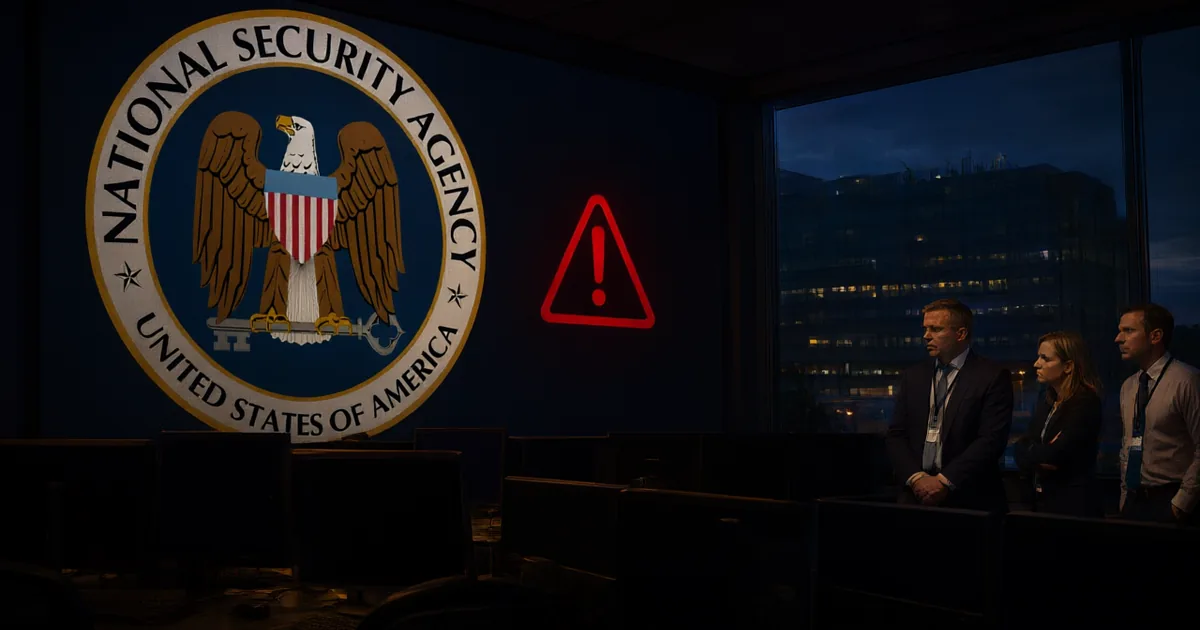
The National Security Agency’s classified internal network went offline on Tuesday, and the agency’s explanation was the most familiar sentence of the week. A U.S. official called it a “temporary degradation during scheduled routine maintenance,” and two sources told CBS News the outage came from routine system patching.
That makes three. Microsoft’s email went dark for 23 hours and 50 minutes last week after a patch went wrong, and the FAA stopped every departing flight in the country after a router swap. The coverage keeps filing this under “bad week,” which is comforting, because a bad week is something you wait out. We think that framing is wrong: the biggest failures of the week are the same failure in different buildings.
What Went Down at Fort Meade
The system is NSA Net, the agency’s network for classified communications and sharing intelligence. With it degraded, the NSA staggered arrival times for non-emergency staff at its Fort Meade headquarters under what sources called “Code Gray,” and some work was redirected to other NSA facilities.
The official line is that “mission/critical capabilities remain fully operational.” CNN reported that urgent intelligence could still reach the President and that Five Eyes sharing with allies was not affected. Officials said there is no evidence of a cyberattack. As of Tuesday it was not clear when full service would return, and outlets disagree on scope: Fox affiliates describe a partial outage, CBS and CNN a network that went down.
One more detail is worth sitting with. A source told The New York Times the system had been unstable for weeks. That is a single source, so treat it as unconfirmed, but if it holds, Tuesday was not a surprise to the people running it.
The Week, In Order
Here is the run of outages since Thursday, November 12, built from official statements and the reporting linked below. Times are as reported; the status column is as of Tuesday afternoon.
| When | What failed | What we know about why | Status |
|---|---|---|---|
| Thu Nov 12, 4:20 p.m. UTC | Microsoft 365: Outlook, Exchange Online, Teams, Copilot | A hidden Windows defect in gateway servers, set off by a traffic shift | Restored Nov 13, 4:10 p.m. UTC |
| Fri Nov 13, about 3 p.m. ET | FAA nationwide departure ground stop | A newly installed router flooded the network with connection requests | Lifted 8:15 p.m. ET |
| Mon Nov 16 | United Airlines departures | A “technology issue,” per United | Resolved |
| Tue Nov 17 | Charles Schwab logins | A “brief webpage loading issue,” per Schwab | Resolved |
| Tue Nov 17 | Apple: iCloud, Apple Pay, Apple Music, the App Store | No explanation yet | Developing |
| Tue Nov 17 | NSA Net, the NSA’s classified internal network | Routine system patching, per two sources | Not yet restored |
Three of those six rows have an explanation beyond “technology issue.” All three happened during maintenance, and that is the story.
Microsoft Wrote Down What Happened
Microsoft’s preliminary report, dated November 15 and laid out in detail by Cybersecurity News, is unusually candid. A fix deployed to its networking gateway servers since July carried a Windows defect that caused lock contention: tasks queued up waiting on shared resources until CPU and memory ran out.
It needed two things to go wrong at once. About 15 hours before the outage, Teams traffic was moved onto the gateways Exchange Online also used. Separately, nearly 14% of gateway capacity was already offline for an unrelated reason.
Then the safety system made it worse. Automated recovery moved connections to healthy servers, which promptly caught the same fault. Failures crossed regions in under two hours, more than 80% of servers stopped responding at the worst point, and restarted machines fell over again when the queued traffic came back. Microsoft also says its fault-containment boundaries failed, which is the line we would underline twice.
The reach was global. Downdetector logged complaints from 74 countries and territories within about an hour, with government systems in Singapore and Japan and communications at the Supreme Court of the Philippines caught in it. We covered the first night as 130,000 outage reports across the Americas.
The FAA Story Rhymes
Now the ground stop. Transportation Secretary Sean Duffy said a contractor replacing copper lines with fiber at a remote FAA site watched a router start sending a flood of connection requests through the network. Federal officials said L3Harris, which manages the FAA’s telecom infrastructure, had installed a new Juniper router at the El Dorado, Arkansas site shortly before the disruption, and that excess traffic was also traced to equipment in Texas.
One box in rural Arkansas overloaded communications at 17 of the FAA’s 22 en route centers. FlightAware counted nearly 25,000 delayed flights and more than 9,000 cancellations that Friday.
The fix, KATV reported, was to disconnect the Arkansas and Texas routers from the larger network. Someone had to build the containment boundary by hand, after the fact.
Same Shape, Different Buildings
Put the two side by side and the pattern is hard to miss:
- One small change. A server patch in Microsoft’s case, a router swap in the FAA’s, system patching at the NSA.
- Connection traffic as the weapon. Lock contention on connections at Microsoft; a flood of connection requests at the FAA.
- No wall to stop it. Microsoft’s containment boundaries failed; the FAA’s problem reached 17 of 22 centers from one site.
We only know the mechanism in detail for the first two; the NSA has said nothing about how its patch failed. But none of the three was a cyberattack. Microsoft executive Charles Lamanna said there was “no indication” of one, and officials said the same of the ground stop and of NSA Net. That should be more alarming, not less. An attacker is at least trying. These systems took themselves down during routine maintenance, and one of them belongs to the country’s signals intelligence agency.
What We Can’t Tie Together Yet
Here the numbers run out, and we are not going to pretend otherwise. United’s Monday delays came with no explanation beyond “technology issue.” Schwab called its problem brief and says trading stayed up. Apple had said nothing at all as of this writing.
Gmail is a useful caution. Downdetector showed a spike in send and receive complaints Monday and Tuesday, but Google said it saw no evidence of a “broad Gmail service disruption,” and its status dashboard showed nothing. Some of what feels like a week of collapse is a week of people now primed to check Downdetector.
So the honest count is three failures set off by maintenance, and three that might be anything.
Blame Is Still Being Assigned
The FAA cause is not settled. Officials have not said whether the router was defective, misconfigured or badly installed. HPE says its Juniper gear worked as intended; L3Harris says it is supporting the investigation. The FAA has paused new router installations and disabled the suspected function on more than 60 similar routers. We laid out the three competing explanations on Saturday, and they have not converged since.
Microsoft owes its repair details by November 20. If they match the preliminary report, it will be a rare thing: one of the world’s largest companies putting “our safety system spread the fire” in writing.
Our Take
The week is not a coincidence, and it is not a sign the machines are failing at random. Big networks are being built so that one part can reach every other part instantly, which is efficient right up until the part that reaches everything is broken. Microsoft’s report says it out loud. The FAA’s response, unplugging two sites, says it in practice. The NSA, sending staff home on a staggered schedule, says it in the language of a federal personnel memo.
The fix is boring and expensive: bulkheads. Limits on how much traffic one component can push, changes rolled out to a slice before the whole, and recovery systems that check whether the destination is healthy before sending it the problem. None of that makes a good press release, which is probably why it keeps getting skipped.
Questions Readers Are Asking
Was any of this a cyberattack?
No evidence so far. Microsoft said there was no indication of malicious activity, and officials said the same about the FAA ground stop and the NSA network outage.
Do I need to change anything on my Microsoft 365 account?
No. Microsoft’s guidance says no tenant or device configuration changes are needed, because the failure was inside its own cloud infrastructure.
When will we get the full explanations?
Microsoft’s repair details are due November 20. The router equipment from the FAA ground stop has gone to L3Harris in Florida for diagnostic testing, with no date given for results.