
“There is, in fact, no doubt that the bridge will be restored. And it will be even better than before.”
Kremlin spokesman Dmitry Peskov on Tuesday, asked about the Crimean Bridge
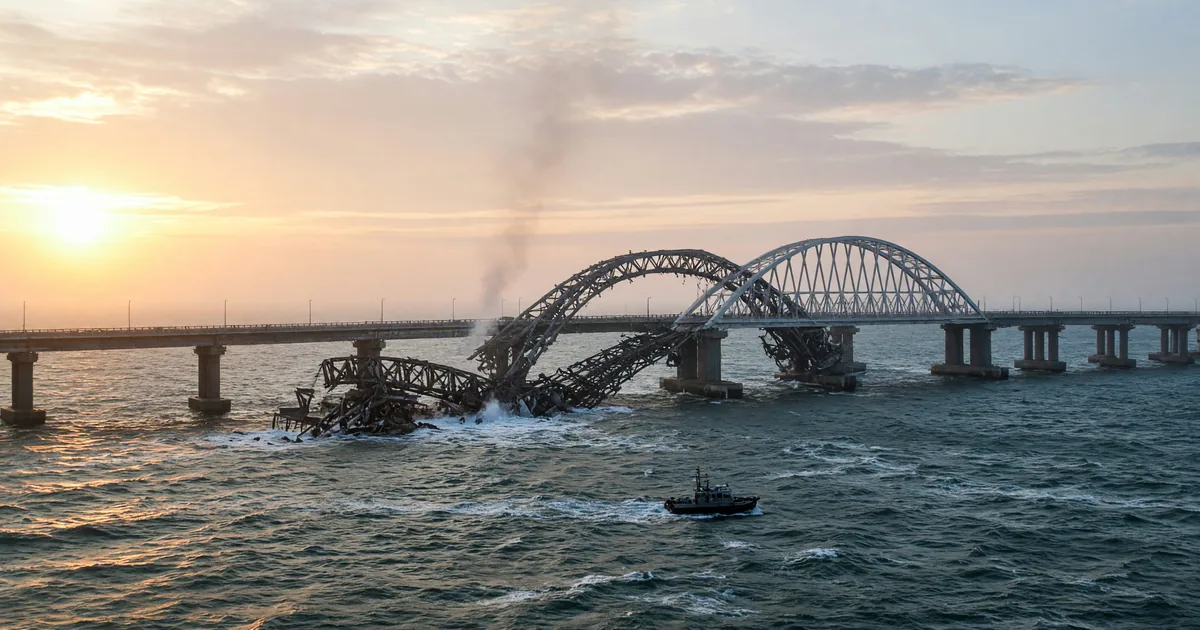
Around 1:34 a.m. on Tuesday, Crimea’s Russian-installed governor, Sergey Aksyonov, wrote on Telegram that “the enemy attacked the Crimean Bridge again” and that traffic was suspended. By daylight, geolocated images showed a section of Vladimir Putin’s showpiece bridge over the Kerch Strait lying in the water, and Ukraine’s General Staff put the damage plainly: “The arch and a span of the bridge’s road section collapsed.” It was the second strike in under 24 hours, and it brought down the road section Putin crossed in a truck when the bridge opened in 2018.
Most of the first-day coverage counts what fell. Very little of it sets this strike beside the three earlier hits on the same bridge, and none that we found turns the engineers’ repair estimates into a cost for a crossing that carried about 24 million vehicles in five years. Both comparisons follow, because they decide what the Kremlin’s promise above is worth. The engineering firm COWI’s David MacKenzie named the difference from the attacks of 2022 and 2023: “the most critical and vulnerable part of the bridge has been hit.”
Four Hits Since 2022, and Only the Latest Took the Arch
Here is the record, assembled from the reporting at the time and this week’s statements:
- October 2022: A blast killed three people and damaged the bridge, and Russian officials said a truck had exploded while crossing it.
- July 17, 2023: Explosions blew up one section, killing a couple and wounding their daughter. Russian authorities said the piers were unaffected and the decking of one road link was damaged, and rail traffic resumed after about six hours.
- June 3, 2025: Ukraine’s security service said it set off 1,100 kilograms of explosives (TNT equivalent) against the underwater supports and called the bridge “effectively in an emergency condition.” It reported no civilian casualties.
- November 16 to 17, 2026: Drones hit the road arch on Monday night and it stayed up, so traffic was paused briefly and then reinstated. Missiles and drones, including a Flamingo, finished it in the early hours of Tuesday, and the arch and road span fell. The rail arch is damaged, and rail traffic reopened on one track while work continues on the second.
In 2023 the trains were moving again within about six hours. This time the people who build bridges are talking about a different order of time. MacKenzie says the wreckage can be cleared quickly but reinstating full road traffic will take over a year, and Monash University structural engineer Colin Capriani called the damage “catastrophic” and found a rebuild “very hard to envisage” so close to Ukrainian weapons. We ran the arithmetic on that: 24 million vehicles over five years is 1,825 days, or about 13,150 vehicles a day, an average that blends civilian and military traffic. A year without full road capacity is therefore on the order of 4.8 million crossings the span cannot carry, and that is the optimistic reading, because MacKenzie’s “over a year” is a floor and not a forecast.
Seven Stages, and a Camera on the Missile
Zelensky called it “an unprecedented operation in response to Russian strikes on our infrastructure” and described Tuesday’s blow as the seventh stage of an effort in which Ukraine spent weeks destroying air defenses, radars and electronic warfare equipment on the way in. The General Staff’s version calls it “a multi-stage joint operation by Ukrainian troops that was carried out over several weeks.” We found no independent confirmation of those preparatory stages, so they stand as Kyiv’s account. What can be checked is the footage: BBC reports a verified video, filmed from a camera aboard a Ukrainian-made Flamingo cruise missile, that shows the weapon approaching the main span and freezes just before impact. Justin Bronk of the Royal United Services Institute said the missile may have been modified for remote control, and that its very heavy warhead suits reinforced concrete spans and supports.
Moscow’s Promise, and a Label We Reject
Peskov’s line is a promise from a spokesman whose government has an obvious reason to make it, and the people whose job is to estimate repairs say otherwise. Military analyst Emil Kastehelmi wrote that the road bridge “won’t be repaired during this war,” and the Institute for the Study of War said the strikes showed Russia’s inability to defend strategic objects critical to its economy and military logistics. We think the engineers are the better guide, and that a bridge “even better than before” is a line for a domestic audience watching a prestige project sink. Russia’s Investigative Committee has opened a criminal case over “a terrorist act,” and that label is spin. The span was, in Zelensky’s words, “the main military crossing” into occupied Crimea, and the evening before the arch fell, Russian ballistic missiles hit bridges over the Dnipro in Kyiv, where Mayor Vitali Klitschko said the damage was being assessed and the attacks disrupted water and heating. Aksyonov said two people were killed by a drone strike in a district near the bridge, while CNBC reported no casualties from the bridge strikes themselves.
What the collapse does to Crimea is still open. BBC’s read is that it is too early to speak of a complete blockade, since a land corridor through occupied Zaporizhzhia and Kherson remains, but that the risk of a serious transport and logistics crisis has increased significantly, with ferry capacity limited and Ukrainian drones active across the Black Sea. Wreckage may also be blocking the shipping channel toward Mariupol and Berdyansk. Aksyonov said ferries are carrying passengers without vehicles and Sevastopol’s governor said the city’s supplies would not be affected. Those are claims to test against fuel and freight arriving on the peninsula, not to take on faith, and the number that matters now is how much one rail track and a handful of ferries can actually move.