
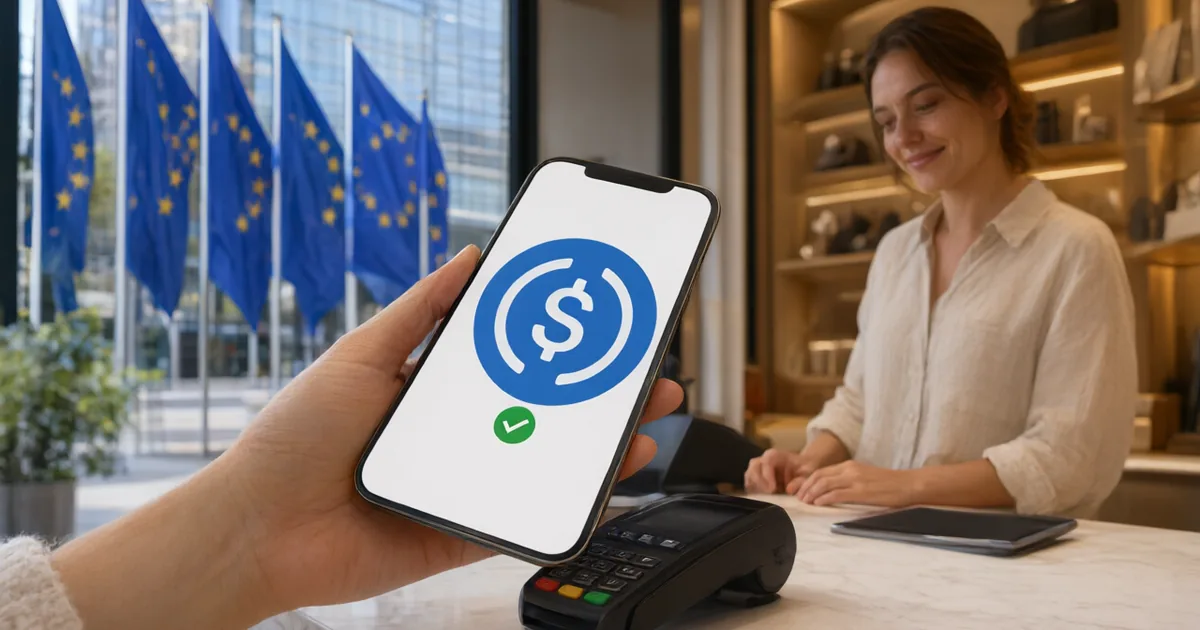
Europe now has the most detailed crypto rulebook of any major economy, and it has quietly reshaped which digital dollars businesses use. Under the Markets in Crypto-Assets Regulation (MiCA), regulated platforms in the EU can only offer stablecoins whose issuers hold the right authorisation. For online shops, agencies and software sellers with international customers, that has made USDC the practical default. If you want to accept USDC payments, it helps to understand what changed, what did not, and how to set up a checkout that keeps both your customers and your accountant comfortable.
What MiCA Changed for Stablecoins
MiCA, formally Regulation (EU) 2023/1114, introduced common rules for crypto-assets across all member states. Its stablecoin chapters started to apply on 30 June 2024, and the rules for crypto-asset service providers such as exchanges and brokers followed on 30 December 2024. National transition periods for existing providers ended by 1 July 2026 at the latest.
For stablecoins pegged to a single currency, MiCA uses the category “e-money token”. An issuer must be an authorised credit institution or electronic money institution, hold reserves under strict rules, publish a white paper and give holders a right to redeem at par.
The ESMA overview of MiCA explains how the national authorities and the EU supervisors share oversight.
Why USDC Ended Up on the Right Side of the Rules
Circle, the issuer of USDC, obtained an electronic money institution licence in France in 2024. That allowed USDC, and its euro-denominated sibling EURC, to be offered as compliant e-money tokens across the European Economic Area.
Tether, the issuer of USDT, chose not to seek that authorisation. Major platforms responded step by step: some exchanges delisted USDT for European users in late 2024, and by mid-2026 regulated platforms in the EEA had stopped offering it to their European customers.
| Question | USDC | USDT |
|---|---|---|
| MiCA status | Authorised e-money token | Not authorised |
| Available on regulated EU exchanges | Yes | No longer offered to EEA users |
| Euro version | EURC, also authorised | No authorised euro version |
| Holding in a personal wallet | Allowed | Allowed |
| Typical use by EU merchants | Primary stablecoin | Accepted mainly from non-EU customers |
It is worth being precise here. MiCA regulates issuers and service providers. It does not make it illegal for a person to hold USDT in a self-custody wallet. What changed is access: a European customer can now easily buy, sell and withdraw USDC through a licensed platform, while USDT has become harder to obtain and cash out within the EU.
Why This Matters for a Merchant
For a business, the payment method you accept should be one your customers can actually obtain and one your bank and accountant will understand. USDC fits that test in Europe for several reasons:
- On-ramps and off-ramps. Customers can buy USDC with euros on regulated exchanges, and you can convert incoming USDC back to euros the same way.
- Clear documentation. Your accountant can point to an authorised issuer and a published white paper.
- Bank conversations. Explaining incoming funds that originated in a regulated stablecoin is simpler when the business needs to show where revenue came from.
- Global reach. USDC is also widely used in the United States, Latin America and Asia, so it works for international customers too.
Many European merchants now accept USDC as their main stablecoin and keep USDT only for customers outside the EU who prefer it.
Choosing the Network for USDC
USDC exists on several blockchains. The token is the same dollar-backed asset, but fees and speed depend on the network. Live measurements on 12 November 2026 put the cost of a typical token transfer at:
| Network | Approximate transfer cost | Settlement speed |
|---|---|---|
| Ethereum | About $0.08 | Blocks every 12 seconds, full finality about 13 minutes |
| BNB Chain | About $0.002 | Finality about 1 second |
| Solana | Under $0.001 | Seconds or less, after the October 2026 Alpenglow upgrade |
| Tron | Around $2 | About a minute for exchange-grade confirmation |
For small and medium payments, low-cost networks such as Solana or BNB Chain make the most sense. For large invoices, many businesses prefer Ethereum for its liquidity and broad exchange support.
Whatever you choose, the invoice must show the network clearly. A customer who sends USDC on a different network than the one your wallet expects can create a recovery problem that has nothing to do with the regulation.
How to Start Accepting USDC
A sensible setup for a small or medium business looks like this:
- Open or confirm a business account on a licensed exchange in your country so you can convert USDC to euros when needed.
- Create a business wallet that you control, and store its recovery phrase offline.
- Pick a payment gateway that supports USDC on the networks your customers use and, ideally, sends payments directly to your wallet rather than holding them.
- Integrate the checkout through a plugin for your store platform or through payment links for invoices.
- Decide on pricing, usually in euros with the USDC amount calculated at checkout and locked for a short period.
- Test with a small payment and confirm that orders update automatically.
- Set a conversion routine, for example converting a fixed share of USDC revenue to euros each week.
Accounting and Tax Points to Discuss With Your Adviser
Rules differ between member states, so take this as a checklist rather than advice:
- VAT applies to the goods or services you sell in the normal way. The payment method does not change the VAT due on a sale.
- Revenue is usually recorded at its euro value on the date of payment.
- Exchange differences may arise if you hold USDC and convert it later at a different EUR/USD rate.
- Records for each sale should include the invoice, the network, the amount, the euro value and the blockchain transaction ID.
- Anti-money-laundering obligations for your own business do not disappear because the payment is digital. Know your customer to the same standard you would for any large transfer.
Common Mistakes When Adding USDC
- Listing only one network. Customers hold USDC on different chains; offering two or three popular networks avoids failed or delayed payments.
- Publishing a single static address. Each order should have its own invoice so payments can be matched automatically.
- Leaving large balances unconverted without a plan. Decide in advance how much stablecoin revenue you keep and how much you convert to euros.
- Treating USDC and EURC as interchangeable. One tracks the dollar and the other the euro, so prices and accounting differ.
- Skipping the test payment. A small live test catches wallet, network and plugin errors before a real customer finds them.
Frequently Asked Questions
Is USDT banned in the EU?
There is no ban on holding it. MiCA prevents regulated platforms from offering unauthorised stablecoins to EU users, which is why USDT has largely disappeared from European exchanges.
Is USDC the same as euros in a bank?
No. USDC is a dollar-denominated e-money token issued by an authorised institution. It is designed to hold its value against the US dollar, so EU businesses also face normal EUR/USD exchange-rate movements.
Should I accept EURC as well?
If most of your customers and costs are in euros, EURC removes currency risk. Demand is still smaller than for USDC, so many businesses offer both.
MiCA has made Europe’s stablecoin market narrower but clearer. For merchants, that clarity is useful: one widely available, authorised digital dollar, a regulated route back to euros and a checkout that fits naturally alongside cards and bank transfers.