
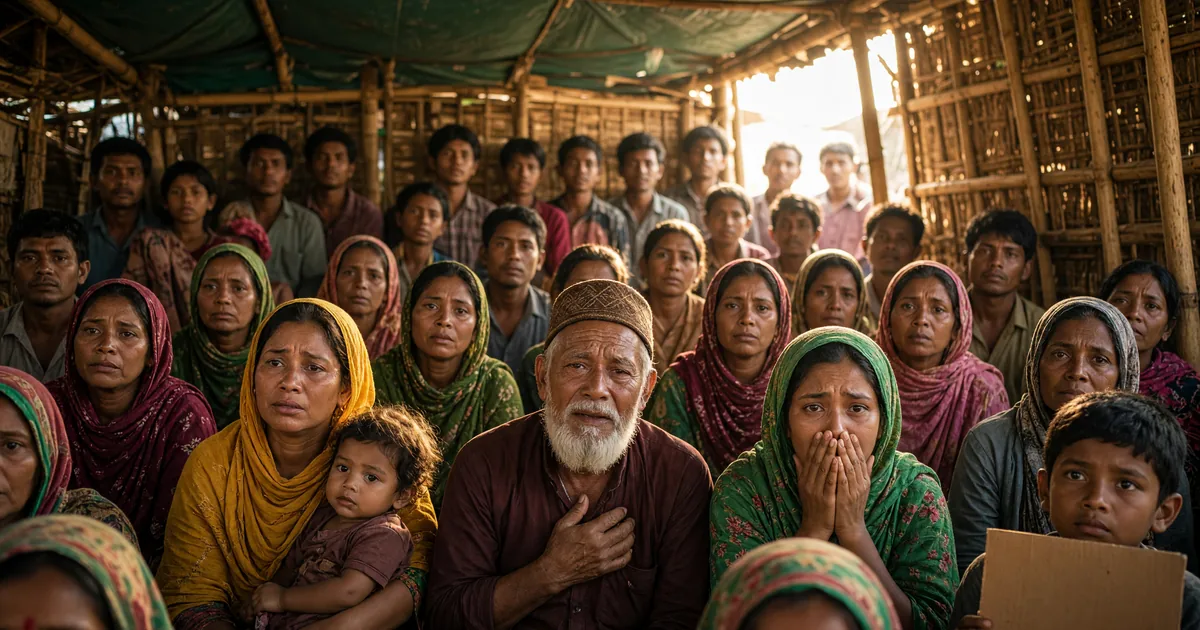
The International Court of Justice ruled on Thursday that Myanmar committed genocide against the Rohingya, the first time in the court’s 80-year history it has held a state responsible for the crime. Most coverage leads with the 9 to 6 split, but the thirteen-paragraph operative clause, which we read in full on the court’s own press release, shows a bench far less divided than that number suggests. It also shows that the standard of proof Trump’s ambassador to the United Nations warned the court not to lower came through the judgment where it was.
What Myanmar Argued
Its 2017 “clearance operations” were a legitimate response to attacks on police posts by the Arakan Rohingya Salvation Army, an armed group. Its military-backed government had not answered the ruling when NPR published.
What the Court Found
Court President Yuji Iwasawa said the executions of Rohingya men and boys, the sexual violence, the targeting of children and babies, the methodical burning of villages and the attacks on fleeing civilians “are not consistent with an intent to conduct counterinsurgency operations.” The court put the dead at about 10,000 and found 392 villages burned in whole or in part.
A Thin Majority on Genocide, a Wide One on Nearly Everything Else
Fifteen judges sat, two of them ad hoc, so nine votes is the smallest majority the bench can produce. Three paragraphs of the operative clause split 9 to 6: the genocide finding itself, the finding that Myanmar violated its duty to prevent genocide by individuals acting alongside its security forces, and the order to give guarantees that it will not happen again. We built the table below from the voting lists printed in the court’s press release.
| Para. | What the court decided | Vote |
|---|---|---|
| 1 | Myanmar committed genocide against the Rohingya in northern Rakhine State | 9 to 6 |
| 2 | Myanmar failed to prevent genocide by individuals acting alongside its security forces | 9 to 6 |
| 3 | Myanmar did not directly and publicly incite genocide (The Gambia’s claim rejected) | 14 to 1 |
| 4 | Myanmar violated its obligation to punish genocide and the other acts the Convention lists | 11 to 4 |
| 5 | Myanmar failed to enact the legislation the Convention requires | 14 to 1 |
| 7 | Myanmar must investigate suspects and, if warranted, prosecute and punish them | 13 to 2 |
| 8 | Myanmar must give assurances and guarantees of non-repetition | 9 to 6 |
| 9 | Myanmar must make restitution, including safe, voluntary and dignified return | 10 to 5 |
| 10 | Myanmar must compensate the Rohingya group and its members | 10 to 5 |
| 11 | The court will set compensation; Myanmar must report within two years | 10 to 5 |
| 12 | Myanmar violated the court’s 2020 order to preserve evidence | 11 to 4 |
| 13 | All other Gambian submissions rejected | Unanimous |
Read the table against the dissent list. The six judges who refused the genocide finding were Vice-President Sebutinde, Judges Tomka, Abraham, Xue and Nolte, and Judge ad hoc Kress. Four of them, Tomka, Xue, Nolte and Kress, still voted that Myanmar must investigate suspects and prosecute them if warranted, and Nolte and Kress also voted that it violated its duty to punish. The incitement claim, that Myanmar directly and publicly incited genocide, failed 14 to 1, with Judge Hmoud alone dissenting. That pattern fits intent being the dividing line, the hardest element to prove under the 1948 Convention. The six filed a joint dissenting opinion, posted with the judgment on the court’s case page, and it is the document to read next; we have not read it yet and will not guess at its reasoning.
The Threshold Waltz Warned About Is Still Where It Was
On October 23, Mike Waltz, Trump’s ambassador to the United Nations, wrote on X that “The ICJ must not be allowed to lower the legal threshold for proving genocide so that weakened and false standard can later be weaponized against American and allied soldiers whenever they raise a finger against terrorists that hide behind civilians.” The BBC’s Jeremy Bowen reports that Waltz also condemned a “leftist, global, antisemitic agenda” and singled out Judge ad hoc Navi Pillay, who voted with the majority. We could verify the post quoted above but not that second one, so treat it as the BBC’s account.
The court did not lower the threshold. Iwasawa said the only reasonable inference that can explain Myanmar’s actions is an intention to destroy the Rohingya, and the court kept the test that intent inferred from a pattern of conduct must be the only reasonable inference. What it rejected was the idea that a military objective rules genocide out: genocidal intent, it said, can coexist with other aims. Myanmar’s defense that it was fighting insurgents lost because the army did not distinguish between militants and civilians. Waltz’s line about terrorists who “hide behind civilians” reads like a pre-emptive brief for that argument, filed in a case the United States is not party to.
We think that tells you who the post was for. It was not for the Rohingya. The State Department’s statement on Thursday said that “the proper interpretation of the Genocide Convention is of paramount importance, as is preventing politicization of the ICJ,” and that it is “studying the decision to fully assess its implications.” The Biden administration formally determined in 2022 that Myanmar’s military committed genocide, so a government that has already said it on the record has nothing to study. The politicization began in October, with its own ambassador pressing a court in public before it ruled.
A Court With No Police
The judgment is final and binding, but the court cannot enforce it. The Gambia could take it to the Security Council, and Britain has said it will call an urgent session and expel Myanmar’s defense attache, though China or Russia could veto a tough resolution. Min Aung Hlaing, who commanded the military during the crackdown, is now Myanmar’s president. The International Crisis Group’s Richard Horsey put the cost plainly: “Governments rolling out the red carpet for Min Aung Hlaing will now be doing so for the head of a state found responsible for genocide.”
The court ordered restitution, including return of displaced Rohingya, but set no compensation figure; Myanmar has two years to report. Most of the land the Rohingya fled is now held by the Arakan Army, and about 1.2 million of them live in Bangladeshi camps where food rations have been cut as aid funding shrinks. Aid for the Rohingya has shrunk, especially since Trump took office in January 2025 and slashed foreign aid. That is the part Washington can change today, without a Security Council vote.
Gaza Is Years From a Ruling
Nothing in this judgment says anything about Israel, and the court made no finding on its conduct. Philippe Sands, part of The Gambia’s legal team, told the BBC that “If the Gambia had lost, South Africa’s case would, in effect, be over,” but that with The Gambia succeeding, “the door remains open for South Africa.” The court’s timetable shows how far off a Gaza judgment is: South Africa’s written reply is due on November 22, 2027, and Israel’s rejoinder on May 22, 2029.
Myanmar has two years to tell the court what it has done. The nearer test is whether anyone attaches a cost to ignoring the ruling, and Washington, which called this genocide in 2022 and now says it is studying the finding, will be watched along with everyone else.