
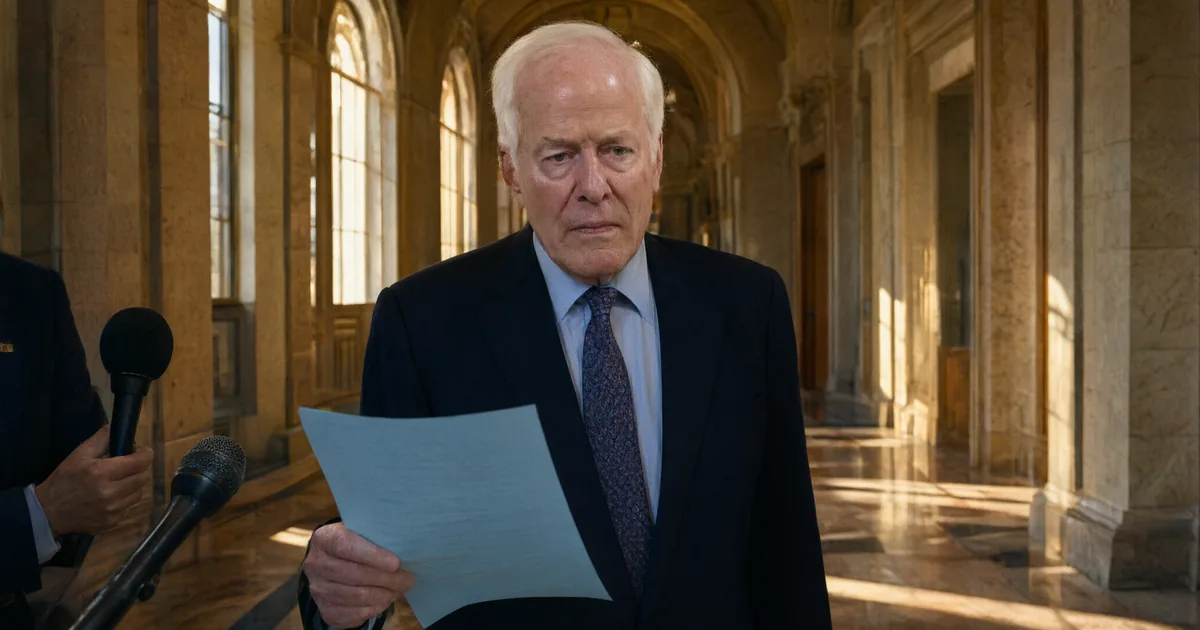
Sen. John Cornyn kept his blue slip, so Elliot Gaiser, head of the Justice Department’s Office of Legal Counsel, did not get the Judiciary Committee hearing the White House wanted for him Wednesday. Seven other judicial nominees testified, and Trump’s pick for a Dallas federal judgeship was not among them.
The argument that followed is about geography. The record a hearing would have examined is not. CBS News reported that Gaiser signed the opinion declaring the Presidential Records Act unconstitutional, which says the law “aggrandizes the legislative branch.” The Department’s own PDF of the September opinion on handgun sales opens by calling the federal ban “unconstitutional as applied to young adults between eighteen and twenty who seek to purchase handguns,” closes by saying it “may not be enforced to impose criminal penalties on dealers,” and ends with the signature block: T. Elliot Gaiser, Assistant Attorney General, Office of Legal Counsel.
Cornyn’s stated reasons are procedural, and blunt. “I just refuse to be jammed by a non-Texan who has no trial experience, who hasn’t been vetted,” he said. He wants the White House to nominate Steve Fahey, a former federal prosecutor. Texas senators normally run district nominees through a bipartisan screening panel, and Bloomberg Law reported that the panel played no part here, unlike Trump’s other Texas picks.
The Clock Is the Real Argument
The sequence fits in one table, and the last row is the one that matters.
| Date | What happened |
|---|---|
| Nov. 3 | Election Day: Democrat James Talarico beats Ken Paxton for Cornyn’s seat, one of the Senate flips that cost Republicans their majority |
| Nov. 4 | Sen. Ted Cruz’s office contacts Gaiser about the Dallas vacancy, according to his nominee questionnaire |
| Nov. 6 | Gaiser speaks with Cornyn’s office |
| Nov. 16 | Cornyn asks the White House to substitute Fahey |
| Nov. 18 | The hearing goes ahead without Gaiser |
| Jan. 3 | Democrats take control of the Senate; Talarico succeeds Cornyn |
That leaves 45 days, counting from today, and Cruz has made the deadline his case. He warned that blocking Gaiser hands the seat to Democrats, who “will keep it vacant in perpetuity,” Newsweek reported. That is an argument about the calendar, and the process for this seat began on Nov. 4, the day after the election, when Cruz’s office first called Gaiser. Cornyn’s reply is that he does not “want the seat to go vacant either.”
We think Cornyn is right to refuse, for a reason he has only half said. A lifetime judge should be asked, under oath, why a lawyer who advised Trump’s 2020 campaign on election challenges, according to Jan. 6 committee testimony, believes a statute on presidential records does not bind the president. Cruz is asking Republicans to skip that question to beat a deadline they let run down. Cornyn holds the one tool that stops it, and he used it. He and Tillis used their seats on the Judiciary Committee the same way against Todd Blanche’s attorney general nomination, and Cornyn has been on his way out since Paxton beat him in the runoff.
What is a blue slip?
A home-state senator’s written sign-off on a district court nominee. Under the Judiciary Committee’s custom, no slip means no hearing. The custom does not extend to appeals court nominees, whose courts span several states.
Can the White House get around Cornyn?
Only if Judiciary Chairman Chuck Grassley drops the custom. Trump called it unconstitutional in August 2025, and Grassley defended it, saying a nominee without a blue slip lacks the votes to clear committee.
What happens to the seat after Jan. 3?
Democrats take the Senate and Talarico takes Cornyn’s seat. Our read: if the committee keeps the custom, a Texas district nominee would need Talarico’s slip, which is why the White House is racing the calendar rather than the nominee’s record.