
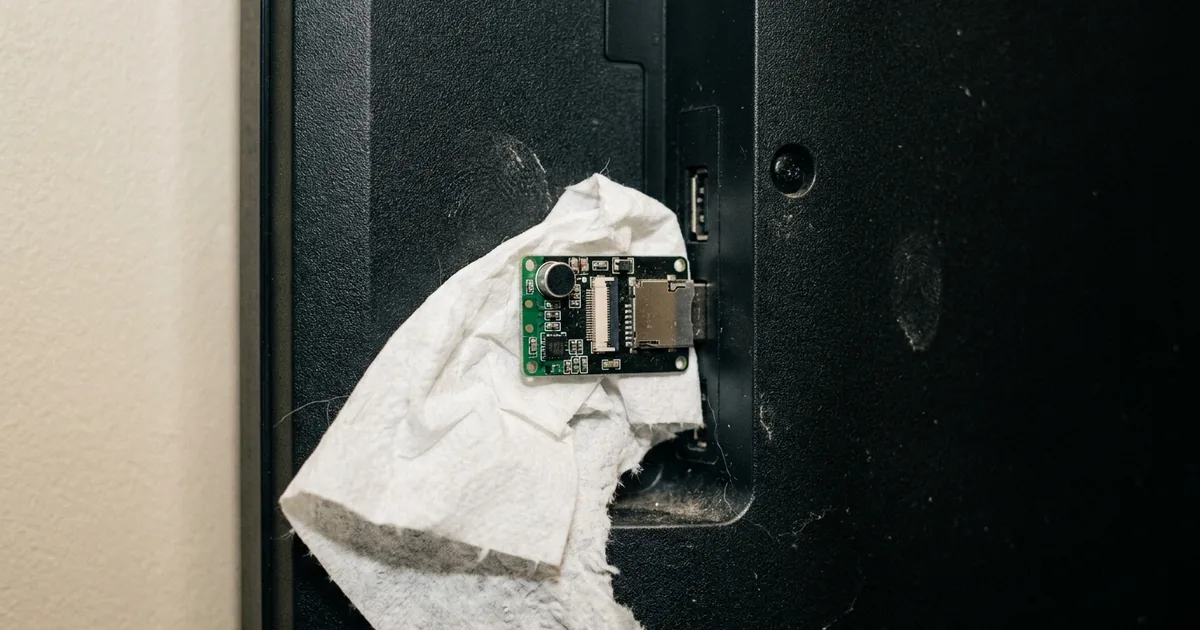
Federal prosecutors say an OpenAI engineer planted a thumb-sized recording device behind a television in an executive conference room, and the most detailed evidence against him came out of a ChatGPT account that belongs to his wife.
- The suspect: Abdulrahman Alfozan, 35, a Saudi national who had worked at OpenAI as an engineer since July 2025.
- The device: found September 30 in a USB port on the back of a TV, wrapped in toilet paper, its recordings encrypted.
- The charge: one count under the federal wiretap statute, 18 U.S.C. 2511(1)(b), with a five-year maximum.
- The status: arrested October 9, in custody, detention hearing October 19. He is presumed innocent.
Every account of the case treats the ChatGPT prompts as the punchline. Nobody has asked the question underneath them: how a customer’s private conversations ended up quoted in a federal complaint, and what OpenAI’s own privacy policy and federal law let a provider do with your chats when the provider is the one being wronged.
The Account Was Not His
The Justice Department says “a chatbot account associated with Alfozan’s spouse” sent prompts between September 24 and September 30 about “build[ing] a continuous audio recorder,” improving “live listening” and “encrypt[ing] the SD card.” That account, the department says, “shared multiple identifiers and attributes” with his own.
Two details matter more than the jokes. The same account asked about the recovered device itself, “including its custom header and unique MAC address,” on September 27 and 28. And OpenAI has confirmed that the chatbot was its own ChatGPT, an account that shared identifiers and IP usage with his own.
His wife is not charged with anything.
What the Policy Already Permits
We read OpenAI’s US privacy policy, last updated September 10, 2026, against the Justice Department’s description of the complaint. The fit is close.
What the Policy Says
OpenAI uses personal data “to protect the security of our systems and Services, including by monitoring any Content submitted or exchanged on our platforms.”
It may share that data with “government authorities” to “protect and defend our rights or property,” or “if we determine, in our sole discretion, that there is a violation of our terms, policies, or the law.”
What the Case Shows
Prompts from a spouse’s account, quoted word for word in a federal complaint and the department’s press release.
An account tied to an employee through “identifiers and attributes,” the company’s own models used to trace the device, and prosecutors asking a judge to seal an arrest warrant eight days after the device was found.
OpenAI Says It Ran Its Own Hunt
On X, OpenAI said it “used our models to understand the device and where it had come from, identifying that a specific employee had planted it a few days earlier.”
Put that sentence next to the complaint. The device carried a unique MAC address. A ChatGPT account had typed that address days before the device was found. Matching the two would lead straight to the account and, through shared identifiers, to the employee.
That is our reading of two public statements. Neither OpenAI nor the Justice Department has said how the account was found, or whether the prompts reached the FBI under a warrant or because OpenAI handed them over. The two were working together within days: by October 5 a camera had been placed in the room.
What Federal Law Allows
The Stored Communications Act, the 1986 law that governs when a service may disclose what its users store with it, starts by forbidding a provider to “knowingly divulge” stored contents. Then it lists exceptions. One of them, section 2702(b)(5), lets a provider disclose contents “as may be necessarily incident to the rendition of the service or to the protection of the rights or property of the provider of that service.”
A bug in your own boardroom is about as clean a case for that exception as exists. If OpenAI found the prompts itself and passed them along, it very likely had the law on its side.
The Charge Is Smaller Than the Rhetoric
FBI Director Kash Patel called protecting “American SI innovation” one of the bureau’s “highest counterintelligence priorities.” The U.S. attorney called it “a matter of national security.” The release describes OpenAI as “a super intelligence (SI), also known as artificial intelligence, company.”
The complaint charges one wiretap count. It does not charge trade-secret theft or economic espionage. OpenAI says it has “no indications” he took model weights, source code or customer data.
The Saudi Questions Remain Unproven
Alfozan is a venture partner at Raed Ventures, a Saudi firm that lists a member of the royal family as a fellow partner, and prosecutors told a judge he had booked a one-way flight to Saudi Arabia, via Istanbul, for October 12. The complaint does not allege that Raed knew anything, and it alleges no foreign tie at all. His lawyer, William Pernik, says the ticket was prepaid and the allegations are “wholly out of character.”
A $13.90 Board
The board Fortune identified, a Seeed XIAO ESP32-S3 Sense, is listed at $13.90 on the maker’s site. It has a microphone and a memory card slot and fits on a thumbnail. That is the whole threat model for a company valued in the hundreds of billions: a hobbyist part, a roll of toilet paper and an unlocked conference room.
What Users Should Take From This
We think OpenAI was entitled to defend itself, and catching a bug in an executive room is exactly what that exception was written for. That is not the end of it.
The episode is the clearest public demonstration yet of what the privacy policy means in practice. Your conversations with ChatGPT are readable by the company whenever it decides its own rights are at stake. OpenAI makes that call itself, in its “sole discretion,” with no judge involved in that decision. Here the person whose chats were searched and published is someone the government has not accused of anything.
OpenAI should say plainly how the account was found, whether a court order was involved, and whether it notified the account holder. It should also start publishing how often it searches user content to protect itself, the same way tech companies report government data demands. Hundreds of millions of people type things into that box they would never say in a conference room. They deserve to know who else is listening.