
The savings the White House wanted from IceCube came to about $3.9 million a year, less than half of one percent of the $900 million it asked for a new icebreaker.
Francis Halzen, an 82-year-old Belgian-born physicist at the University of Wisconsin-Madison, won the 2026 Nobel Prize in Physics on Tuesday for the IceCube Neutrino Observatory, a cubic kilometer of Antarctic ice wired with light sensors.
The prize coverage this morning celebrates the instrument. What it leaves out is that in 2025 the White House asked Congress to cut IceCube’s operating money nearly in half.
That request is a document, not a vibe, so start there.
When the National Science Foundation published its fiscal 2026 budget request, The Polar Journal read the IceCube line and reported that its funding “would be cut by almost half from $7.94 million to $4 million.”
The same line spelled out what that meant on the ice: operations would continue “with a reduction in staff deploying to Antarctica and minimal maintenance activities.”
Minimal maintenance, on an instrument whose sensors are frozen permanently into the ice more than a kilometer down and can never be pulled up and fixed. The people and computers on the surface are the only part anyone can keep healthy.
Congress did not go along. It rejected the administration’s proposal of $3.9 billion for the whole foundation and funded NSF at $8.75 billion instead, according to the American Institute of Physics.
Then, in July, the foundation renewed IceCube’s operations agreement with the university: five years, $53 million, running through 2031.
Halzen, who is still IceCube’s principal investigator, called that money “generous” in August. It is about $10.6 million a year, for the instrument a Nobel committee has now called fantastic.
It even grew. The IceCube Upgrade, approved in 2019, went into the ice early this year, the first significant expansion since the array was finished.
So the detector survived. The thinking behind the cut did not go away.
The fiscal 2027 request, released this spring, asks for $4 billion for NSF, a 54% cut from what Congress enacted for 2026. It would shrink the agency to about 2,900 competitive awards in 2027, against 7,400 in 2025.
It also proposes cutting the Office of Polar Programs, which pays for IceCube’s operations, by 13%, to $497 million.
And, separately from that topline, it asks for $900 million to build a new Antarctic research icebreaker.
Run the numbers and the shape of the thing is plain. The White House wants a nine-figure ship to reach Antarctica while trimming the office that funds the science that happens once you get there.
The IceCube cut it proposed in 2025 would have saved roughly $3.9 million a year. That is less than half of one percent of the icebreaker.
Now the product itself, because it is the whole story.
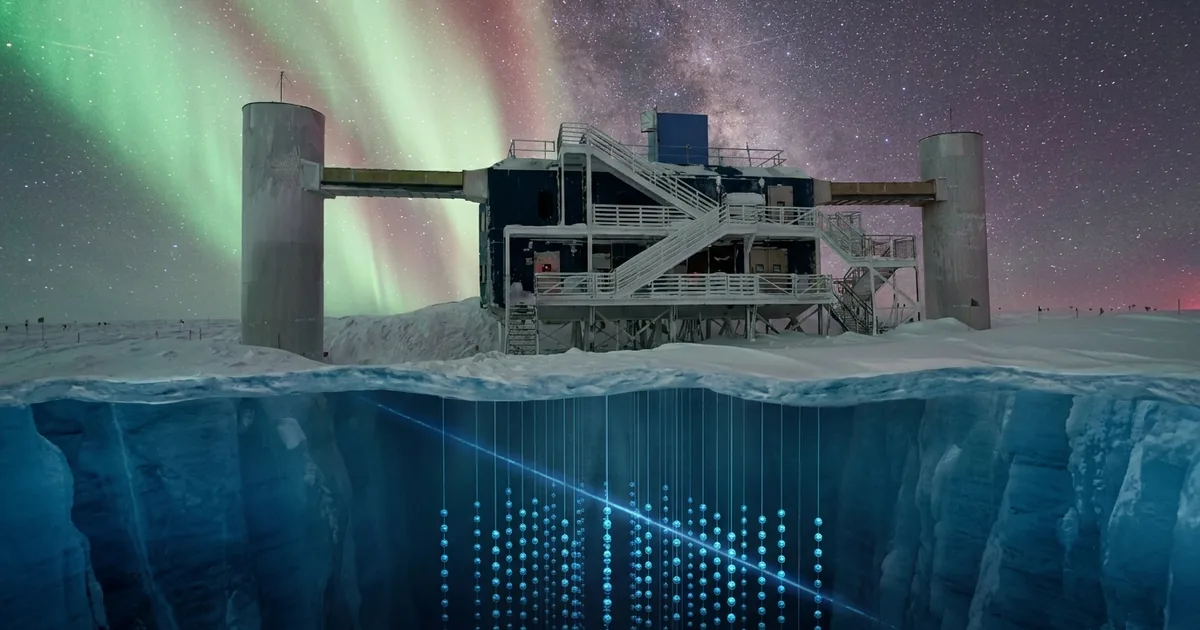
Neutrinos are nearly massless particles that pass through the Earth, and through you, without stopping. Very rarely one hits an atomic nucleus in the ice and throws off a faint flash of light.
IceCube is a grid of more than 5,000 light sensors frozen into the ice at the Amundsen-Scott South Pole Station, waiting for those flashes.
From the pattern of the light, a collaboration of more than 450 scientists works out where a neutrino came from and how much energy it carried.
The payoff is a new kind of telescope. Light and charged particles get bent, absorbed or scattered on the way here. Neutrinos arrive in a straight line, so they point back at the violent places that made them.
IceCube has found high-energy neutrinos from outside our solar system, traced some of them to two distant galaxies, and picked up neutrinos coming from our own Milky Way.
The Royal Swedish Academy of Sciences’ announcement dates Halzen’s idea to 1988, when he first proposed using the polar ice as a detector. The array was finished in 2011.
That is 23 years from pitch to working instrument, and 38 years from pitch to Nobel.
“His tenacity and scientific vision has paved the way for a new kind of astronomy,” said Mark Pearce, who chairs the Nobel Committee for Physics.
Tenacity is the right word, and it is also the problem.
A project like this exists only because someone kept paying for it through the long years before it had a result anyone could put in a headline.
A budget office reading line items one year at a time sees $7.94 million for a hole in the ice. It does not see 1988.
The 2025 IceCube cut was a bad proposal that Congress was right to kill, and the 2027 request deserves the same answer.
The responsibility sits with the White House budget office, which wrote both requests, and with the appropriators who will decide whether to repeat last year’s rejection.
They should repeat it, line by line, and they should fund the polar science office at a level that lets the new ship carry researchers who have grants.
The Nobel does not prove that every NSF dollar is well spent. It does prove that the timescale on which basic physics pays off is longer than any budget cycle, and that cutting the maintenance staff on a one-of-a-kind instrument is a false economy.
The next Halzen is probably proposing something strange right now. Whether it gets built in 2050 depends on budgets written in the next few months.