
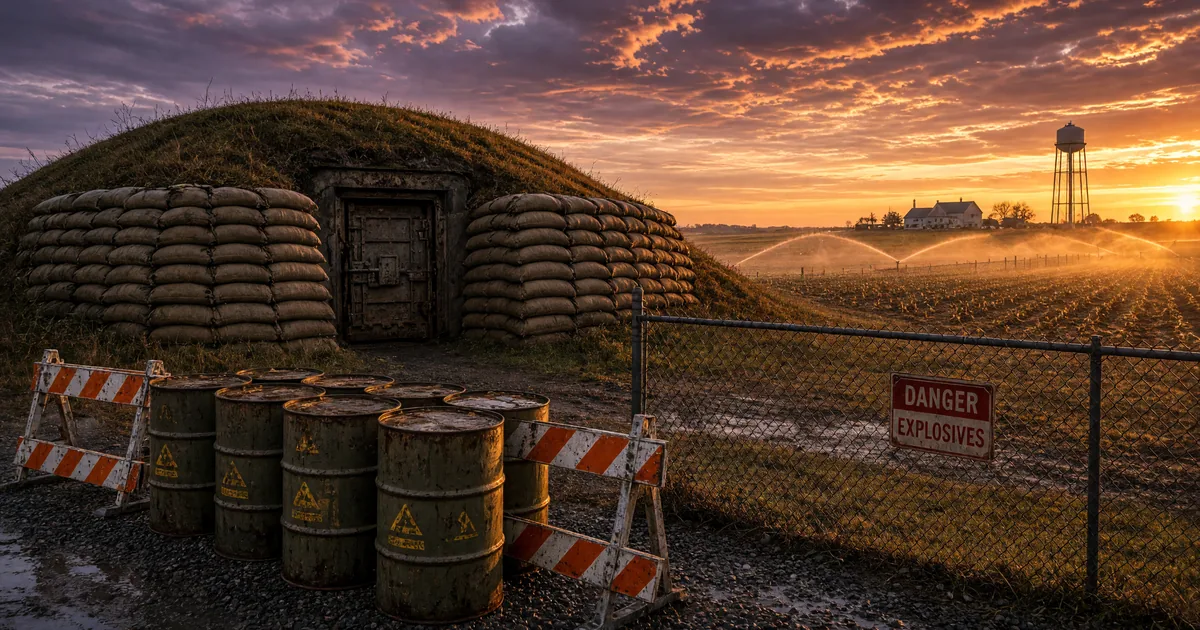
“The good thing is, if people have concerns about it being on their property, all they have to do is hose that off, and it’s gone.”
Army spokesperson Justine Barati, November 17, on the lead dust a Monday detonation in Middletown, Iowa, could scatter
The U.S. Army wants to blow up nearly five tons of lead azide at the Iowa Army Ammunition Plant on Monday, and the Justice Department has now told a federal appeals court the Army may be able to do it without the permit that court just froze. The Army calls detonation the lowest-risk choice, and that claim is hard to square with its own record: eight months ago it hired a company to neutralize the stuff chemically, then dropped the deal.
Most coverage carries the Army’s safety line in one paragraph and the permit fight in another. Put the dates side by side and they tell a different story. We built this timeline from the EPA’s emergency permit notice, the Army’s statements and the reporting cited below.
| Date | What happened |
|---|---|
| September 2025 | Army contracting notice says plant operator American Ordnance will perform “lead azide neutralization” |
| March 12, 2026 | EPA learns the stored lead azide has degraded and recrystallized |
| March 2026 | Army hires MuniRem Environmental to neutralize it chemically |
| About May 2026 | Army cancels the MuniRem deal, two months in |
| April to September 2026 | EPA issues three emergency storage permits; the drums stay put |
| November 13, 2026 | EPA emergency permit for detonation, valid through February 11, 2027 |
| November 15, 2026 | Army announces a Friday detonation date and releases plume maps |
| November 19, 2026 | Eighth Circuit pauses the permit |
| November 20, 2026 | Justice Department cites the “immediate threat” exception; detonation moved to Monday |
From the day the EPA learned of the problem to Monday is 256 days. The permit the Army asked for runs 90 days, and Monday would use only the first ten of them. That’s the backdrop for the government’s new argument.
Here is the mechanism you need to follow. The Iowa Environmental Council and the Sierra Club’s Iowa chapter, represented by Earthjustice, asked the Eighth Circuit to block the EPA permit. The court put the permit on hold late Thursday while it considers that request. On Friday the Justice Department filed notice that it will oppose the groups, and in that notice it pointed out that EPA rules let the Army treat waste “without an EPA permit” when there is “an immediate threat to human health, public safety, property, or the environment,” Fortune reported.
Read that plainly. The court is deciding whether the permit should stand, and the government is reminding everyone that the Army might not need one. Thien Chau, the Earthjustice senior attorney on the case, called the provision “an extraordinary and extreme backstop” and urged the Army not to lean on it. The Army has not said whether it will.
Its case for urgency is the weather. Acting Army Secretary Adam Telle said Monday is the “latest possible moment prior to a forecasted temperature drop, which would risk further destabilization of the material.” Cold may well make recrystallized lead azide more dangerous. It also arrives in Iowa every winter, and the Army had all of spring and summer.
The contract is the part nobody has explained. A New York Times report published Saturday, summarized by Iowa Public Radio, says the Army hired MuniRem, a Georgia firm, in March to neutralize the lead azide and canceled two months later. An Army contracting officer’s email the Times reviewed says the cancellation had nothing to do with MuniRem’s technical proposal.
The official account runs the other way. EPA Region 7 Administrator Jim Macy wrote that the Army weighed several alternatives and found each posed “an unacceptable safety risk” because of “advanced crystallization.” Both can’t be the whole truth. If the method was unsafe, why did the cancellation have nothing to do with the method? If it wasn’t, why is the safer option off the table?
The people downwind are owed that answer before Monday. Army modeling showed dust settling across a roughly 25-mile stretch north of the plant, and the groups’ emergency motion says lead dust could travel 100 miles or more under some conditions, toward western Illinois. Middletown, a town of about 360, was asked to clear out because the blast could shatter windows. Illinois Gov. JB Pritzker, Sens. Dick Durbin and Tammy Duckworth and Iowa Sen.-elect Josh Turek signed a letter asking Telle and EPA Administrator Lee Zeldin to wait “until there is an opportunity to explore safer alternatives.” Gov. Kim Reynolds’ office says the state wasn’t told before the November 15 announcement.
We think the Army should not touch the emergency exception, and the Justice Department should not have floated it. An agency that sat on a problem for eight months, renewed storage permits three times and walked away from a neutralization contract for reasons its own contracting officer says were not technical can’t credibly claim it has no time to let a court rule. If the threat is truly immediate, the Army can make that case to the Eighth Circuit in the response the government has promised by Sunday. Going around the judges instead would tell every community near a federal site that a court order lasts only until an agency finds it inconvenient.
Iowa’s and Illinois’ delegations have one concrete thing to demand before anything detonates: the MuniRem cancellation file. A spokesperson’s advice to hose off the lawn is not a substitute for it.