
Episode 3 of our paper-puppet show opens on a pause. Ross Douthat asks Peter Thiel whether he would prefer the human race to endure, and Thiel takes so long to answer that Douthat says so out loud: “This is a long hesitation.”
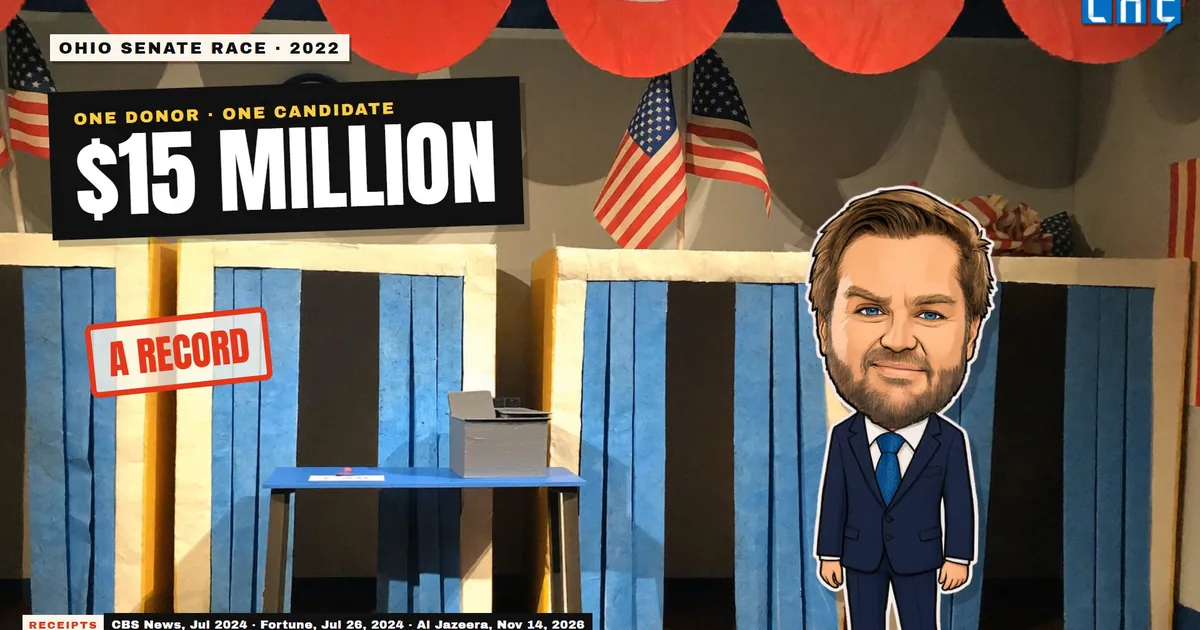
The next eight and a half minutes try to answer the question that pause raises. What did the tech billionaires actually buy? The news hook is Ohio. Thiel put $15 million behind JD Vance’s 2022 Senate race, a record for a single Senate contest, and on Nov. 3 voters gave that seat to Democrat Sherrod Brown. We laid out the money and the dates in the companion article. The episode goes somewhere the coverage of that flip mostly did not.
Where the Eight Minutes Go
We timed the finished cut chapter by chapter. The Ohio seat, the part of this story that made the election-night headlines, gets about 18 seconds. The exit gets nearly two minutes.
| Segment | Runtime | What it covers |
|---|---|---|
| Cold open | 0:57 | The Douthat clip, the $15 million, Ohio flipping, Jensen Huang resigning |
| The prophecy | 0:46 | The Sovereign Individual, a 1997 book on the end of the nation-state, reissued in 2020 with a Thiel preface |
| Part 1: Competition is for losers | 1:13 | PayPal, Musk ousted while on his honeymoon, a retirement account turned into $5 billion |
| Part 2: The seeing stone | 0:42 | Palantir, early CIA venture money, a $30 million ICE contract |
| Part 3: Buying people | 1:27 | Gawker, the 2009 essay, the 2016 convention speech, Vance |
| What access buys | 0:34 | Rubio’s briefing on Air Force One, Huang on the Beijing trip anyway |
| Part 4: The exit | 1:54 | A New Zealand passport after 12 days, seasteading, Prospera, a 99-year AI-hub lease in Manila, the Antichrist lectures |
| So what did they buy? | 0:43 | The verdict |
| Outro | 0:26 | Sources and the next episode |
That ratio is the argument, and we built it in on purpose. A Senate seat is the cheapest thing on the list to take back. Ohio did it in one November, for free. A citizenship granted after a 12-day stay does not come up for a vote. Neither does a charter city on a Honduran island with its own justice system, whose investors are now suing Honduras for $1.63 billion. A government lease that can run 99 years outlasts every senator who will ever hold Vance’s old seat.
So the midterms were a real win, and a small one. Voters reclaimed the one asset that had a term limit. The ones built to outlive elections are still standing.
The Receipts Rule
The puppets are construction paper. Everything they stand next to is sourced. Episode 3 rests on 39 cited sources and two interview clips, 41 receipts in an 8:42 runtime, which works out to one roughly every 13 seconds. Real people say only their own words, in real clips or on quote cards. The skits, like the clerk who has to explain why ICE needs software to watch people leave, use unnamed characters. Where a subject disputes a claim, the episode says so: Megaspeed denies diverting chips.
The jokes sit on top of the facts, never in place of them. “Most people read a prophecy. He invested in one” only works because the 2020 preface is real.
Catch Up on the Series
This is the third episode. The first covered the week Nvidia’s Jensen Huang affair broke, and the second traced the year Washington was warned before he fell. Huang turns up again here, in the 34 seconds on what access buys.
The episode closes on a line worth holding onto. They have the money to try again in two years, and they are counting on everyone to forget. The seat came back cheaply. Keeping it will cost more attention than one election night.